Empirical evidence is
-
A
repeatable by multiple scientists.
-
B
used to explain the placebo effect.
-
C
created using deductive reasoning.
-
D
data that contains metric base units.
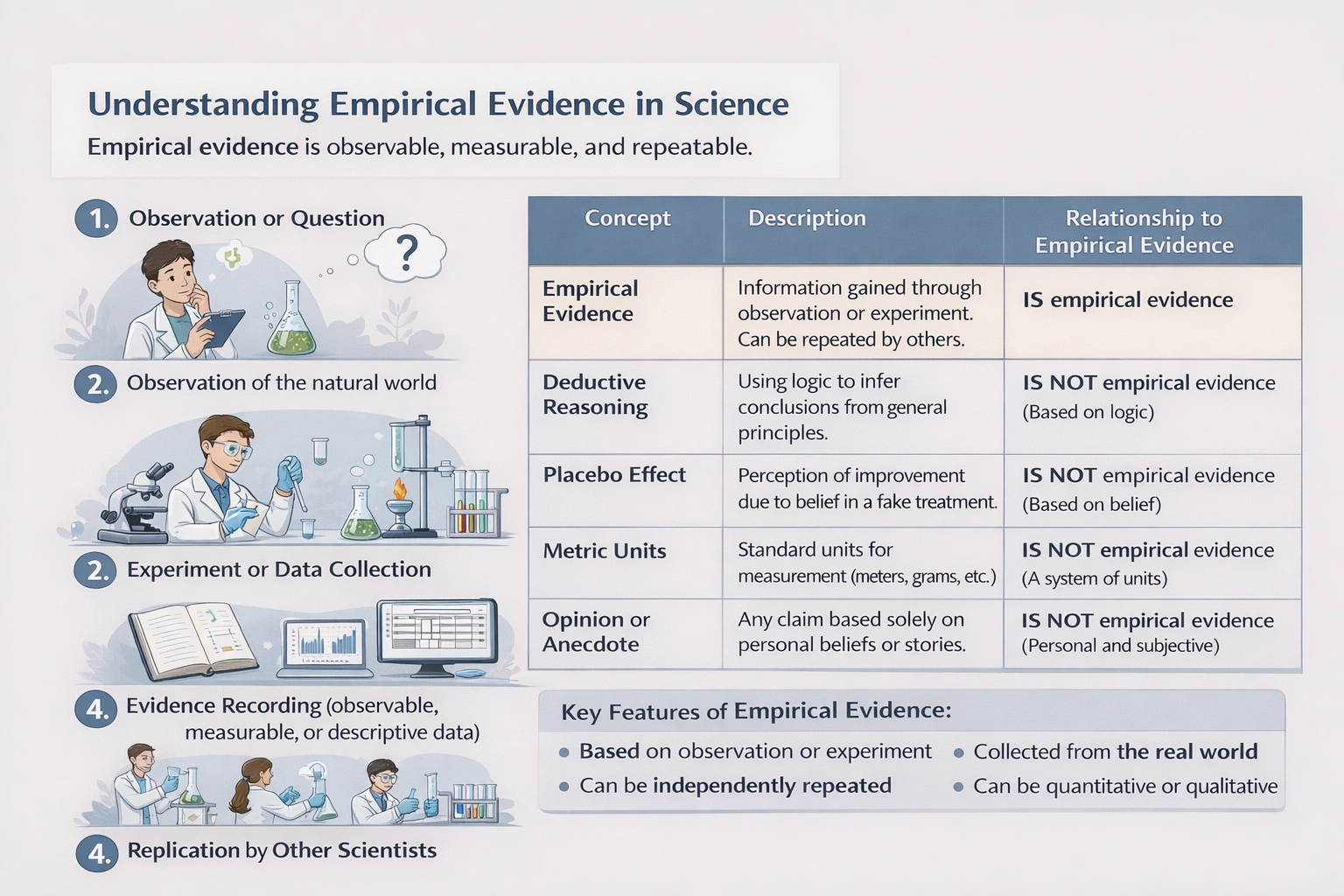
Empirical evidence is repeatable by multiple scientists.
Empirical evidence is information acquired through direct observation or experimentation. It is the factual data upon which scientific knowledge is built, and its defining characteristic is its basis in sensory experience and its capacity for independent verification.
A) Repeatable by multiple scientists.
This is a cornerstone of the scientific method. For evidence to be considered robust and objective, the observations or experiments that generate it must be replicable by other researchers following the same procedures. Repeatability eliminates the possibility of error, fraud, or unique circumstance, transforming a single observation into a verifiable fact. It is this requirement for independent confirmation that grounds empirical evidence in objectivity.
B) Used to explain the placebo effect.
While empirical evidence is the means by which the placebo effect is studied and documented—through controlled clinical trials that collect data on patient outcomes—this is an application of empirical methods, not a definition of empirical evidence itself. Empirical evidence can be used to investigate any natural phenomenon, from physics to psychology; its use in studying the placebo effect is just one example among countless others.
C) Created using deductive reasoning.
Deductive reasoning is a logical process that starts with a general premise or theory and moves to a specific, logical prediction (e.g., All men are mortal; Socrates is a man; therefore, Socrates is mortal). Empirical evidence is not "created" by this top-down logic. Instead, empirical evidence is gathered through observation and is typically used in inductive reasoning, where specific observations lead to broader generalizations or hypotheses. Evidence is collected from the physical world, not deduced purely from existing ideas.
D) Data that contains metric base units.
Empirical evidence can be quantitative (numerical) or qualitative (descriptive). Quantitative data often uses standardized units like the metric system (meters, grams, seconds) for clarity and precision in communication. However, empirical evidence is not restricted to metric units or even to numerical data. A biologist's observation of an animal's behavior, a chemist's note of a color change, or a geologist's description of a rock layer are all forms of empirical evidence, even though they may not involve metric measurements.
Conclusion:
The fundamental attribute that distinguishes empirical evidence from anecdote or opinion is its verifiability through independent repetition. While it can be applied to study specific effects like the placebo effect, can be analyzed through various reasoning modes, and often uses standardized units, its core defining feature is that it is observable, measurable, and repeatable by others.
Topic Flashcards
Click to FlipWhat is the defining characteristic that distinguishes empirical evidence from anecdotal evidence?
Empirical evidence is objective and repeatable by others through observation or experiment.
Which reasoning process is primarily used to generate empirical evidence: deductive reasoning or inductive reasoning?
Inductive reasoning (specific observations lead to general conclusions).
Can a qualitative observation (like a color change in a chemical reaction) be considered empirical evidence? Why or why not?
Yes. Empirical evidence includes any data gathered through direct observation or measurement, whether qualitative or quantitative.
In the scientific method, what role does empirical evidence play in forming a conclusion?
It provides the objective, verifiable data used to support or refute a hypothesis.
Why is the repeatability of empirical evidence by multiple scientists so crucial?
It ensures the evidence is objective, reliable, and not the result of error, bias, or unique circumstance.