Extract:

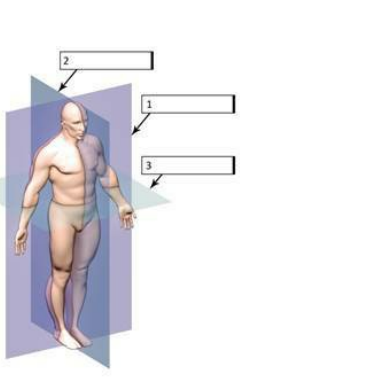
Identify the correct sequence of the 3 primary body planes as numbered 1, 2, and 3 in the above image.
-
A
Plane 1 is coronal, plane 2 is sagittal, and plane 3 is transverse.
-
B
Plane 1 is sagittal, plane 2 is coronal, and plane 3 is medial.
-
C
Plane 1 is coronal, plane 2 is sagittal, and plane 3 is medial.
-
D
Plane 1 is sagittal, plane 2 is coronal, and plane 3 is transverse.
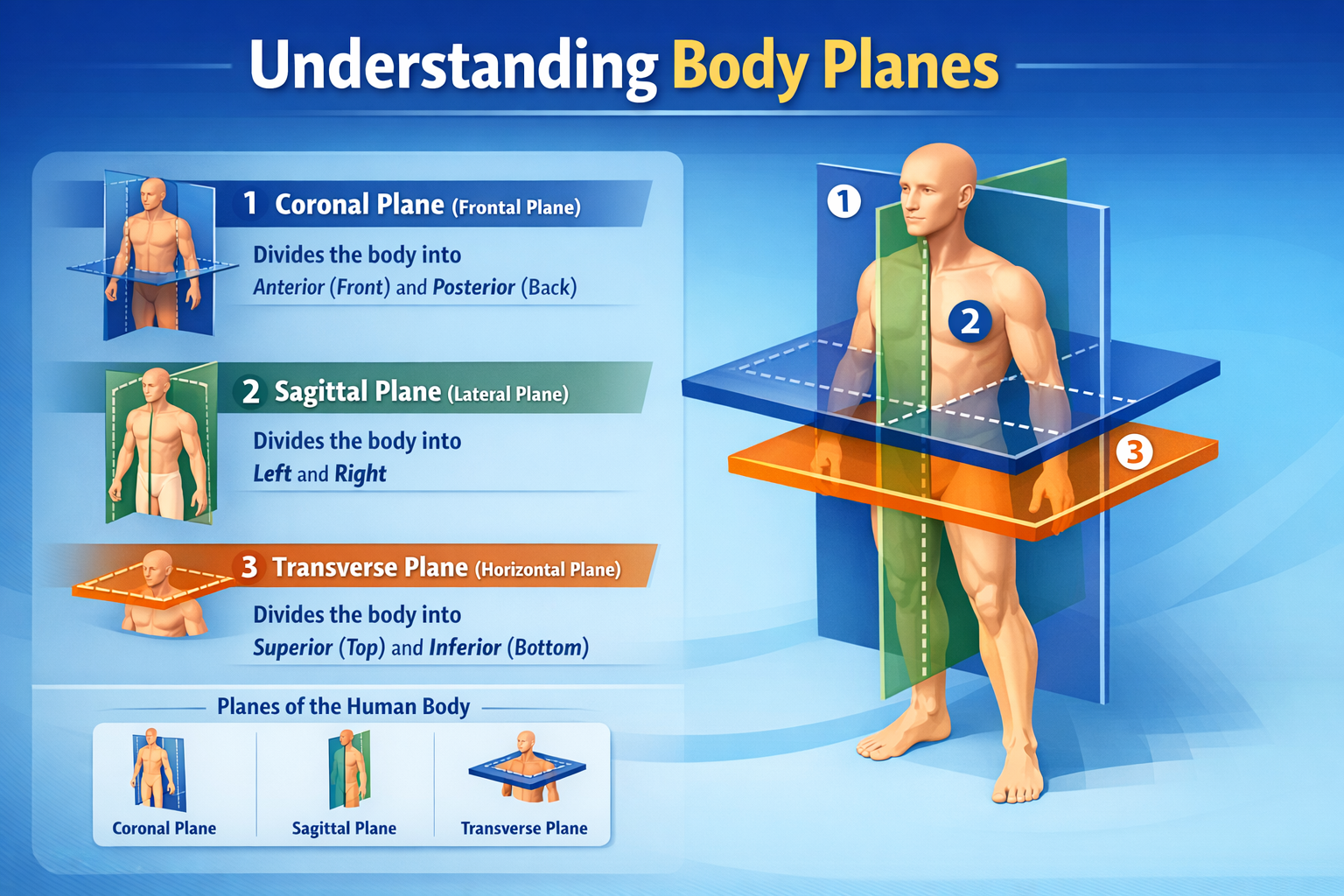
The three primary anatomical planes form a standardized coordinate system for describing spatial relationships in the human body. The sagittal plane divides the body into left and right portions, the coronal (frontal) plane divides it into anterior (front) and posterior (back) portions, and the transverse (horizontal) plane divides it into superior (upper) and inferior (lower) portions. In standard anatomical illustrations, these planes are depicted with specific orientations: the sagittal plane runs vertically from anterior to posterior (dividing left and right), the coronal plane runs vertically from side to side (dividing front and back), and the transverse plane runs horizontally (dividing top and bottom). The provided diagram follows this conventional arrangement, with plane 1 corresponding to the sagittal plane, plane 2 to the coronal plane, and plane 3 to the transverse plane.
A) Plane 1 is coronal, plane 2 is sagittal, and plane 3 is transverse
This option reverses the sagittal and coronal planes. The coronal plane (plane 1 in this option) would incorrectly be described as dividing the body into front and back, while the sagittal plane (plane 2) would divide it into left and right. In standard anatomical diagrams, the plane running vertically from front to back (sagittal) is typically labeled first (as plane 1), while the plane running vertically from side to side (coronal) is labeled second (as plane 2). This misassignment contradicts established anatomical conventions and would lead to incorrect spatial descriptions.
B) Plane 1 is sagittal, plane 2 is coronal, and plane 3 is medial
This option correctly identifies the first two planes but erroneously describes plane 3 as "medial." Medial is a directional term indicating proximity to the midline (e.g., the sternum is medial to the deltoid), not an anatomical plane. The third primary plane must be transverse (horizontal), as it is the only plane that divides the body into superior and inferior sections. Using "medial" for plane 3 represents a fundamental misunderstanding of anatomical terminology, as directional terms cannot describe planes.
C) Plane 1 is coronal, plane 2 is sagittal, and plane 3 is medial
This option contains two critical errors: it reverses the sagittal and coronal planes (as in option A) and mislabels plane 3 as "medial" (as in option B). The coronal plane should not be assigned to plane 1, and "medial" is invalid as a plane descriptor. This combination of errors would result in completely inaccurate anatomical descriptions, such as misidentifying the orientation of surgical incisions or imaging studies.
D) Plane 1 is sagittal, plane 2 is coronal, and plane 3 is transverse
This option accurately describes the standard anatomical plane arrangement. Plane 1 (sagittal) runs vertically from anterior to posterior, dividing the body into left and right. Plane 2 (coronal) runs vertically from side to side, perpendicular to the sagittal plane, dividing the body into front and back. Plane 3 (transverse) runs horizontally, perpendicular to both sagittal and coronal planes, dividing the body into upper and lower sections. This sequence aligns with universal anatomical standards: the sagittal plane is typically the first referenced (as it includes the midline), followed by the coronal plane, with the transverse plane as the horizontal reference. In the provided diagram, plane 1 is positioned vertically along the midline (sagittal), plane 2 vertically across the shoulders (coronal), and plane 3 horizontally at the waist (transverse).
Conclusion:
The primary anatomical planes provide an essential framework for precise communication in medicine, surgery, and imaging. The sagittal plane (left-right division), coronal plane (front-back division), and transverse plane (top-bottom division) must be correctly identified to avoid clinical errors. Option D reflects the universally accepted sequence, with plane 1 as sagittal, plane 2 as coronal, and plane 3 as transverse—ensuring accurate spatial orientation in anatomical descriptions. Mislabeling these planes (as in other options) could lead to critical mistakes in procedures like surgical planning or radiological interpretation.