What is the major difference between somatic and germline mutations?What is the major difference between somatic and germline mutations?
-
A
Somatic mutations usually benefit the individual while germline mutations usually harm them
-
B
Since germline mutations only affect one cell, they are less noticeable than the rapidly dividing somatic cells.
-
C
Somatic mutations are not expressed for several generations, but germline mutations are expressed immediately.
-
D
Germline mutations are usually inherited while somatic mutations will affect only the individual.
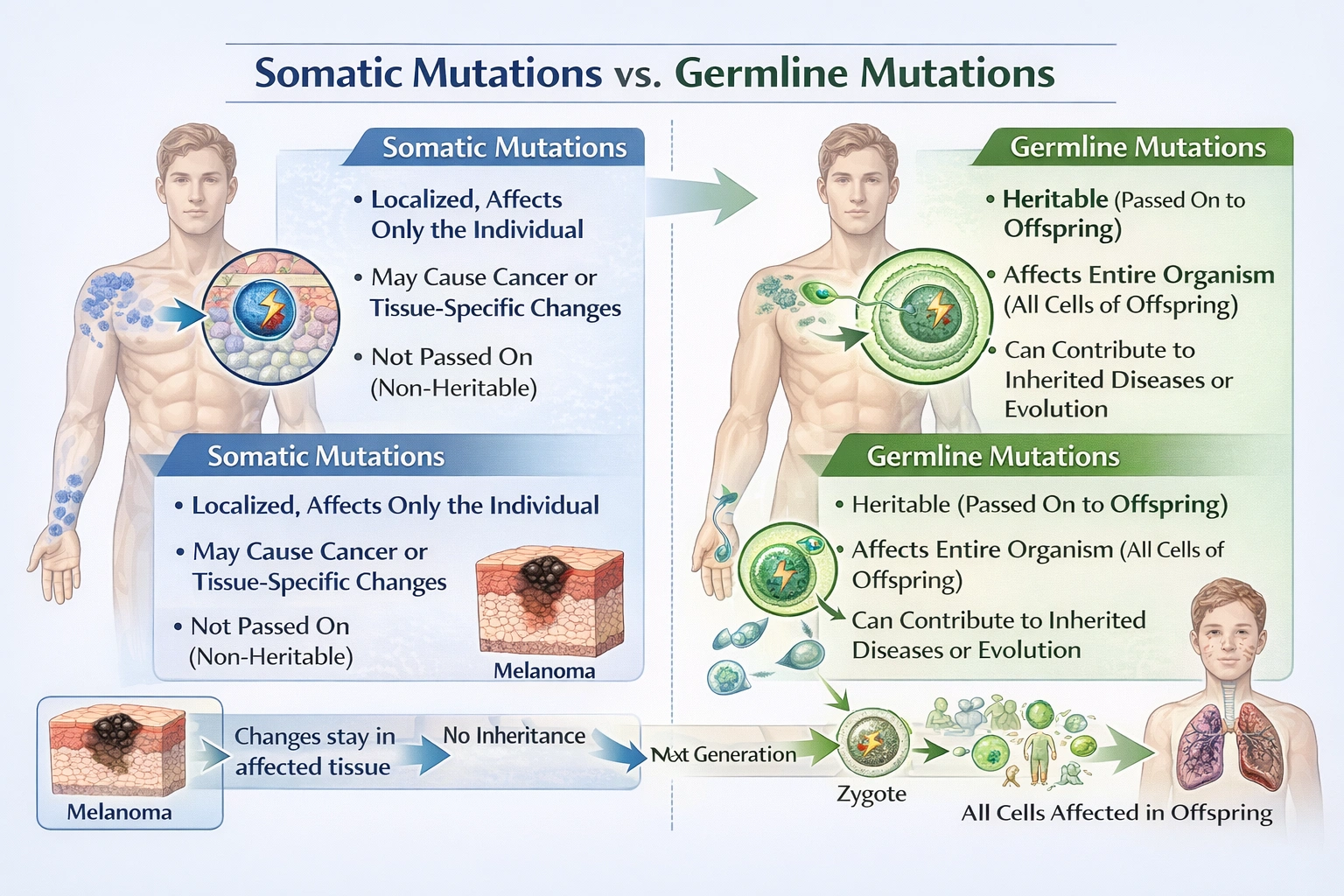
Germline mutations occur in gametes and can be transmitted to offspring, whereas somatic mutations arise in non-reproductive body cells and affect only the individual in which they occur.
This fundamental distinction determines whether a genetic alteration propagates through generations or remains confined to specific tissues within a single organism's lifetime, with profound implications for inheritance patterns, disease manifestation, and evolutionary biology.
A) Somatic mutations usually benefit the individual while germline mutations usually harm them
Both somatic and germline mutations exhibit variable effects—beneficial, neutral, or deleterious—depending on the gene affected, mutation type, and environmental context. Somatic mutations can cause cancer (harmful) or confer resistance to pathogens (potentially beneficial in specific contexts). Germline mutations may cause hereditary diseases like cystic fibrosis (harmful) or provide evolutionary advantages like sickle cell trait conferring malaria resistance (beneficial in endemic regions). The assertion that mutation types consistently differ in benefit/harm distribution lacks biological basis; selection acts on phenotypic outcomes regardless of mutation origin.
B) Since germline mutations only affect one cell, they are less noticeable than the rapidly dividing somatic cells
Germline mutations occur in gamete precursor cells (spermatogonia or oogonia) and, upon fertilization, become incorporated into every cell of the resulting zygote and subsequent offspring—potentially affecting trillions of cells across the entire organism. Somatic mutations affect only the progeny of the mutated somatic cell, creating mosaicism limited to specific tissues (e.g., a patch of skin or portion of an organ). Germline mutations are therefore highly noticeable when expressed phenotypically across the whole organism and transmissible to descendants, while somatic mutations often remain localized and non-heritable.
C) Somatic mutations are not expressed for several generations, but germline mutations are expressed immediately
Somatic mutations express within the individual's lifetime in affected tissues (e.g., melanoma from UV-induced skin cell mutations) but cannot transmit to offspring, making generational expression irrelevant. Germline mutations may express immediately in offspring if dominant (e.g., Huntington's disease) or remain latent for generations if recessive (e.g., cystic fibrosis requiring homozygous inheritance). Expression timing depends on dominance relationships and inheritance patterns, not mutation origin—recessive germline mutations can skip multiple generations before phenotypic manifestation.
D) Germline mutations are usually inherited while somatic mutations will affect only the individual
Germline mutations arise in cells destined to become gametes (sperm or egg) and, if present in a fertilizing gamete, become part of the zygote's genome—transmitting to all cells of the offspring and potentially to subsequent generations. Somatic mutations occur in non-germline body cells after fertilization; they may proliferate within tissues (e.g., creating a tumor clone) but cannot enter the germline and therefore remain confined to the individual. This inheritance distinction defines the major biological difference: germline mutations contribute to evolutionary change and familial disease patterns, while somatic mutations underlie age-related diseases like cancer without generational transmission.
Conclusion:
The critical distinction between somatic and germline mutations lies in their cellular origin and heritability. Germline mutations in reproductive cells become constitutional in offspring and can propagate through lineages, shaping population genetics and inherited disease risk. Somatic mutations, confined to mitotic lineages within an individual's somatic tissues, influence personal disease susceptibility but vanish with the organism's death. Option D accurately captures this fundamental dichotomy that governs genetic inheritance patterns, disease transmission, and evolutionary mechanisms—while other options misrepresent mutation effects, cellular scope, or expression timing.
