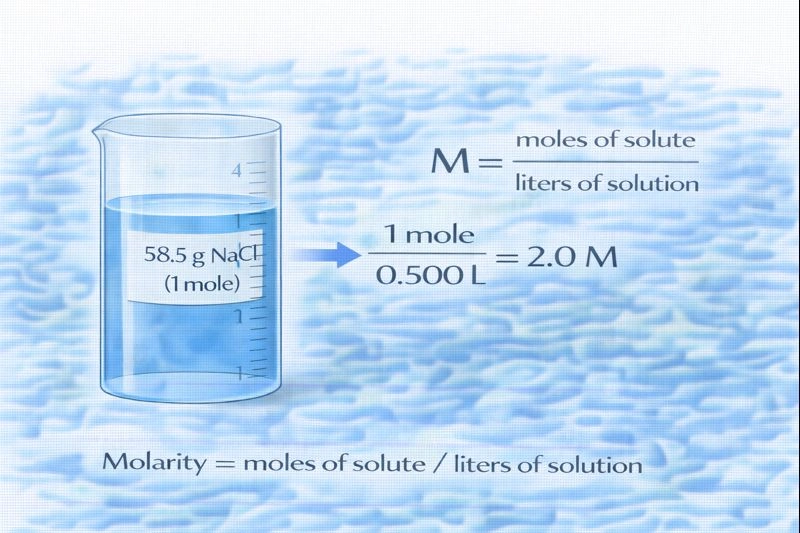
If 58.5 g of NaCl (1 mole) are dissolved in 0.500 L, what is the molarity?
-
A
1.0 M
-
B
2.0 M
-
C
11.7 M
-
D
Cannot be determined
The molarity of the NaCl solution is 2.0 M.
Molarity is defined as the number of moles of solute dissolved per liter of solution. In this problem, the mass of sodium chloride given (58.5 g) corresponds to approximately one mole of NaCl, and the volume of the solution is clearly stated as 0.500 liters. Because both the amount of solute (in moles) and the volume of the solution are provided, the molarity can be calculated directly using the molarity formula.
The molar mass of sodium chloride (NaCl) is about 58.44 g/mol, which confirms that 58.5 g is a reasonable approximation of one mole. Using the molarity formula, M=moles of soluteliters of solutionM = \frac{\text{moles of solute}}{\text{liters of solution}}M=liters of solutionmoles of solute, dividing 1 mole by 0.500 liters results in a molarity of 2.0 M.
A. 1.0 M
A molarity of 1.0 M would mean that one mole of solute is dissolved in exactly one liter of solution. In this question, the volume of the solution is only 0.500 liters, which is half of a liter. Because the same amount of solute is dissolved in a smaller volume, the concentration must be higher than 1.0 M.
B. 2.0 M
One mole of NaCl dissolved in 0.500 liters of solution yields a molarity of 2.0 M. This result comes directly from applying the molarity formula and reflects the increased concentration caused by dissolving the solute in less than one liter of solution.
C. 11.7 M
This value likely results from an incorrect calculation that involves dividing the mass of NaCl by the volume of the solution without properly converting grams to moles. For example, dividing 58.5 g by 0.500 L gives 117 g/L, which is a mass concentration, not molarity. Molarity must always be expressed in moles per liter, not grams per liter.
D. Cannot be determined
All the information required to calculate molarity is provided in the question: the amount of solute (given as one mole) and the volume of the solution (0.500 L). Since no additional data are needed, the molarity can be determined with certainty.
Conclusion
Molarity depends on the number of moles of solute and the volume of the solution in liters. With one mole of sodium chloride dissolved in 0.500 liters of solution, the concentration is calculated as 2.0 M.

Topic Flashcards
Click to FlipWhat is the two-step calculation process if you are given the mass of a solute in grams and the volume of the solution in liters, and need to find molarity?
Step 1: Convert grams to moles using molar mass. Step 2: Divide moles by volume in liters (M = mol / L).
How many moles of solute are present in 2.0 liters of a 0.5 M NaCl solution?
1.0 mole. (Moles = Molarity × Volume = 0.5 mol/L × 2.0 L = 1.0 mol).
If you dissolved 29.25 g of NaCl (molar mass ~58.5 g/mol) in water to make a 1.0 L solution, what would the molarity be?
0.50 M. (Moles = 29.25 g / 58.5 g/mol = 0.5 mol; M = 0.5 mol / 1.0 L = 0.5 M).
Why is it crucial to use liters of solution (not solvent) in the molarity formula?
Molarity is defined per liter of the final solution volume. Adding solute can change the total volume, so using the initial solvent volume alone would give an incorrect concentration.
What would be the new molarity if 500 mL of a 2.0 M solution is diluted with water to a total volume of 2.0 L?
0.5 M. (M1V1 = M2V2; (2.0 M)(0.500 L) = (M2)(2.0 L); M2 = 0.5 M).