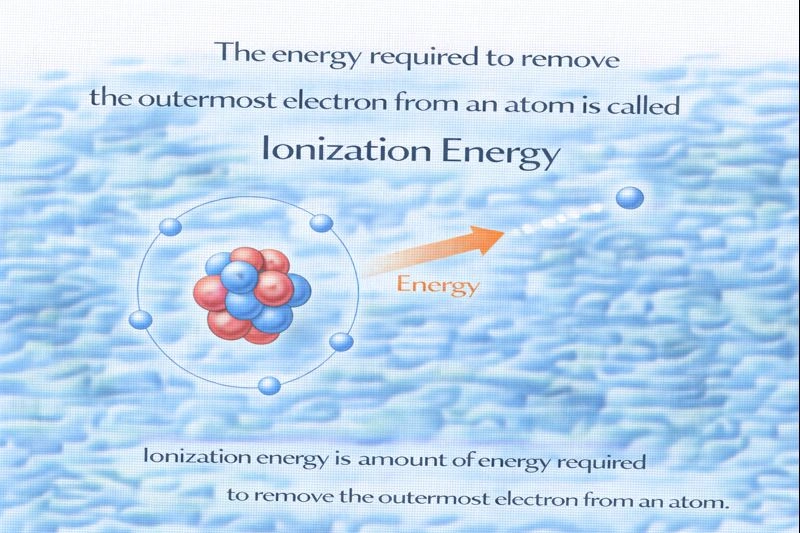
The energy required to remove the outermost electron from an atom is called
-
A
covalent bonding
-
B
electronegativity
-
C
atomic radius
-
D
ionization energy
The energy required to remove the outermost electron from an atom is called ionization energy.
Ionization energy refers specifically to the amount of energy needed to remove the most loosely bound electron from a neutral atom in the gaseous state. This concept is fundamental to understanding atomic structure, periodic trends, and chemical reactivity. Atoms that hold their outer electrons tightly have high ionization energies, while atoms that lose electrons easily have low ionization energies. Ionization energy is influenced primarily by nuclear charge, atomic size, and electron shielding.
A. Covalent bonding
Covalent bonding describes a type of chemical bond formed when two atoms share one or more pairs of electrons in order to achieve greater stability. It explains how atoms connect to form molecules, not how much energy is required to remove an electron from an atom. Covalent bonding involves electron sharing, whereas ionization energy involves electron removal.
B. Electronegativity
Electronegativity is a measure of an atom’s ability to attract electrons toward itself when it is part of a chemical bond. It is a relative scale used to compare atoms, not a direct measurement of energy. While atoms with high electronegativity often also have high ionization energies, electronegativity does not describe the energy required to remove an electron from an isolated atom.
C. Atomic radius
Atomic radius refers to the size of an atom, typically defined as the distance from the nucleus to the outer boundary of the electron cloud. Although atomic radius influences ionization energy (larger atoms tend to have lower ionization energies because their outer electrons are farther from the nucleus), atomic radius itself is a size measurement, not an energy term.
D. Ionization energy
Ionization energy is defined as the minimum energy required to remove the outermost electron from a neutral atom in the gas phase, forming a positively charged ion (cation). The first ionization energy specifically refers to removing the first electron. This concept explains many periodic trends, such as why metals readily lose electrons and nonmetals tend to hold onto them.
Conclusion
The term that describes the energy needed to remove the outermost electron from an atom is ionization energy. It is a key concept in chemistry that helps explain atomic behavior, periodic trends, and why certain elements are more reactive than others.

Topic Flashcards
Click to FlipDefine first ionization energy. What happens to the atom when this energy is supplied?
It is the minimum energy required to remove the outermost (highest energy) electron from a neutral gaseous atom. The atom becomes a positively charged ion (cation).
What is the general trend for first ionization energy as you move from left to right across a period on the periodic table? Explain the primary reason for this trend.
It generally increases. The primary reason is the increasing nuclear charge (more protons) which pulls the electron cloud closer, making electrons harder to remove.
Why do Group 1 elements (alkali metals) have the lowest first ionization energies in their respective periods?
They have a single electron in their outermost s-orbital. This electron is shielded by filled inner electron shells and is relatively far from the nucleus, making it easy to remove.
Which has a higher first ionization energy: Lithium (Li) or Sodium (Na)? Explain why this trend exists down a group.
Lithium has a higher first ionization energy. Moving down a group, the atomic radius increases and electron shielding increases, so the outer electron is less strongly held and easier to remove.
Explain the exception in the first ionization energy trend between Group 15 (e.g., Nitrogen) and Group 16 (e.g., Oxygen).
Nitrogen has a higher first ionization energy than oxygen. Nitrogen has a stable half-filled 2p subshell. Removing an electron from oxygen's 2p orbital disrupts a stable electron pair, requiring slightly less energy.