Why does fluorine have a higher ionization energy than oxygen?
-
A
Smaller neutron number
-
B
. Larger neutron number
-
C
Smaller nuclear charge
-
D
Larger nuclear charge
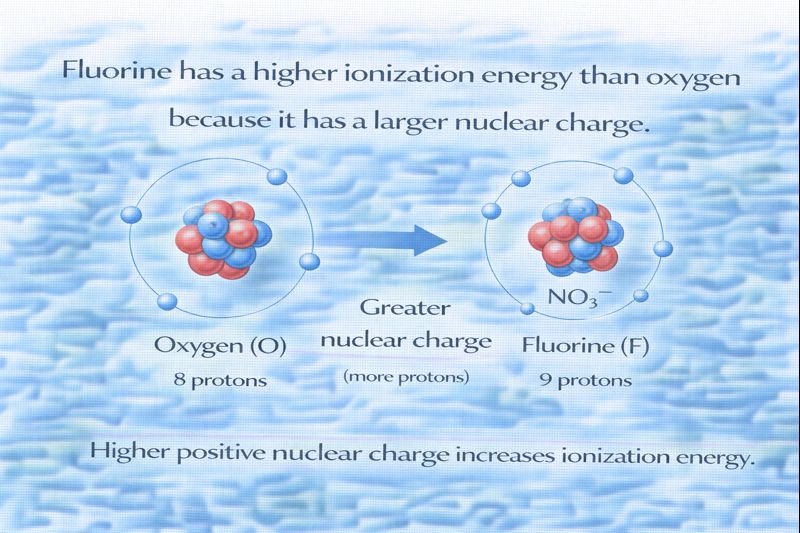
Fluorine has a higher ionization energy than oxygen because it has a larger nuclear charge.
Ionization energy is the amount of energy required to remove the most loosely bound (outermost) electron from a gaseous atom. As you move across a period on the periodic table from left to right, ionization energy generally increases. This trend occurs because the number of protons in the nucleus increases, leading to a stronger attractive force between the positively charged nucleus and the negatively charged electrons. Fluorine and oxygen are both small atoms in the same period, but fluorine has one additional proton, which significantly affects how tightly its electrons are held.
A. Smaller neutron number
The number of neutrons in an atom mainly affects the atom’s mass and nuclear stability, not how strongly electrons are attracted to the nucleus. Changes in neutron number do not significantly alter the electrostatic force between the nucleus and the electrons, so neutron number has little direct impact on ionization energy.
B. Larger neutron number
This option is also incorrect. While increasing the number of neutrons increases atomic mass, it does not increase the positive charge of the nucleus. Since ionization energy depends on the attraction between protons and electrons, neutron number is not a determining factor in explaining why fluorine has a higher ionization energy than oxygen.
C. Smaller nuclear charge
A smaller nuclear charge would mean fewer protons in the nucleus, resulting in a weaker attraction between the nucleus and the electrons. Weaker attraction makes electrons easier to remove, which would lower ionization energy rather than increase it. This directly contradicts the observed trend.
D. Larger nuclear charge
Fluorine has nine protons in its nucleus, whereas oxygen has eight. This greater positive charge increases the electrostatic attraction between fluorine’s nucleus and its electrons. Because fluorine and oxygen have similar atomic sizes and electron shielding is minimal in the same energy level, fluorine’s higher effective nuclear charge pulls its electrons more strongly. As a result, more energy is required to remove an electron from fluorine, giving it a higher ionization energy than oxygen.
Conclusion
Ionization energy increases across a period due to increasing nuclear charge. Fluorine’s additional proton strengthens the attraction between its nucleus and its electrons compared to oxygen, making its electrons harder to remove. This stronger nuclear pull explains why fluorine has a higher ionization energy.

Topic Flashcards
Click to FlipDefine ionization energy. What trend does it follow across a period (left to right) on the periodic table, and what is the primary reason?
Ionization energy is the energy required to remove an electron from a gaseous atom. It generally increases across a period due to increasing nuclear charge, which pulls electrons closer more strongly.
Why is there a slight dip in the ionization energy trend between Nitrogen (N) and Oxygen (O), even though the general trend is increasing?
Oxygen's electron configuration has two paired electrons in one 2p orbital, which experience electron-electron repulsion, making one slightly easier to remove than nitrogen's more stable half-filled 2p subshell.
What two opposing factors—related to nuclear attraction and electron-electron repulsion—determine the ease of removing an electron?
1) Effective Nuclear Charge: The net positive charge felt by an electron (stronger pull = harder to remove). 2) Shielding/Repulsion: Inner electrons shield outer electrons from the nucleus, and electron-electron repulsion in the same orbital can make an electron easier to remove.
Predict which element in Period 2 (from Li to Ne) has the highest first ionization energy and explain your reasoning.
Neon (Ne). It has the largest effective nuclear charge in Period 2, pulling its electrons in very tightly. Additionally, its electron configuration (a stable, filled octet) is very difficult to disturb.
Between Magnesium (Mg) and Aluminum (Al), which has a lower first ionization energy? Explain why this exception to the trend occurs.
Aluminum has a lower first ionization energy. The electron removed from Al is in a higher-energy 3p orbital, which is farther from the nucleus and shielded by the 3s electrons, making it easier to remove than an electron from Mg's filled and stable 3s orbital.