100% 4 Rated
Attempts 127

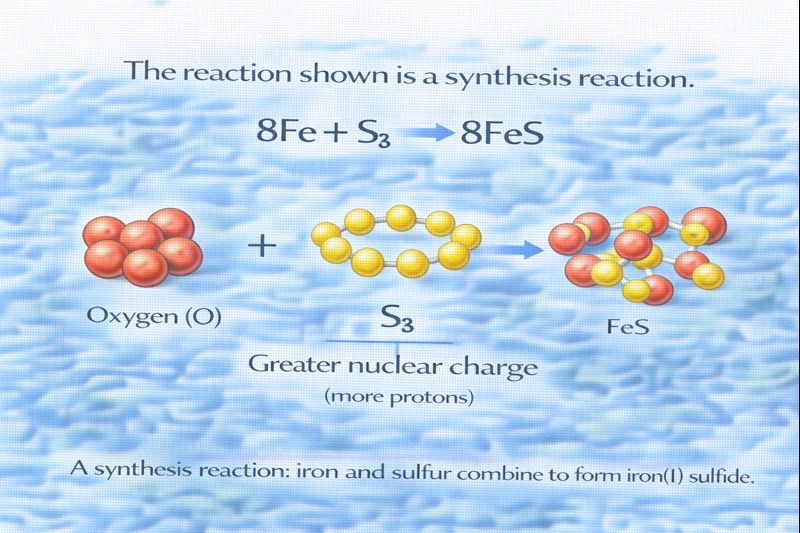
Name the reaction: 8Fe + S₈ → 8FeS

  1. A
    Single displacement
  2. B
    Double displacement
  3. C
    Synthesis
  4. D
    Acid-base

Topic Flashcards

Click to Flip
Question

What is the defining characteristic of a synthesis (combination) reaction? Give the general form.

Answer

Two or more substances (usually elements or simple compounds) combine to form one, more complex product. General form: A + B → AB.

Question

For the reaction 2Mg + O₂ → 2MgO, explain why it is a synthesis reaction and identify a key feature of its reactants.

Answer

Two elements (Mg and O₂) combine to form a single compound (MgO). A key feature is that the reactants are in their elemental forms.

Question

Why is the reaction 8Fe + S₈ → 8FeS not classified as single displacement? What is missing from the reactants?

Answer

Single displacement requires an element and a compound (A + BC → AC + B). Here, the reactants are only elements (Fe and S₈), with no compound for one element to displace another from.

Question

What are the four main types of chemical reactions you would use to classify a given equation, and what is a quick way to identify a synthesis reaction from this list?

Answer

Synthesis, Decomposition, Single Displacement, Double Displacement. A quick identifier for synthesis is: Multiple reactants, one product.

Question

Provide two real-world examples of synthesis reactions, one involving metals and one involving nonmetals.

Answer

1) Rusting: 4Fe + 3O₂ → 2Fe₂O₃. 2) Formation of ammonia (Haber process): N₂ + 3H₂ → 2NH₃.

Mini Quiz

1 / 3
Is the reaction 2H₂ + O₂ → 2H₂O a synthesis reaction?
Available Test Sets
Available FREE Test Sets