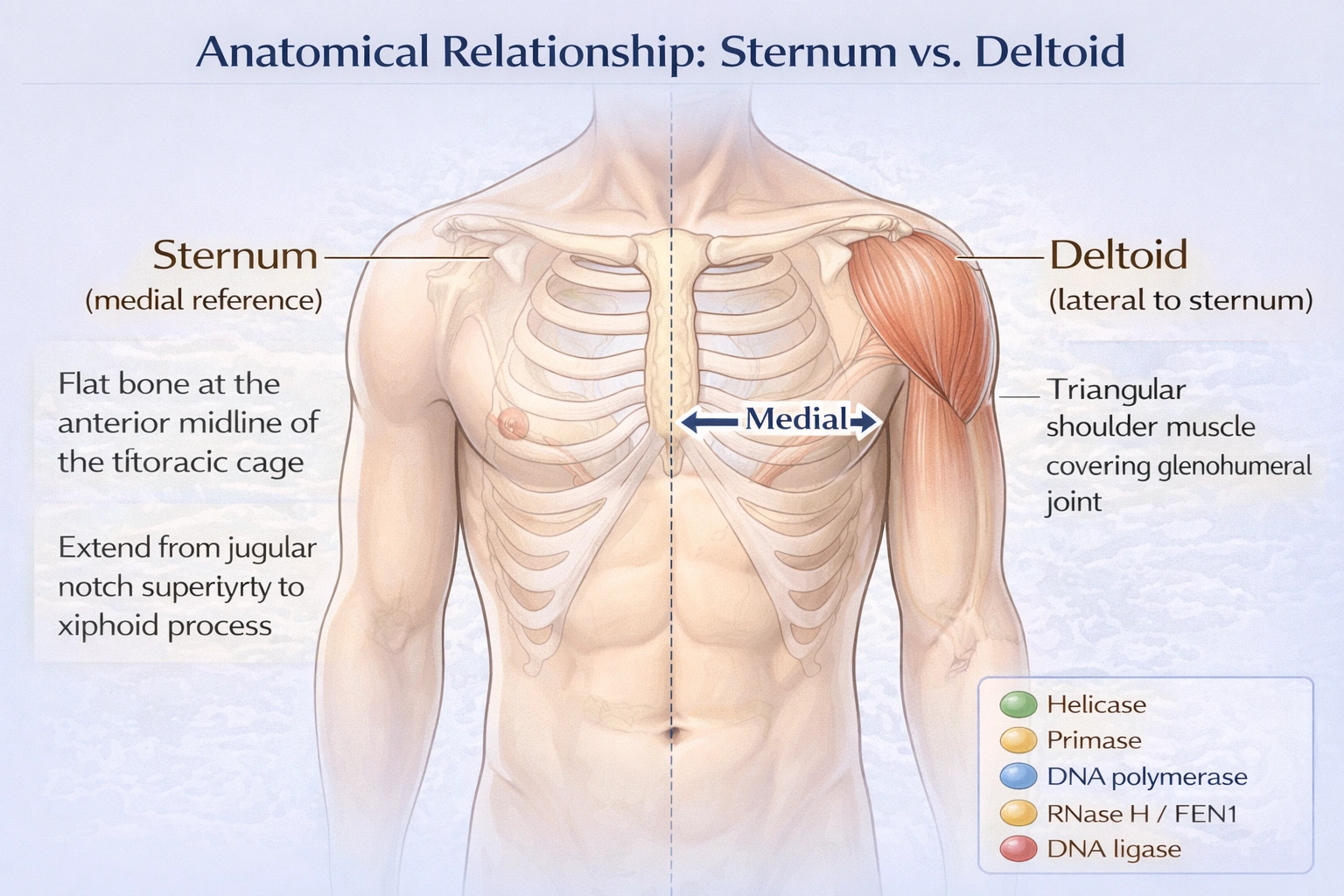
Using anatomical terms, what is the relationship of the sternum relative to the deltoid?
-
A
Medial
-
B
Lateral
-
C
Superficial
-
D
Posterior
The sternum is medial to the deltoid.
In standard anatomical position with the body upright, facing forward, and arms at the sides, directional relationships are defined relative to the body's midline plane (a vertical plane dividing the body into equal right and left halves). The sternum, commonly known as the breastbone, is a flat, elongated bone situated precisely at the anterior midline of the thoracic cage, extending from the jugular notch superiorly to the xiphoid process inferiorly. The deltoid muscle forms a thick, triangular cap over the glenohumeral (shoulder) joint, with its origins spanning three distinct regions: the lateral third of the clavicle (anterior fibers), the acromion process of the scapula (middle fibers), and the spine of the scapula (posterior fibers); its insertion occurs on the deltoid tuberosity of the humerus. When describing the sternum's position relative to the deltoid, we establish the deltoid as the reference point and determine where the sternum lies in relation to it. Since the sternum resides closer to the body's midline than any portion of the deltoid muscle—which occupies the lateral aspect of the shoulder region extending from approximately the mid-clavicle laterally around the shoulder—the sternum is correctly described as medial to the deltoid. This relationship holds true across all regions of the deltoid, as even the most medial fibers attaching to the clavicle remain lateral to the sternum's position at the anterior midline.
A) Medial
Medial describes a position closer to the midline of the body relative to another structure. The sternum occupies the precise anterior midline of the thorax, while the deltoid muscle envelops the lateral aspect of the shoulder joint. Even the most medial attachment of the deltoid—the anterior fibers originating from the lateral third of the clavicle—remains lateral to the sternum's position. When using the deltoid as the reference structure, the sternum lies toward the midline from that reference point, making "medial" the anatomically precise descriptor. This directional term specifically addresses the horizontal plane relationship perpendicular to the midline, which is the primary spatial relationship being queried in this question.
B) Lateral
Lateral describes a position farther from the midline relative to another structure. If the sternum were lateral to the deltoid, it would need to reside farther from the body's midline than the deltoid muscle. However, the sternum sits directly on the midline itself, while the deltoid occupies distinctly lateral territory on the shoulder. From the deltoid's perspective, structures lateral to it would include the lateral arm, hand, or outer shoulder region—not the midline sternum. This option reverses the actual anatomical relationship and would only be correct if the question asked for the deltoid's position relative to the sternum (in which case the deltoid would be lateral to the sternum).
C) Superficial
Superficial describes a position closer to the body surface relative to another structure, while deep indicates greater distance from the surface. Both the sternum and deltoid have complex depth relationships that vary by location: the manubrium of the sternum lies relatively superficial beneath the skin and pectoral fascia in the upper chest, while the deltoid forms the prominent superficial contour of the shoulder. However, in the region where these structures might be compared vertically (e.g., upper sternum versus clavicular portion of deltoid), the sternum actually lies deep to the pectoralis major muscle and associated fascia, whereas the deltoid's anterior fibers lie superficial over the shoulder joint. More critically, "superficial" does not address the primary horizontal plane relationship (midline versus lateral) that defines the spatial orientation between these two structures. Anatomical directional questions typically prioritize the most fundamental spatial relationship—here, the medial-lateral axis—rather than depth relationships that vary by specific anatomical cross-section.
D) Posterior
Posterior (or dorsal) describes a position toward the back of the body relative to another structure, while anterior (or ventral) indicates a position toward the front. The sternum occupies an unequivocally anterior position as the most ventral bony structure of the thoracic cage. The deltoid muscle, while wrapping around the shoulder joint with anterior, middle, and posterior components, maintains an overall anterior-lateral position relative to the torso. No portion of the sternum lies posterior to any portion of the deltoid; in fact, the entire sternum is anterior to the vertebral column and thoracic cavity contents, while the deltoid's posterior fibers attach to the scapular spine but still project laterally rather than posteriorly relative to the sternum. Describing the sternum as posterior to the deltoid fundamentally misrepresents the anterior-posterior orientation of these structures within the body plan.
Conclusion:
Anatomical directional terminology follows strict conventions based on the body's fundamental planes and axes. When determining the relationship of structure X relative to structure Y, structure Y serves as the reference point. Here, with the deltoid as reference, the sternum's position closer to the midline defines it as medial. While additional descriptors could apply in specific contexts (e.g., the sternum is also inferior to the superior fibers of the deltoid, and generally anterior to deep shoulder structures), the medial-lateral relationship represents the most direct and unambiguous spatial orientation between these two structures. The sternum's midline position versus the deltoid's lateral shoulder location makes "medial" the singularly correct directional term among the options provided, reflecting precise anatomical language essential for accurate clinical and scientific communication.