Extract:

Ligaments connect what?
-
A
Muscle to muscle
-
B
Bone to bone
-
C
Bone to muscle
-
D
Muscle to tendon
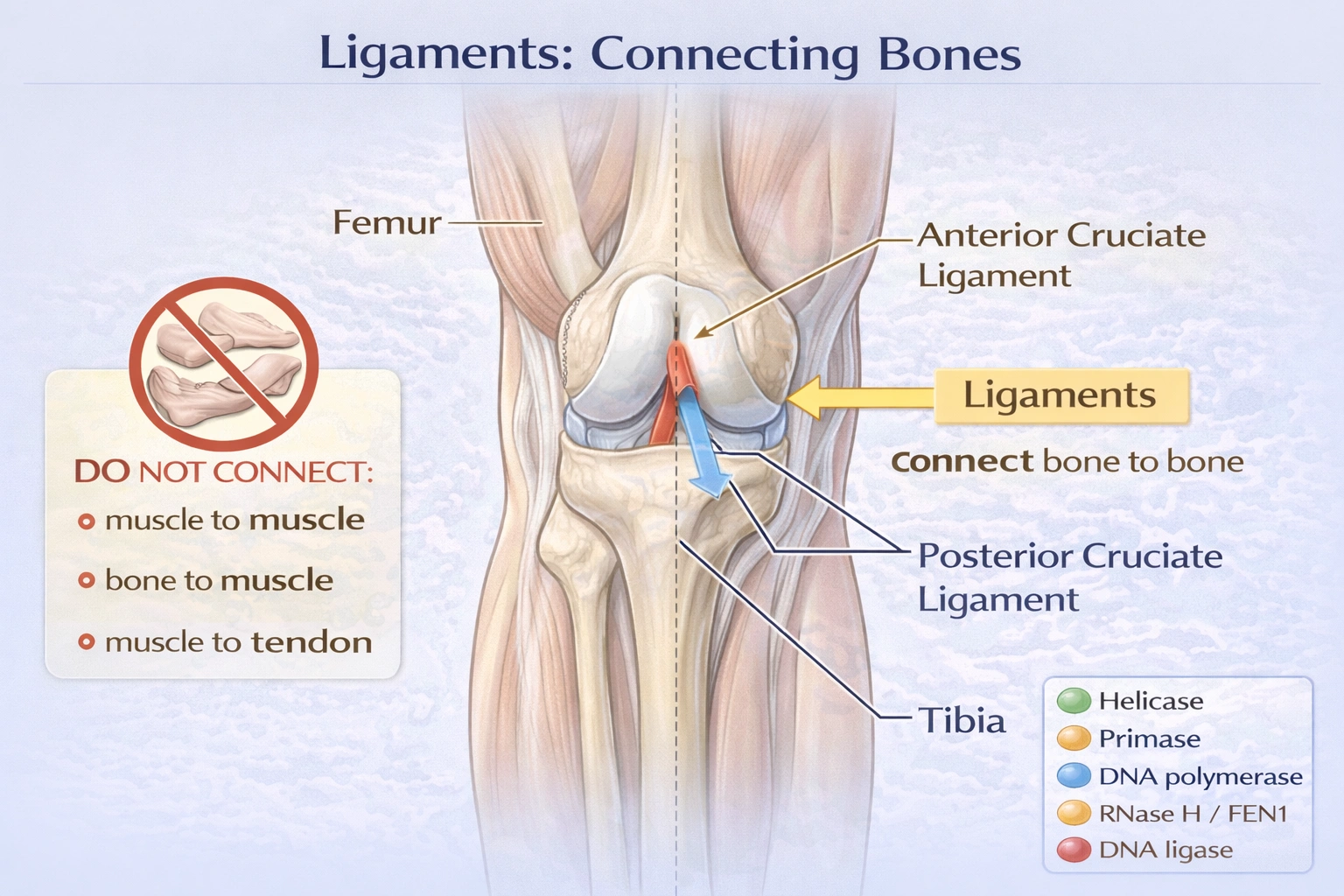
Ligaments connect bone to bone.
Ligaments are specialized fibrous connective tissues composed predominantly of type I collagen that function to stabilize joints by anchoring adjacent bones together. These structures provide mechanical stability, restrict excessive joint movement, and guide physiological motion within safe ranges while allowing necessary flexibility. Ligaments contain sparse cellular components (primarily fibroblasts) embedded in a dense extracellular matrix of collagen fibers arranged in parallel bundles, giving them high tensile strength and limited elasticity. Unlike tendons, ligaments do not transmit contractile forces from muscles but rather serve as passive restraints against dislocation.
A) Muscle to muscle
This describes intermuscular septa or fascial connections, not ligaments. Intermuscular septa are sheets of connective tissue that separate muscle groups (e.g., the interosseous membrane between forearm bones), but they do not constitute ligaments. Ligaments are exclusively defined by their attachment to bone, and no ligament connects two muscles directly.
B) Bone to bone
Ligaments are defined by their attachment to bone at both ends. For example, the anterior cruciate ligament (ACL) connects the femur (thigh bone) to the tibia (shin bone) within the knee joint, while the coracoclavicular ligament connects the coracoid process of the scapula to the clavicle in the shoulder. These connections provide structural integrity to joints, preventing hyperextension or dislocation. Ligaments also contain proprioceptive nerve endings that provide sensory feedback about joint position and movement, contributing to neuromuscular coordination.
C) Bone to muscle
This describes tendons, which are distinct structures composed of collagen fibers that transmit mechanical force from muscle to bone. Tendons originate from the epimysium of muscles and insert onto bone periosteum (e.g., the Achilles tendon connecting the gastrocnemius muscle to the calcaneus). While ligaments and tendons share similar collagenous composition, their functional roles and attachment points differ fundamentally: ligaments stabilize bone-bone interfaces, whereas tendons facilitate movement through muscle-bone connections.
D) Muscle to tendon
This option misrepresents anatomical relationships. Tendons are the terminal structures of muscles and do not connect to other tendons in a way that defines ligaments. While some tendons may merge (e.g., in the hand's extensor mechanism), this does not constitute ligamentous tissue. Ligaments are never involved in muscle-tendon connections; such interfaces involve aponeuroses (flat tendons) or direct muscle fiber insertions.
Conclusion:
Ligaments are critical components of the musculoskeletal system that exclusively connect bone to bone, providing joint stability and proprioceptive feedback. Their structural role differs fundamentally from tendons (bone-muscle connections) and other connective tissues. Understanding this distinction is essential for accurate clinical diagnosis and treatment of joint injuries, as ligament damage (e.g., ACL tears) requires different management than tendon or muscle injuries.