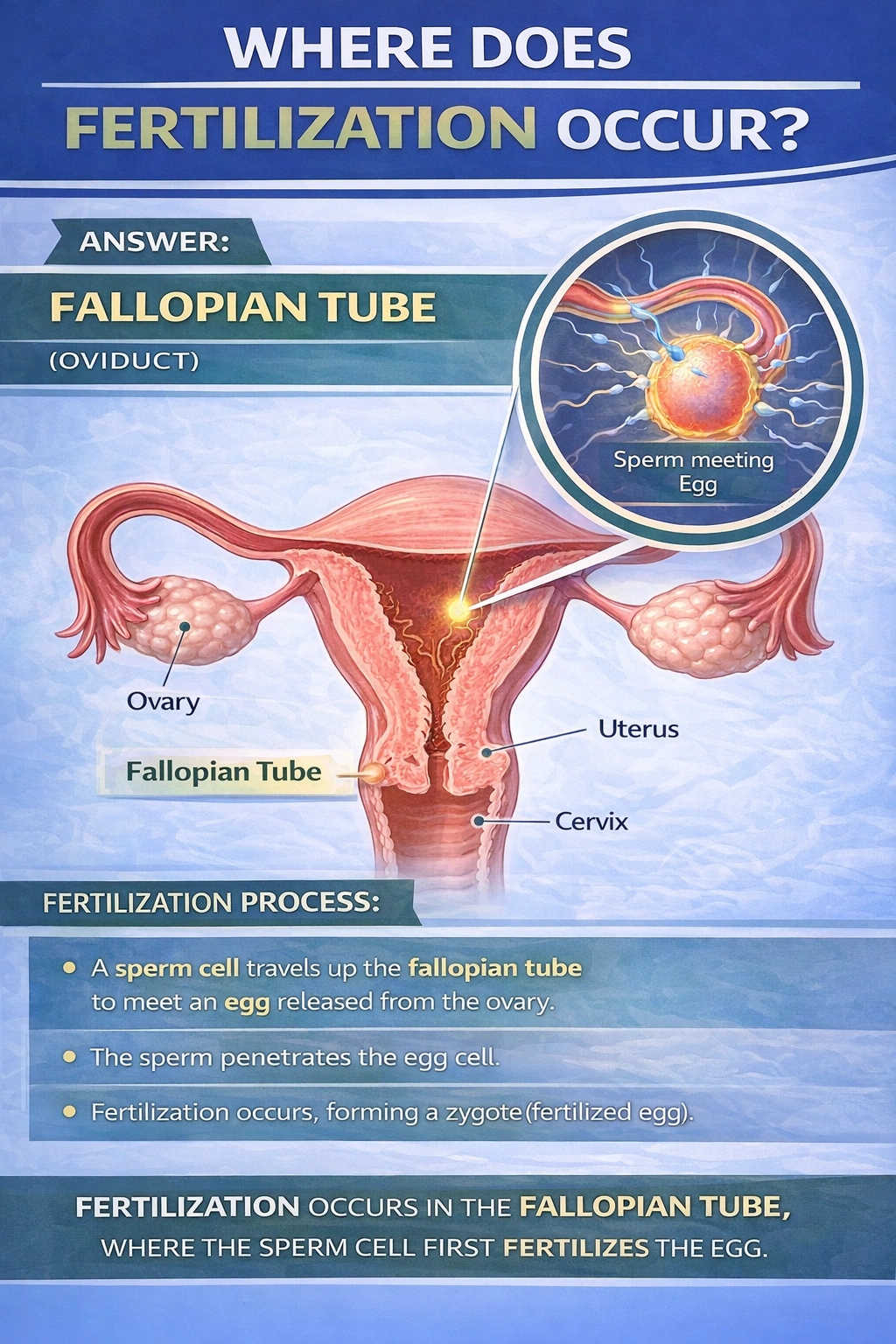
In which location does a sperm cell first fertilize an egg?
-
A
Cervix
-
B
Ovary
-
C
fallopian tube
-
D
uterus
A sperm cell first fertilizes an egg in the fallopian tube.
After ovulation, the egg is released from the ovary and enters the fallopian tube, where it remains viable for approximately 12–24 hours. Sperm cells travel from the vagina through the cervix and uterus into the fallopian tubes. Fertilization normally occurs in the ampullary region of the fallopian tube, where the sperm penetrates the egg to form a zygote. The newly formed zygote then travels to the uterus for implantation.
A) Cervix
The cervix is the lower, narrow portion of the uterus that opens into the vagina. Its role in reproduction is to allow sperm to pass from the vagina into the uterus and to protect the upper reproductive tract from infection.
Although sperm must pass through the cervix to reach the upper reproductive organs, fertilization does not occur there. The cervix lacks the appropriate environment and anatomical conditions needed for sperm–egg fusion. Therefore, this option is incorrect.
B) Ovary
The ovary is the organ responsible for producing and releasing eggs during ovulation. Each month, a mature egg is released from the ovary into the nearby fallopian tube.
While the ovary is the origin of the egg, it is not the site of fertilization. Sperm do not typically enter the ovary, and fertilization does not occur within ovarian tissue. Instead, the egg must first travel into the fallopian tube before fertilization can take place. For this reason, this option is incorrect.
C) Fallopian tube
The fallopian tube is the normal and primary site of fertilization.
After ovulation, the egg enters the fallopian tube, and sperm that have traveled through the female reproductive tract meet the egg in this location. Fertilization most commonly occurs in the ampulla, the widest part of the tube. Here, the sperm penetrates the egg’s outer layers, and their genetic material combines to form a zygote.
This structure provides the ideal conditions for fertilization and early cell division before the developing embryo moves into the uterus. Therefore, this option is correct.
D) Uterus
The uterus is the site of implantation and fetal development, not fertilization.
Once fertilization has occurred in the fallopian tube, the zygote divides and travels to the uterus, where it implants into the endometrial lining. The uterus supports the growth of the embryo and fetus throughout pregnancy but does not serve as the location where sperm and egg first unite. Thus, this option is incorrect.
Conclusion:
Fertilization requires the meeting of a sperm and an egg in an environment that supports their fusion and early development. The cervix serves as a passageway, the ovary releases the egg, and the uterus supports implantation and pregnancy. The fallopian tube is the only structure where fertilization normally occurs.
Therefore, the correct answer is the fallopian tube.
Topic Flashcards
Click to FlipWhat is the name of the specific region within the fallopian tube where fertilization most commonly occurs?
The ampulla (the widest, longest portion).
After fertilization, what is the single-celled structure called before it begins to divide?
A zygote.
What is the term for the process by which the developing embryo travels from the fallopian tube to the uterus?
Tubal transport (or embryo migration).
What are the finger-like projections at the end of the fallopian tube that help capture the ovulated egg?
Fimbriae
What is the window of time after ovulation during which an egg can be fertilized?
About 12–24 hours.