Which part of the nervous system includes the femoral, radial, and ulnar nerves?
-
A
Somatic
-
B
Autonomic
-
C
Sympathetic
-
D
Parasympathetic
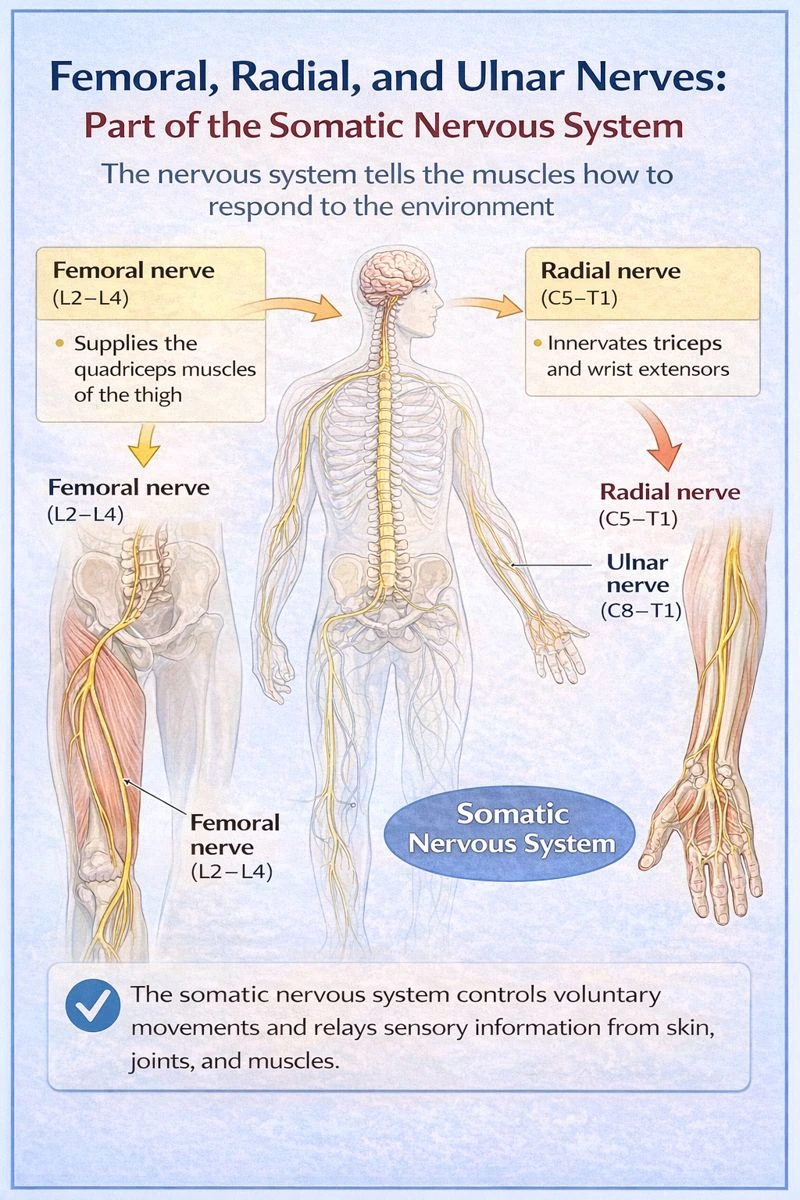
The femoral, radial, and ulnar nerves are part of the somatic nervous system.
These nerves are peripheral spinal nerves that carry motor commands from the central nervous system to skeletal muscles and transmit sensory information from the skin, joints, and muscles back to the brain and spinal cord. Their functions are largely under voluntary control, which is the defining characteristic of the somatic division of the nervous system.
A) Somatic
The somatic nervous system includes all peripheral nerves that innervate skeletal muscle and convey conscious sensory input from the body.
The femoral nerve (arising from spinal levels L2–L4) supplies the quadriceps muscles and enables knee extension and hip flexion. The radial nerve (C5–T1) innervates the triceps and wrist extensors, allowing elbow extension and hand positioning. The ulnar nerve (C8–T1) supplies many intrinsic hand muscles and is essential for fine motor control and finger movement.
All three nerves control voluntary muscle activity and transmit sensory information from the limbs. Because these functions are hallmarks of the somatic nervous system, this option is correct.
B) Autonomic
The autonomic nervous system regulates involuntary body functions such as heart rate, digestion, pupil size, and glandular secretion.
It innervates smooth muscle, cardiac muscle, and glands, not skeletal muscle. Its pathways use a two-neuron chain involving preganglionic and postganglionic neurons and different neurotransmitters than those used at skeletal neuromuscular junctions.
Since the femoral, radial, and ulnar nerves directly control skeletal muscle and conscious movement, they do not belong to the autonomic nervous system. This option is incorrect.
C) Sympathetic
The sympathetic nervous system is a subdivision of the autonomic nervous system responsible for the “fight-or-flight” response.
Its fibers arise from the thoracic and lumbar regions of the spinal cord and primarily regulate functions such as increased heart rate, bronchodilation, pupil dilation, and reduced digestive activity.
It does not form the named peripheral motor nerves to skeletal muscles and does not directly control voluntary limb movement. Therefore, this option is incorrect.
D) Parasympathetic
The parasympathetic nervous system is another subdivision of the autonomic nervous system and governs “rest-and-digest” activities such as slowing the heart rate, stimulating digestion, and promoting glandular secretion.
Its fibers originate mainly from cranial nerves and sacral spinal segments and supply internal organs rather than limb muscles.
Because the femoral, radial, and ulnar nerves innervate skeletal muscles of the arms and legs and are not involved in visceral control, this option is incorrect.
Conclusion:
The femoral, radial, and ulnar nerves are peripheral nerves that control voluntary movement of skeletal muscles and transmit conscious sensory information from the limbs. These functions define the somatic nervous system, not the autonomic or its sympathetic and parasympathetic subdivisions.
Therefore, the correct answer is the somatic nervous system.

Topic Flashcards
Click to FlipWhat type of neurons (by function) are found in the femoral, radial, and ulnar nerves?
Somatic motor neurons (to skeletal muscle) and somatic sensory neurons (from skin, muscles, joints).
From which spinal cord segments does the radial nerve primarily arise?
C5–T1 (part of the brachial plexus).
What is the name of the nerve plexus that gives rise to the femoral nerve?
The lumbar plexus.
What is the term for the protective connective tissue sheath that surrounds each peripheral nerve?
The epineurium.
Which nerve is commonly known as the "funny bone" nerve, and what is the sensation caused by its irritation?
The ulnar nerve; tingling/numbness in the ring and little fingers.