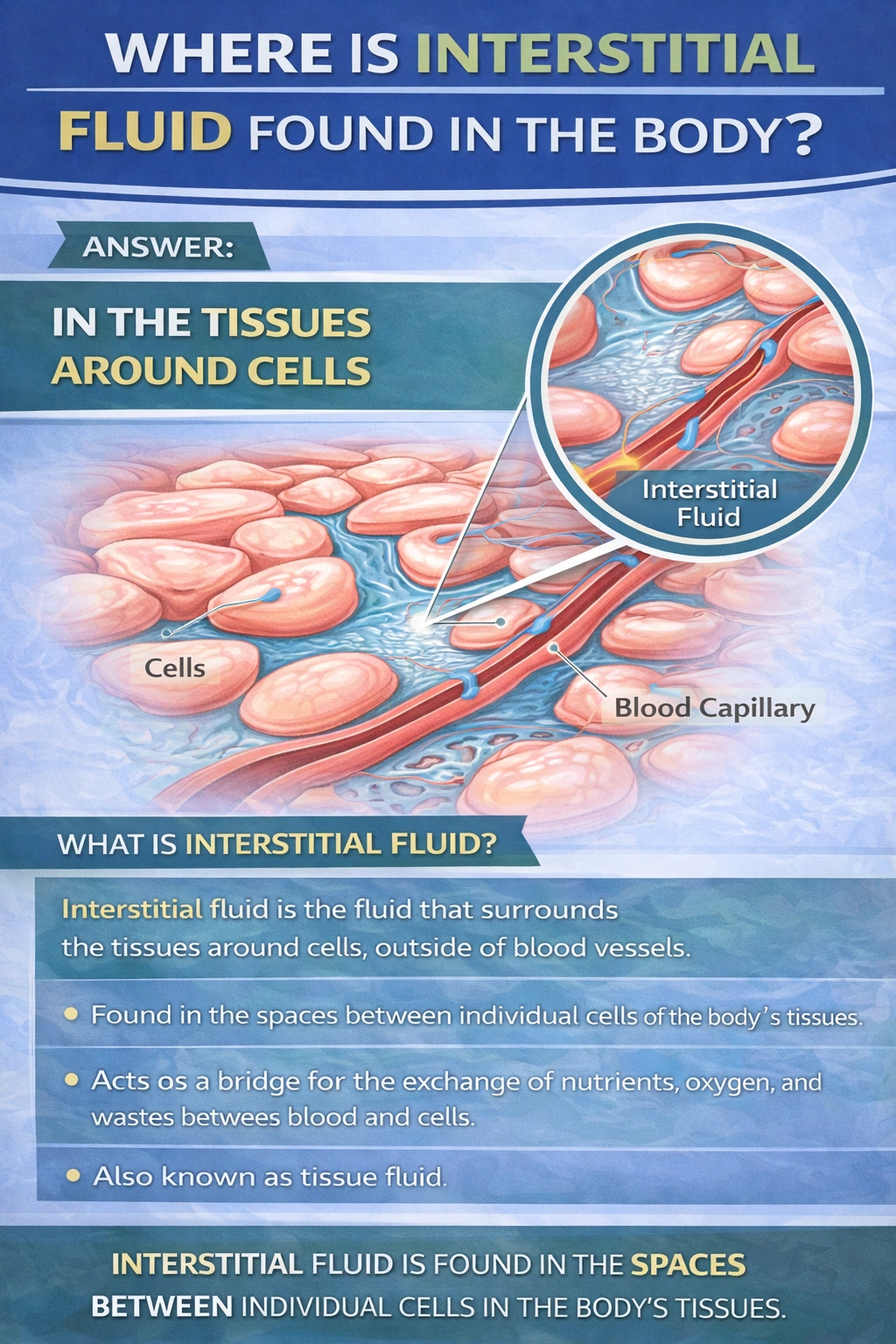
Where is interstitial fluid found in the body?
-
A
around the brain and spinal cord
-
B
inside the stomach
-
C
inside of cells
-
D
in the tissues around cells
Interstitial fluid is found in the tissues around cells.
Interstitial fluid is a major component of extracellular fluid and occupies the microscopic spaces between cells within tissues. It serves as the immediate environment for cells, allowing the exchange of oxygen, nutrients, hormones, and waste products between the bloodstream and body cells. Without this fluid medium, cells would not be able to receive essential substances or eliminate metabolic waste efficiently.
A) Around the brain and spinal cord
The fluid that surrounds the brain and spinal cord is called cerebrospinal fluid (CSF), not interstitial fluid.
CSF is produced by the choroid plexus and circulates within the ventricles of the brain and the subarachnoid space. Its primary functions are to cushion the central nervous system, protect it from mechanical injury, and help remove metabolic waste.
Although CSF is part of the body’s extracellular fluids, it is a specialized fluid confined to the central nervous system and is anatomically and functionally distinct from interstitial fluid. Therefore, this option is incorrect.
B) Inside the stomach
The stomach contains gastric fluid, which consists of hydrochloric acid, digestive enzymes such as pepsin, mucus, and water.
This fluid is located within the lumen of the stomach and is involved in digestion. It does not participate in nutrient or waste exchange between cells and blood vessels and is not located within tissue spaces.
Because interstitial fluid is found between cells in tissues rather than inside digestive organs, this option is incorrect.
C) Inside of cells
The fluid located inside cells is known as intracellular fluid.
Intracellular fluid makes up the largest portion of the body’s total fluid volume and contains water, electrolytes, proteins, and metabolites necessary for cellular function. However, it is confined within cell membranes.
Interstitial fluid, by contrast, is located outside cells but within tissues. Since this option describes intracellular fluid rather than interstitial fluid, it is incorrect.
D) In the tissues around cells
Interstitial fluid occupies the spaces between cells in tissues throughout the body.
It originates from blood plasma that filters out of capillaries and bathes the surrounding cells. Through this fluid, oxygen and nutrients diffuse from the blood to cells, while carbon dioxide and metabolic waste diffuse from cells back into the bloodstream.
This positioning makes interstitial fluid essential for maintaining homeostasis and enabling cellular survival and function. Because this accurately describes the location and role of interstitial fluid, this option is correct.
Conclusion:
Interstitial fluid is part of the extracellular fluid compartment and functions as the medium of exchange between blood and body cells. It is not cerebrospinal fluid, gastric fluid, or intracellular fluid.
It is specifically located in the tissue spaces surrounding cells, where it supports nutrient delivery, waste removal, and cellular communication.
Therefore, interstitial fluid is found in the tissues around cells.
Topic Flashcards
Click to FlipWhat is the collective term for all fluid found outside of cells, which includes interstitial fluid and plasma?
Extracellular fluid (ECF).
By what process does interstitial fluid form from blood plasma?
Capillary filtration (due to hydrostatic and osmotic pressures).
What is the name of the vessels that collect excess interstitial fluid and return it to the bloodstream?
Lymphatic vessels (it becomes lymph once inside them).
What condition results from an abnormal accumulation of interstitial fluid in tissues?
Edema.
What are the two main forces described in the Starling equation that govern fluid movement between capillaries and interstitial space?
Hydrostatic pressure and colloid osmotic (oncotic) pressure.