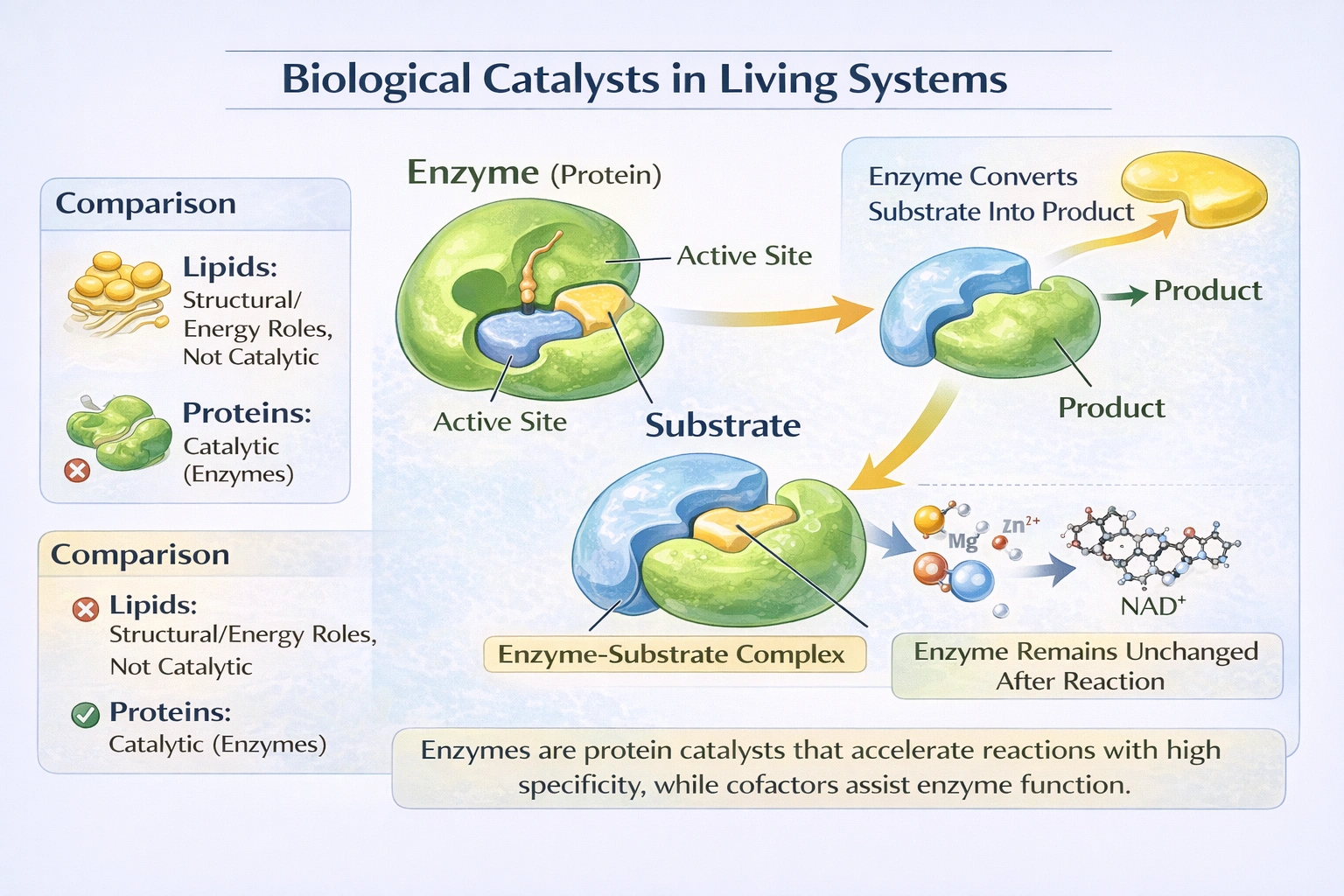
Most catalysts found in biological systems are which of the following?
-
A
Special lipids called cofactors
-
B
Special proteins called enzymes
-
C
Special lipids called enzymes
-
D
Special proteins called cofactors
Most biological catalysts are specialized proteins called enzymes that accelerate biochemical reactions with high substrate specificity and regulatory control.
Enzymes constitute the predominant catalytic machinery in living organisms, with over 5,000 distinct enzymes identified in human metabolism alone—each facilitating specific transformations essential for energy production, biosynthesis, signal transduction, and homeostasis through precisely structured active sites that bind substrates and stabilize transition states.
A) Special lipids called cofactors
Lipids serve primarily as membrane structural components, energy storage molecules, or signaling mediators—not as catalysts. Cofactors are non-protein chemical compounds (metal ions like Mg²⁺ or Zn²⁺, or organic coenzymes like NAD⁺) that assist enzyme function but lack catalytic activity independently. No lipid-based cofactors function as primary catalysts; this option conflates structural biomolecules with catalytic helpers while misassigning catalytic identity to lipids.
B) Special proteins called enzymes
Enzymes are globular proteins with precisely folded tertiary structures creating active sites that bind substrates through complementary shape, charge distribution, and hydrophobic interactions. Catalytic mechanisms include acid-base catalysis (e.g., chymotrypsin's histidine residue), covalent catalysis (e.g., glyceraldehyde-3-phosphate dehydrogenase forming thiohemiacetal intermediates), and metal ion catalysis (e.g., carbonic anhydrase using Zn²⁺). Enzymes achieve rate enhancements of 10⁶ to 10¹⁴ times uncatalyzed reactions while maintaining exquisite specificity—properties arising from protein structure's chemical versatility and conformational dynamics. Ribozymes (catalytic RNA) exist but represent a small minority of biological catalysts compared to protein enzymes.
C) Special lipids called enzymes
Lipids lack the structural complexity and functional group diversity required for catalysis. Their hydrophobic nature prevents formation of precise binding pockets and catalytic residues necessary for transition state stabilization. No lipid molecules function as enzymes; the term "enzyme" exclusively denotes biological catalysts, predominantly proteins (with rare RNA exceptions). This option represents a fundamental biochemical misconception conflating lipid functions with protein catalysis.
D) Special proteins called cofactors
Cofactors are non-protein components required by some enzymes for activity—they are not proteins themselves. Protein components of enzyme systems are called apoenzymes (inactive without cofactor) or holoenzymes (active with cofactor bound). Cofactors include inorganic ions (e.g., Fe²⁺ in catalase) and organic coenzymes (e.g., thiamine pyrophosphate in decarboxylases). Labeling proteins as "cofactors" inverts the actual relationship: cofactors assist proteins, not vice versa.
Conclusion:
Protein-based enzymes dominate biological catalysis due to amino acid side chains' chemical diversity enabling precise substrate binding, transition state stabilization, and regulated activity through allosteric sites or post-translational modifications. While ribozymes demonstrate RNA's catalytic capacity and cofactors enhance certain enzymatic functions, proteins remain the primary catalytic workhorses of cellular metabolism. Option B correctly identifies enzymes as specialized proteins—distinguishing them from structural lipids, helper molecules (cofactors), or mislabeled categories—reflecting a foundational principle of biochemistry essential for understanding metabolic regulation and drug design.