Which of the following is unique to covalent bonds?
-
A
Most covalent bonds are formed between the elements H, F, N, and O.
-
B
Covalent bonds are dependent on forming dipoles.
-
C
Bonding electrons are shared between two or more atoms.
-
D
Molecules with covalent bonds tend to have a crystalline solid structure.
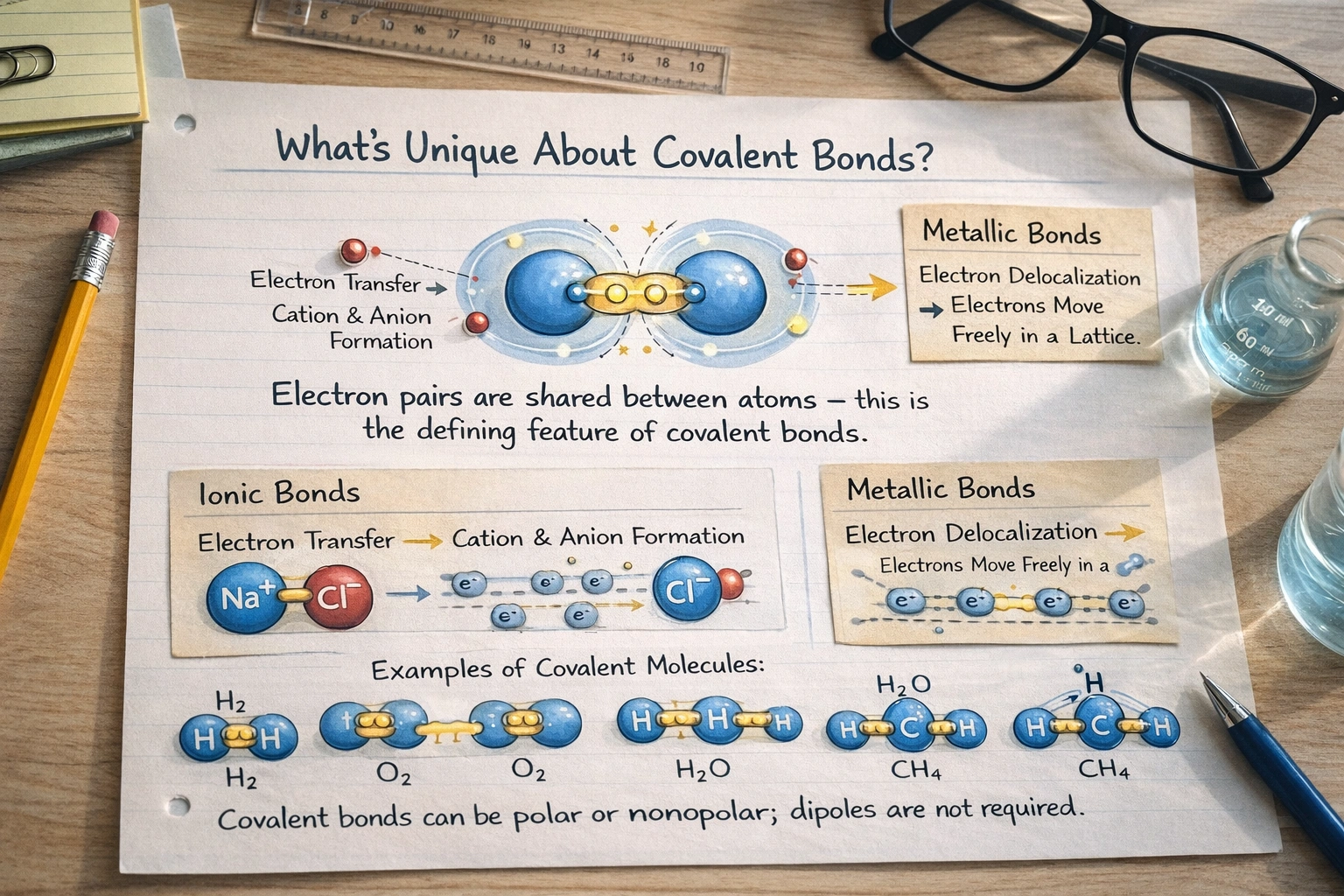
Electron sharing between atoms constitutes the defining characteristic unique to covalent bonds, distinguishing them from ionic bonds (electron transfer) and metallic bonds (electron delocalization).
Covalent bonding occurs when atomic orbitals overlap to create molecular orbitals occupied by electron pairs shared between nuclei, lowering system energy through increased electron density between positively charged nuclei—a quantum mechanical stabilization mechanism absent in other bond types.
A) Most covalent bonds are formed between the elements H, F, N, and O
Covalent bonds form between virtually all nonmetal elements across the periodic table—not exclusively H, F, N, O. Carbon-carbon bonds form organic molecular backbones; silicon-oxygen bonds create silicate minerals; phosphorus-nitrogen bonds exist in biochemical compounds. While H, F, N, O participate in many covalent bonds (particularly polar covalent bonds in biological molecules), this represents a frequency observation rather than a defining or unique characteristic. Ionic compounds also involve these elements (e.g., NaF, NH₄Cl), and covalent bonding occurs abundantly without them (e.g., Cl₂, S₈, P₄).
B) Covalent bonds are dependent on forming dipoles
Dipole formation occurs only in polar covalent bonds where electronegativity differences create uneven electron distribution (e.g., H-Cl). Nonpolar covalent bonds between identical atoms (e.g., O₂, N₂, diamond's C-C network) exhibit perfectly symmetrical electron sharing with zero dipole moment. Dipole formation is neither necessary nor universal for covalent bonding—many covalent substances lack permanent dipoles entirely. Ionic bonds also create charge separation (full charges rather than partial), so dipoles are not unique to covalent interactions.
C) Bonding electrons are shared between two or more atoms
Electron sharing defines covalent bonding at the quantum mechanical level: atomic orbitals overlap to form bonding molecular orbitals occupied by electron pairs localized between nuclei. This contrasts with ionic bonding (complete electron transfer creating separate ions held by electrostatic forces) and metallic bonding (electrons delocalized throughout a lattice). Even coordinate covalent bonds—where one atom donates both electrons—still involve shared electron pairs occupying molecular orbitals between atoms. This electron-sharing mechanism produces directional bonds with characteristic bond lengths and angles, enabling complex molecular geometries impossible in ionic lattices. No other bond type features true electron sharing as its fundamental mechanism.
D) Molecules with covalent bonds tend to have a crystalline solid structure
Covalent substances exhibit diverse solid-state structures: molecular covalent compounds (e.g., ice, sucrose) form crystalline solids through intermolecular forces, but many exist as liquids (water) or gases (O₂) at room temperature. Network covalent solids (diamond, quartz) form rigid crystals, but this crystallinity stems from extended bonding networks—not covalent bonding per se. Ionic compounds more consistently form crystalline solids due to non-directional electrostatic forces favoring regular lattice packing. Crystalline structure is neither universal nor unique to covalent substances; amorphous covalent solids like glass also exist.
Conclusion:
Electron sharing represents the singular feature exclusive to covalent bonding—distinguishing it from ionic electron transfer and metallic electron delocalization. This quantum mechanical characteristic enables directional bonds, molecular geometry prediction via VSEPR theory, and the vast structural diversity of organic and inorganic molecules. Options A, B, and D describe tendencies or subsets of covalent bonding but fail as universal or exclusive characteristics: covalent bonds form between many elements beyond H/F/N/O, exist without dipoles in nonpolar molecules, and produce varied physical states beyond crystalline solids. Option C identifies the fundamental mechanism that defines covalent bonding across all contexts.
