Which of the following areas of the body has the most sweat glands?
-
A
Upper back
-
B
Arms
-
C
Feet
-
D
Palms
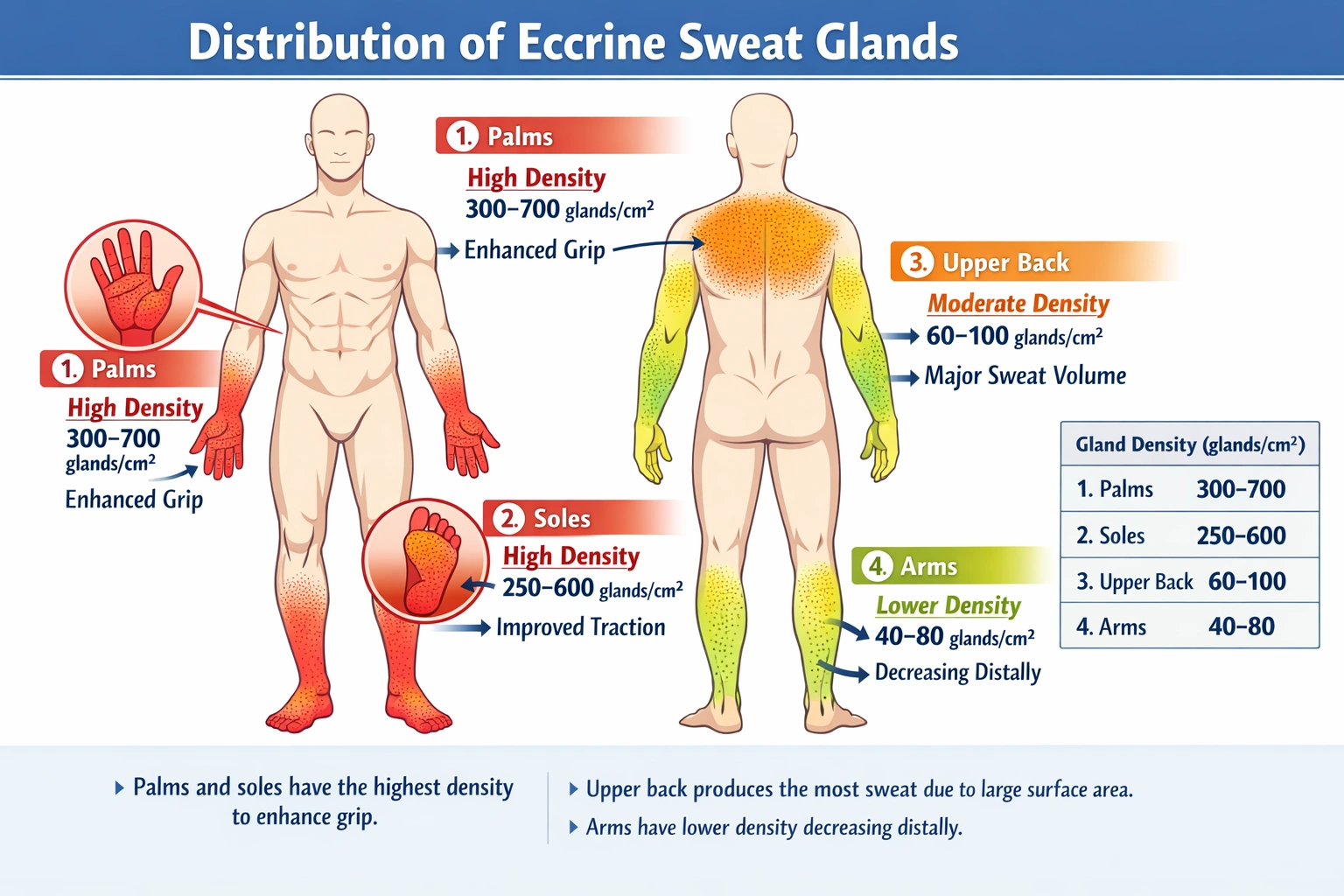
The palms of the hands possess the highest density of eccrine sweat glands.
Eccrine sweat glands distribute non-uniformly across the body surface, concentrating in regions requiring enhanced grip security through moisture-mediated friction control and thermoregulatory efficiency—particularly the palmar and plantar surfaces where gland density peaks despite these areas contributing minimally to whole-body heat dissipation.
A) Upper back
The upper back contains moderate eccrine gland density (approximately 60–100 glands/cm²), contributing significantly to total body sweat production due to its large surface area—making it important for thermoregulation during exercise. However, gland density per unit area remains substantially lower than on palmar surfaces. Apocrine glands also concentrate in axillary and upper back regions, but these produce viscous secretions unrelated to thermoregulatory sweating and activate only after puberty.
B) Arms
The arms exhibit relatively low eccrine gland density (approximately 40–80 glands/cm² on the forearm), with distribution decreasing distally toward the wrist. While arm sweating contributes to overall evaporative cooling, the density remains an order of magnitude lower than palmar regions. Hair follicle density on arms further reduces available surface area for eccrine pore placement compared to glabrous (hairless) skin regions.
C) Feet
The soles of the feet possess very high eccrine gland density (approximately 250–600 glands/cm²), second only to the palms among body regions. This concentration supports grip enhancement during locomotion and climbing—critical evolutionary adaptations for arboreal ancestors. However, precise anatomical studies consistently measure slightly lower maximum densities on soles compared to palms, with palmar densities reaching up to 700 glands/cm² in some individuals versus 600 glands/cm² maximum on soles.
D) Palms
The palmar surface demonstrates the highest eccrine sweat gland density in the human body (300–700 glands/cm²), concentrated particularly in the central palm and finger pads. These glabrous skin regions lack hair follicles, allowing maximal pore distribution. Palmar sweating serves dual functions: enhancing tactile grip through controlled moisture-mediated friction (critical for tool manipulation and climbing) and providing limited thermoregulation. Sympathetic cholinergic innervation triggers palmar sweating during emotional stress independent of thermal needs—a vestigial response possibly evolved for improving grip during fight-or-flight situations.
Conclusion:
Sweat gland distribution reflects evolutionary adaptations balancing thermoregulation with functional requirements like grip enhancement. While the upper back contributes most to total sweat volume due to surface area, gland density peaks on glabrous skin surfaces—particularly the palms, which consistently demonstrate the highest eccrine gland concentration per unit area (300–700/cm²) compared to soles (250–600/cm²), upper back (60–100/cm²), and arms (40–80/cm²). This palmar concentration supports fine motor control through moisture-regulated friction, explaining why emotional stress triggers hand sweating even in thermoneutral environments. Option D correctly identifies palms as the region with maximal sweat gland density among the choices.