Which solution would change red litmus paper to blue?
-
A
NaCl
-
B
NaOH
-
C
HNO₃
-
D
H₂SO₄
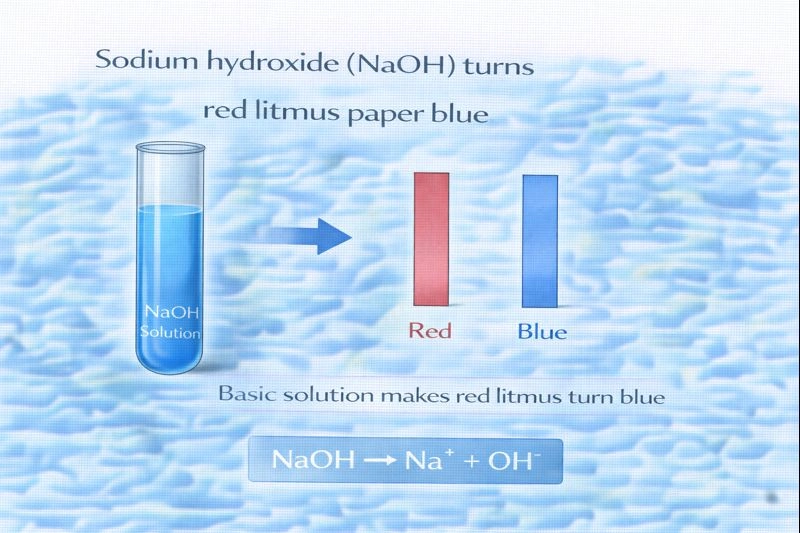
The solution that would change red litmus paper to blue is sodium hydroxide (NaOH).
Red litmus paper is used to identify basic (alkaline) solutions. A base causes red litmus paper to turn blue because bases increase the concentration of hydroxide ions (OH⁻) in solution, raising the pH above 7. Only substances that produce a clearly alkaline environment will cause this color change, while neutral or acidic solutions will not.
A. NaCl
Sodium chloride is a neutral salt formed from the reaction between a strong acid (hydrochloric acid) and a strong base (sodium hydroxide). When NaCl dissolves in water, it dissociates into sodium and chloride ions, neither of which significantly alters the pH of the solution. As a result, an NaCl solution has a pH close to 7 and does not cause any change in red litmus paper, which remains red in neutral conditions.
B. NaOH
Sodium hydroxide is a strong base that dissociates completely in water to release hydroxide ions (OH⁻). The presence of these hydroxide ions raises the pH of the solution well above 7, creating an alkaline environment. This alkaline condition causes red litmus paper to change color to blue, which is a classic and reliable indicator of a basic solution.
C. HNO₃
Nitric acid is a strong acid that releases hydrogen ions (H⁺) into solution, resulting in a low pH. Acids do not turn red litmus paper blue. Instead, acids turn blue litmus paper red, while red litmus paper remains red. Therefore, nitric acid cannot produce the color change described in the question.
D. H₂SO₄
sulphuric acid is also a strong acid that significantly lowers the pH of a solution by producing hydrogen ions. Like nitric acid, sulphuric acid will not turn red litmus paper blue. Its effect would be observed only on blue litmus paper, which would turn red in an acidic environment.
Conclusion
Red litmus paper turns blue only in the presence of a basic solution. Among the options provided, sodium hydroxide is the only substance that produces hydroxide ions and creates an alkaline environment capable of causing this color change. Sodium chloride is neutral, while nitric acid and sulphuric acid are acidic.

Topic Flashcards
Click to FlipWhat ion is primarily responsible for a solution being basic, and what is its effect on red litmus paper?
Hydroxide ions (OH⁻). Their presence raises the pH above 7, causing red litmus paper to turn blue.
What would you observe if you placed blue litmus paper into a solution of sulfuric acid (H₂SO₄)? Explain why.
The blue litmus paper would turn red. Sulfuric acid is a strong acid that increases the concentration of H⁺ ions, creating an acidic solution (pH < 7).
Sodium chloride (NaCl) solution does not change the color of litmus paper. What term describes such a solution, and why does it not cause a change?
It is a neutral solution. It is the salt of a strong acid and a strong base, so it doesn't produce an excess of H⁺ or OH⁻ ions in water, resulting in a pH of ~7.
Besides NaOH, name two other common household or laboratory substances that would turn red litmus paper blue.
Examples include ammonia (NH₃) solution, bleach (NaOCl), or a solution of baking soda (NaHCO₃).
What is the name for a substance, like litmus paper, that changes color in response to the acidity or basicity of a solution?
An acid-base indicator.