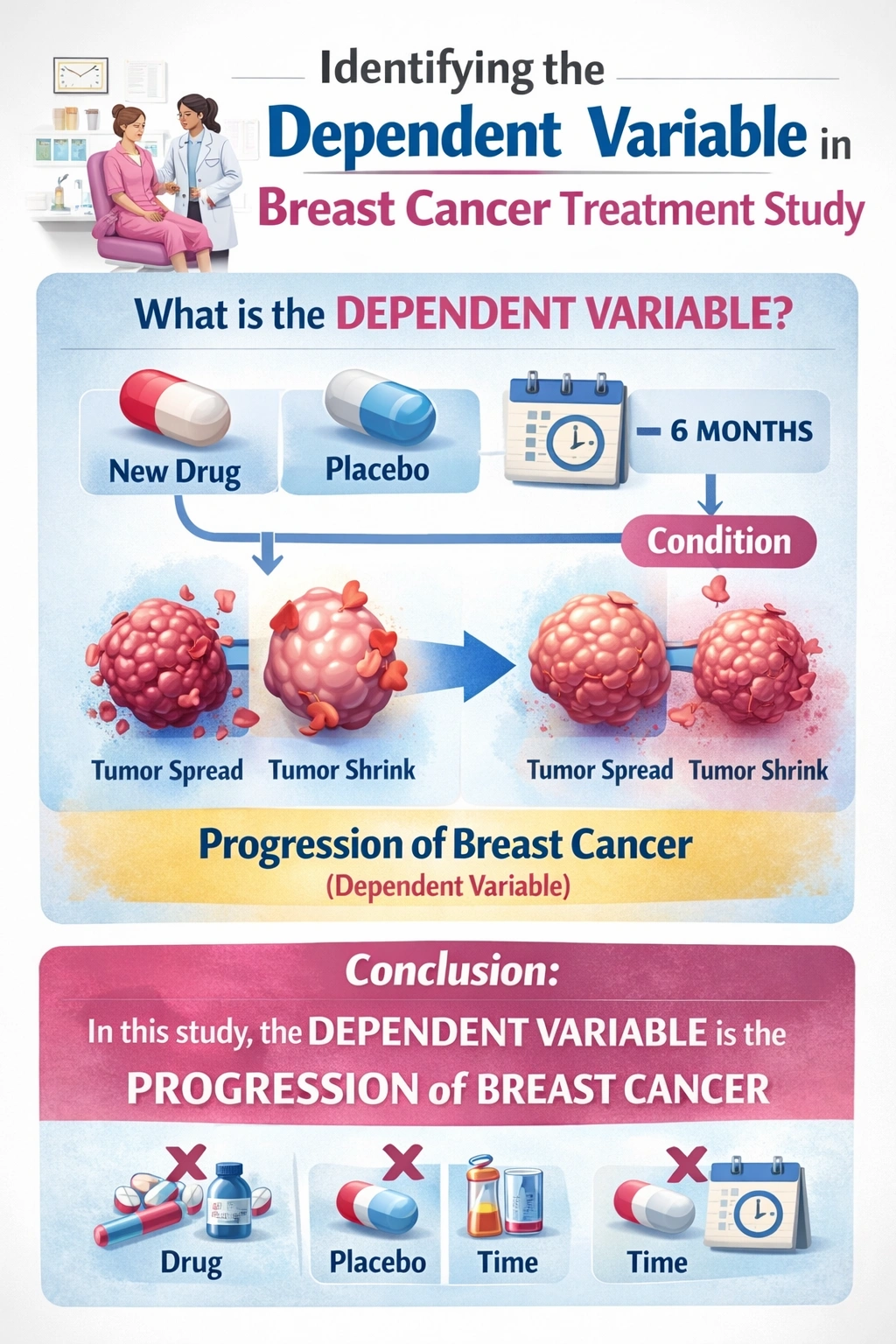
Several participants are enrolled in a study that is evaluating the effectiveness of a new drug targeted at slowing the progression of breast cancer. Some participants are asked to take the new drug and monitored over a six-month period. Others are asked to take a placebo. They are also monitored over six months. What is the dependent variable?
-
A
Drug
-
B
Condition
-
C
Placebo
-
D
Time
The dependent variable is the condition, specifically the progression of breast cancer.
In an experimental design, the dependent variable is the outcome or response that is measured to see if it is influenced by changes in the independent variable. It is the effect presumed to depend on the treatment or intervention applied. In this clinical study, researchers are administering different treatments (new drug or placebo) to observe their impact on the health status of the participants.
A) Drug
The drug is the treatment being tested and is deliberately manipulated by the researchers. They assign participants to either receive the new drug or a placebo. This active manipulation makes the drug (or the type of treatment) the independent variable. It is the cause or input in the experiment, not the measured outcome. Classifying it as the dependent variable confuses the agent of change with the result being studied.
B) Condition
The condition refers to the state of breast cancer progression in the participants. This is the primary outcome measure of the study. Researchers monitor changes in tumor size, metastasis, or other clinical indicators over the six-month period to see if these changes depend on which treatment was received. Because this outcome is measured and is expected to vary based on the intervention, it fulfills the definition of the dependent variable.
C) Placebo
The placebo is one specific form of the independent variable, serving as the control or comparison treatment. It is an inert substance administered to the control group. The placebo itself is not an outcome or response measured in the participants; it is part of the experimental manipulation. Its role is to provide a baseline against which the effects of the active drug can be compared, not to be a variable that changes in response to something else.
D) Time
The six-month duration is a fixed parameter or constant of the study design. While the condition is measured over time, time itself is not the variable whose value is expected to change as a result of the drug treatment. It is a controlled variable, held constant across groups to ensure that any differences in the condition are not due to different observation periods. Time provides the framework for measurement but is not the measured outcome of interest.
Conclusion:
In this experiment, the independent variable is the type of treatment (new drug vs. placebo), which is manipulated. The dependent variable, the presumed effect, is the progression of the breast cancer condition, which is carefully monitored and quantified. The placebo is a level of the independent variable, and time is a controlled constant. Thus, the condition is correctly identified as the dependent variable.

Topic Flashcards
Click to FlipIn the breast cancer drug study, what is the dependent variable (the outcome being measured)?
The progression of the breast cancer condition (e.g., changes in tumor size or health status).
What is the independent variable (the factor manipulated by researchers) in this drug trial?
The type of treatment administered—either the new drug or the placebo.
What is the primary purpose of giving a placebo to one group of participants in this study?
To serve as a control or comparison group. This helps determine if changes in the dependent variable are due to the new drug itself and not other factors like participant expectations.
In this experiment, is 'time' (the six-month period) the dependent variable? Why or why not?
No. Time is a controlled constant—it is the same for all groups. It is the framework for measurement, not the outcome that is expected to change because of the treatment.
In an experiment, what do we call the group that receives the placebo (a non-active treatment)?
The control group. Its results are compared to those of the experimental group (which gets the drug).