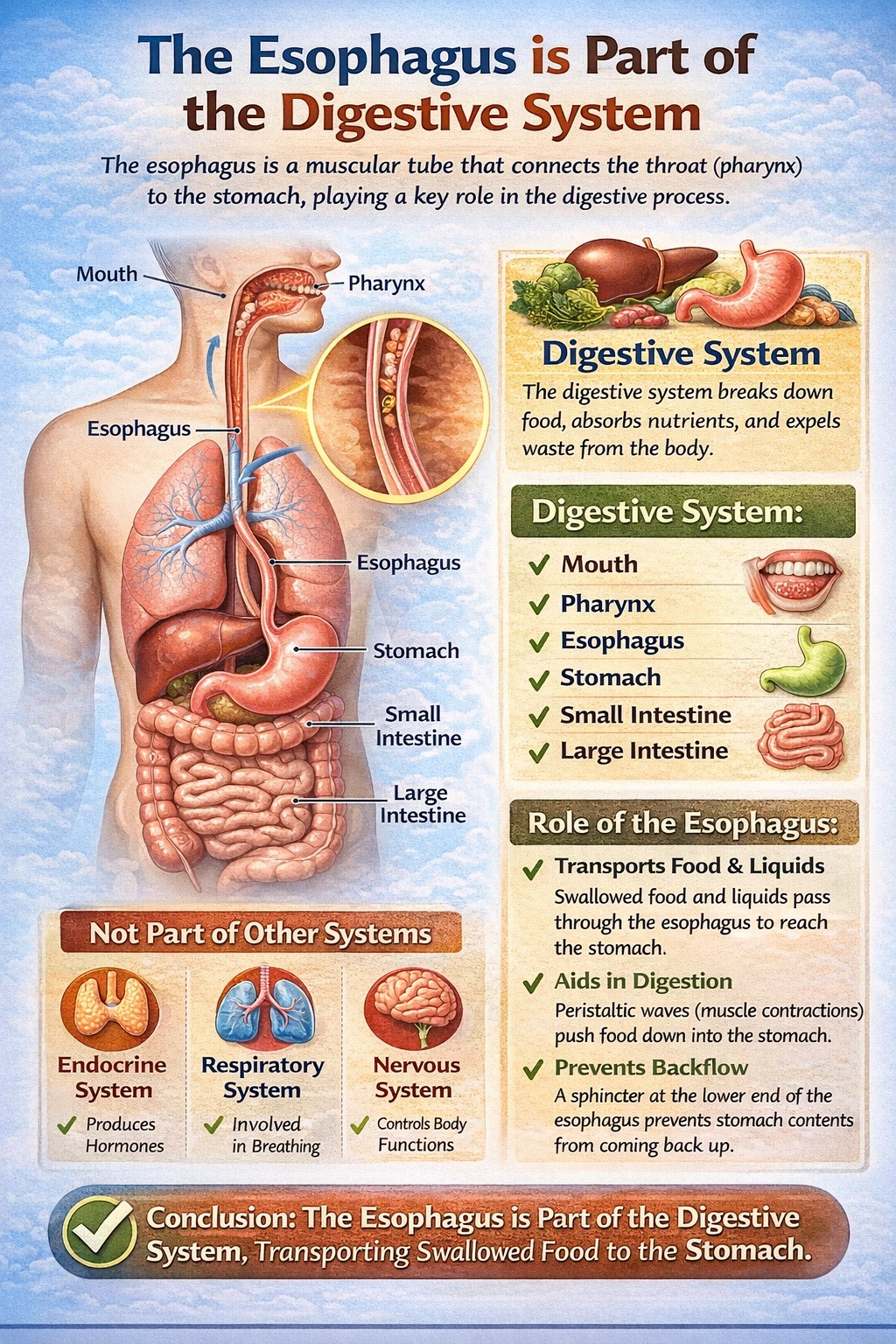
The esophagus is part of the ___________.
-
A
endocrine system
-
B
digestive system
-
C
respiratory system
-
D
nervous system
The esophagus is part of the digestive system.
It is a muscular tube that connects the throat (pharynx) to the stomach, allowing food and liquids to pass from the mouth to the stomach. The esophagus plays a key role in the process of digestion by transporting swallowed food and liquids to the stomach, where further digestion occurs.
A. Endocrine system
The endocrine system is responsible for producing hormones that regulate various bodily functions, such as metabolism, growth, and mood. The esophagus does not play a role in hormone production or regulation, so it is not part of the endocrine system.
B. Digestive system
This is the correct answer. The esophagus is a critical part of the digestive system. It is involved in the mechanical process of moving food from the mouth to the stomach for digestion. The digestive system includes other organs like the mouth, stomach, small intestine, and large intestine.
C. Respiratory system
The respiratory system is responsible for the exchange of gases, such as oxygen and carbon dioxide, and includes organs like the lungs and trachea. While the esophagus is located near the trachea, it is not part of the respiratory system. The esophagus is involved in digestion, not in breathing or gas exchange.
D. Nervous system
The nervous system is responsible for transmitting signals between different parts of the body, enabling communication and coordination. While the esophagus is controlled by the autonomic nervous system (which controls involuntary actions), it is not part of the nervous system itself.
Conclusion:
The esophagus is part of the digestive system, playing a crucial role in the movement of food from the mouth to the stomach. Other systems like the endocrine, respiratory, and nervous systems serve different functions in the body.

Topic Flashcards
Click to FlipWhich body system includes the esophagus as a primary structure?
Digestive system — the esophagus is the muscular tube that carries swallowed food from the throat to the stomach through peristaltic contractions.
What is the main role of the esophagus in human anatomy?
Transports food and liquids from the pharynx to the stomach — it is lined with stratified squamous epithelium and uses smooth muscle for involuntary propulsion.
Of the endocrine, digestive, respiratory, and nervous systems, which one contains the esophagus?
Digestive system. It is part of the alimentary canal (GI tract); endocrine involves glands/hormones, respiratory handles air/gas exchange, nervous controls signals.
Why is the esophagus not part of the respiratory system?
It transports food, not air; the trachea and bronchi are for respiration — the esophagus lies posterior to the trachea and shares a common entry (pharynx) but diverges at the larynx.
How does the esophagus contribute to digestion?
It mechanically moves bolus (chewed food) to the stomach via peristalsis; no chemical digestion occurs there, but it delivers food for gastric processing.