Three different dispersants that are used to break up oil in water are evaluated for their effectiveness. Dispersant A has a concentration of 10m, dispersant B has a concentration of 7m, and dispersant C has a concentration of 3m. Each dispersant is separately poured into a solution of water and oil. The amount of time it takes each dispersant to disperse the oil is recorded. Which of the following statements describes the positive correlation observed in this study?
-
A
Oil remains suspended in solution despite dispersant addition.
-
B
As more dispersant is added to the water, more oil is dispersed.
-
C
Dispersant C is the least effective at dispersing oil in the solution of water.
-
D
When a high concentration of dispersant is added, less oil disperses in water.
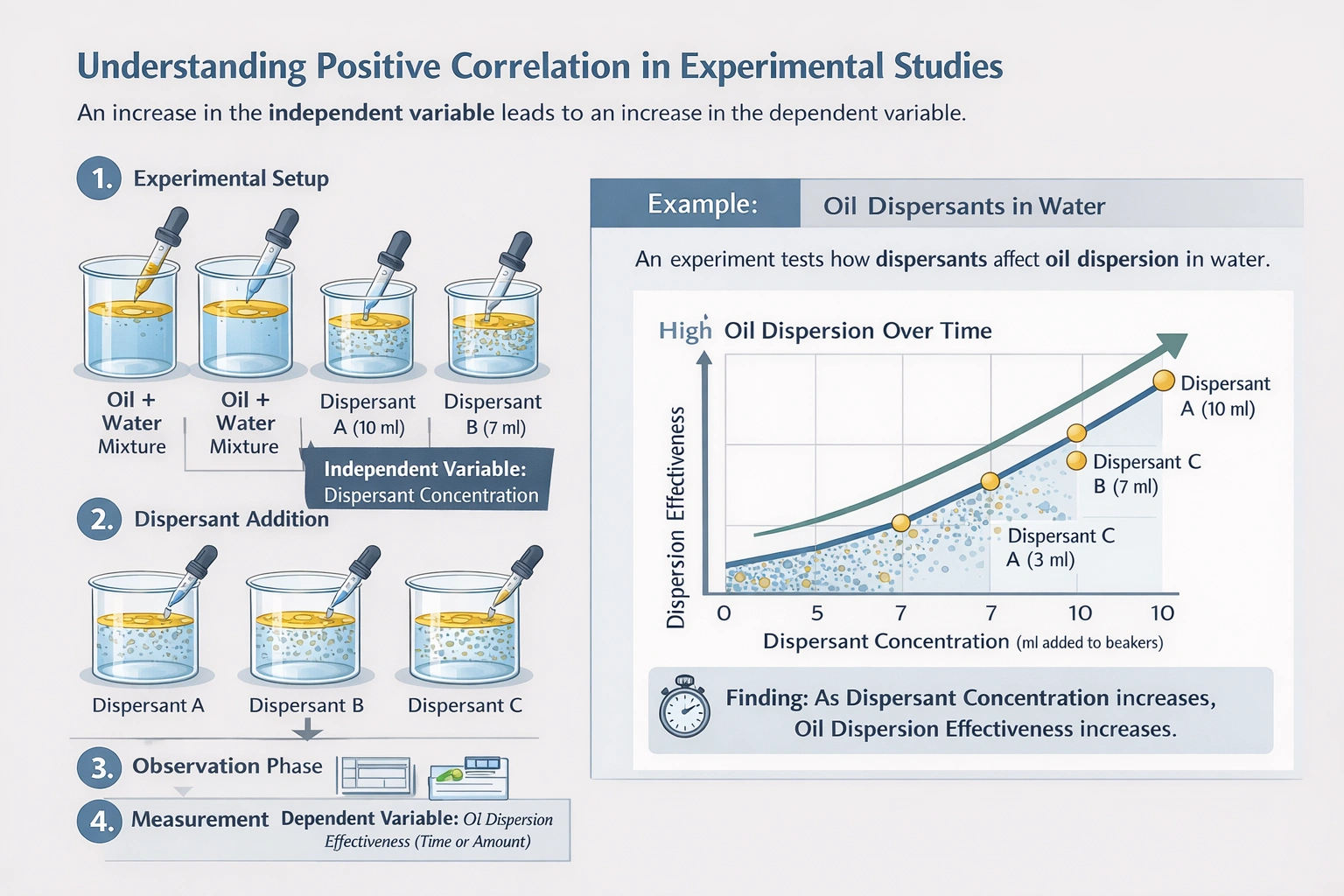
A positive correlation in this study would be described by the statement: As more dispersant is added to the water, more oil is dispersed.
A positive correlation exists when two variables change in the same direction; an increase in one variable is associated with an increase in the other. In this experimental context, the concentration of the dispersant is the independent variable, and the effectiveness (implied by the time it takes to disperse oil or the amount dispersed) is the dependent variable. A positive correlation would mean higher concentrations lead to greater effectiveness.
A) Oil remains suspended in solution despite dispersant addition.
This statement suggests a null effect or a complete failure of the treatment. It indicates that the dispersant concentration has no impact on the outcome, as the oil remains suspended regardless. This describes a lack of correlation, not a positive one. If anything, it implies the variables are independent of each other.
B) As more dispersant is added to the water, more oil is dispersed.
This statement directly captures the essence of a positive correlation. It explicitly links an increase in the independent variable ("more dispersant") with an increase in the desired outcome ("more oil is dispersed"). The term "more" indicates a directional relationship where both variables move upward together, which is the definition of a positive correlation.
C) Dispersant C is the least effective at dispersing oil in the solution of water.
This is a specific comparative conclusion about one level of the independent variable (the 3m concentration). It is a discrete data point, not a description of the relationship between the variables across their range. While this observation might be consistent with a positive correlation (the lowest concentration has the least effect), it does not describe the overarching trend or correlation itself. It is a singular result, not a statement of relationship.
D) When a high concentration of dispersant is added, less oil disperses in water.
This statement describes a negative or inverse correlation. It posits that as the independent variable (dispersant concentration) increases, the dependent variable (amount of oil dispersed) decreases. This is the opposite of a positive correlation. Such a relationship might indicate that excessively high concentrations are counterproductive, but it does not represent the positive correlation asked for in the question.
Conclusion:
A positive correlation describes a proportional relationship where both variables increase together. The only statement that generalizes this direct, upward trend between dispersant amount and dispersal effectiveness is the one stating that as more dispersant is added, more oil is dispersed.
Topic Flashcards
Click to FlipIn an experiment, you change the concentration of a reactant and measure the reaction speed. What term describes the situation where increasing the concentration consistently increases the speed?
A positive correlation.
If a study finds that higher study hours are linked to higher exam scores, what type of correlation is this?
Positive correlation.
In the dispersant experiment, what are the two main variables being studied for a correlation?
Independent variable: Dispersant concentration. Dependent variable: Effectiveness (time or amount of oil dispersed).
What would a graph of the dispersant data look like if it showed a positive correlation?
A trend line with an upward slope, showing that as concentration (x-axis) increases, effectiveness (y-axis) increases.
Why is the statement "Dispersant C is the least effective" not a description of a correlation?
Because it only describes the result for one specific data point, not the overall relationship or trend between the two variables.