Time is measured using a
-
A
barometer.
-
B
stopwatch.
-
C
graduated cylinder.
-
D
triple beam balance.
Time is measured using a stopwatch.
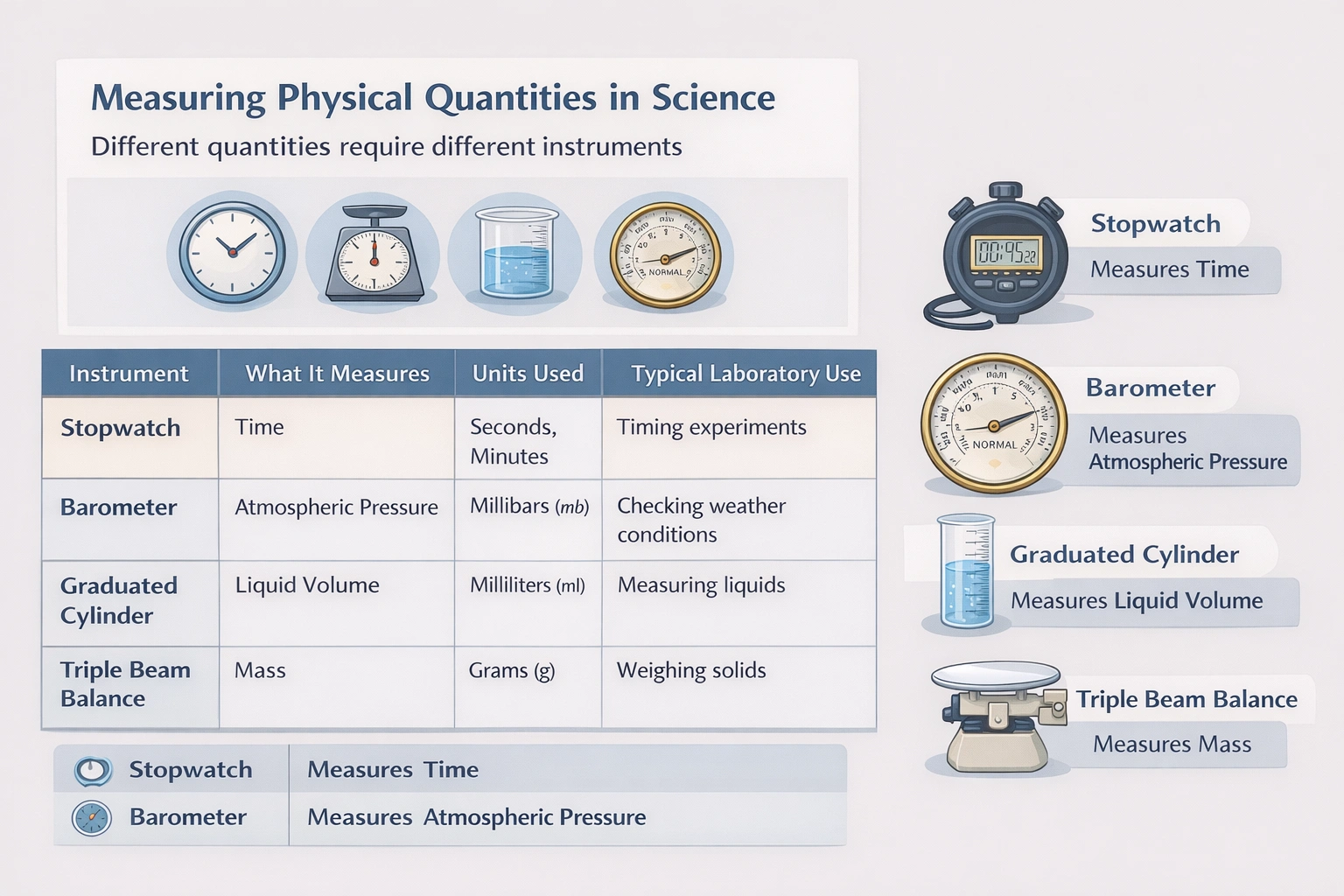
Measurement in science requires tools specifically designed to quantify particular physical quantities. Each instrument has a dedicated function based on its operating principle and calibration.
A) Barometer
A barometer is an instrument designed to measure atmospheric pressure. It operates by balancing the weight of a column of mercury (or another fluid) or by using an aneroid cell that flexes with pressure changes. Its scale is calibrated in units of pressure such as millimeters of mercury (mmHg), atmospheres (atm), or pascals (Pa). It provides no mechanism or scale for measuring temporal intervals.
B) Stopwatch
A stopwatch is a timekeeping instrument engineered to measure elapsed time with precision. It can be analog, with a sweeping second hand and a minute dial, or digital, using a quartz crystal oscillator for high accuracy. Activation and deactivation controls allow a user to start, stop, and reset the timing function. Its readout is in units of time: seconds, minutes, and often hundredths of a second. It is the standard tool in laboratories for timing chemical reactions, physiological processes, and physical events.
C) Graduated cylinder
A graduated cylinder is a piece of volumetric glassware used to measure the volume of a liquid. It is a tall, cylindrical container with a spout and a series of calibrated markings (graduations) along its side. The user reads the meniscus—the curve of the liquid's surface—to determine the volume in milliliters (mL) or liters (L). Its design pertains to spatial capacity, not temporal duration.
D) Triple beam balance
A triple beam balance is a mechanical mass-measuring instrument. It consists of a platform on which an object is placed and three sliding weights (beams) that move along calibrated scales. The user adjusts these weights to balance the object's mass against known masses. The sum of the positions of the weights gives the mass in grams. Its function is to determine the quantity of matter, independent of time.
Conclusion:
While a barometer measures pressure, a graduated cylinder measures volume, and a triple beam balance measures mass, only the stopwatch is fundamentally designed and calibrated for the sole purpose of measuring the passage of time. Its mechanism, from its oscillator to its display, is dedicated to quantifying temporal intervals.
Topic Flashcards
Click to FlipWhat is the primary physical quantity that a stopwatch is designed to measure?
Elapsed time or time intervals.
Which lab instrument would you select to determine how long it takes for a solid to dissolve: a graduated cylinder or a stopwatch?
A stopwatch.
What is the SI base unit for time, and which common lab tool is dedicated to measuring it?
The second (s); a stopwatch (or clock).
Why is a barometer the wrong choice for measuring the length of a class period?
A barometer measures atmospheric pressure, not time intervals.
If you need to collect data on both the mass of a reactant and the duration of the reaction, which two tools from the list must you use?
A triple beam balance (for mass) and a stopwatch (for time).