What does lipase do?
-
A
It breaks down nucleic acids into nucleotides.
-
B
It breaks down fats into fatty acids and glycerol.
-
C
It breaks down carbohydrates into starch and sugar.
-
D
It breaks down proteins into peptides and amino acids.
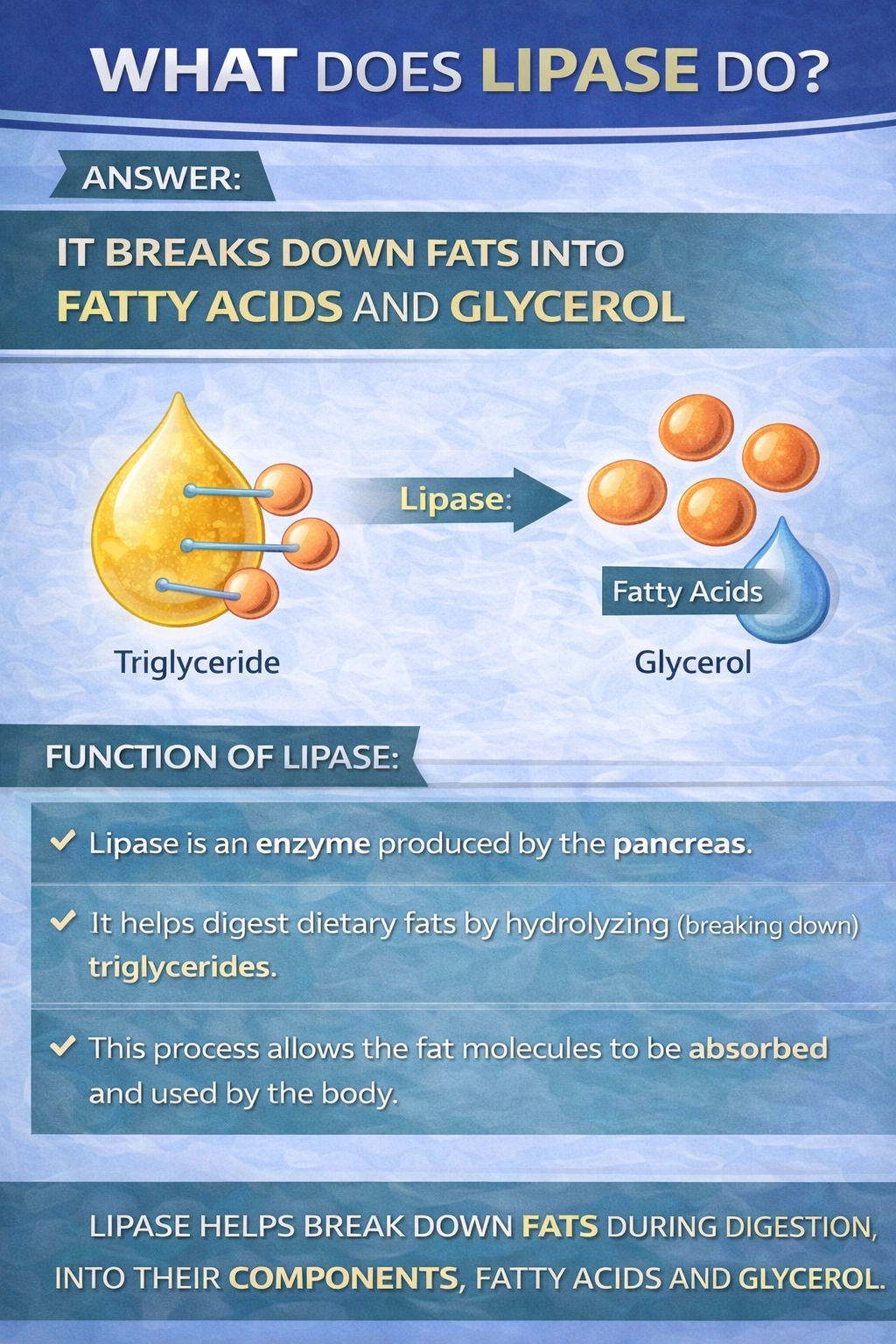
Lipase breaks down fats into fatty acids and glycerol.
Lipase is a digestive enzyme whose primary role is to chemically digest dietary fats (triglycerides) into smaller molecules that the body can absorb and use for energy, cell membrane formation, and hormone synthesis. It is mainly produced by the pancreas and released into the small intestine, where most fat digestion occurs.
A) It breaks down nucleic acids into nucleotides
This function is performed by nucleases, not lipase.
Nucleic acids such as DNA and RNA are large molecules composed of nucleotide units. During digestion, specialized enzymes called nucleases cleave these molecules into individual nucleotides so they can be absorbed and reused by the body.
Lipase has no activity on nucleic acids and does not participate in genetic material digestion. Therefore, this option is incorrect.
B) It breaks down fats into fatty acids and glycerol
Lipase specifically targets triglycerides, the main form of fat in food.
A triglyceride molecule consists of:
- One glycerol backbone
- Three fatty acid chains
Lipase catalyzes the hydrolysis of the bonds connecting fatty acids to glycerol, releasing free fatty acids and glycerol. These products are then absorbed through the intestinal lining and transported for:
- Energy production
- Storage in adipose tissue
- Construction of cell membranes
- Synthesis of steroid hormones
Because this description matches lipase’s true biological role, this option is correct.
C) It breaks down carbohydrates into starch and sugar
Carbohydrate digestion is carried out by enzymes such as:
- Amylase (saliva and pancreas)
- Maltase, sucrase, and lactase (intestinal enzymes)
These enzymes convert complex carbohydrates into simple sugars like glucose.
Lipase does not interact with carbohydrates and cannot digest starch or sugars. Therefore, this option is incorrect.
D) It breaks down proteins into peptides and amino acids
Protein digestion is performed by proteases such as:
- Pepsin (in the stomach)
- Trypsin and chymotrypsin (from the pancreas)
These enzymes break peptide bonds between amino acids.
Lipase does not act on proteins and cannot cleave peptide bonds. Its activity is limited to lipid molecules. Therefore, this option is incorrect.
Conclusion:
Lipase is a specialized digestive enzyme that acts on fats, breaking triglycerides into fatty acids and glycerol so they can be absorbed and utilized by the body. It does not digest nucleic acids, carbohydrates, or proteins.
Therefore, the correct answer is that lipase breaks down fats into fatty acids and glycero
Topic Flashcards
Click to FlipWhich organ secretes the primary form of lipase responsible for digesting most dietary fat in the small intestine?
The pancreas (pancreatic lipase).
Besides pancreatic lipase, name two other types of lipase found in the human digestive system and where they are active.
Lingual lipase (mouth/stomach) and gastric lipase (stomach).
What substance, produced by the liver and stored in the gallbladder, emulsifies fats to increase the surface area for lipase action?
Bile (bile salts).
What is the medical term for a condition where the body cannot properly digest fats due to a lack of lipase or bile?
Steatorrhea (fatty, pale, foul-smelling stools).
Elevated levels of lipase in the blood are a key diagnostic marker for inflammation of which organ?
The pancreas (acute pancreatitis).