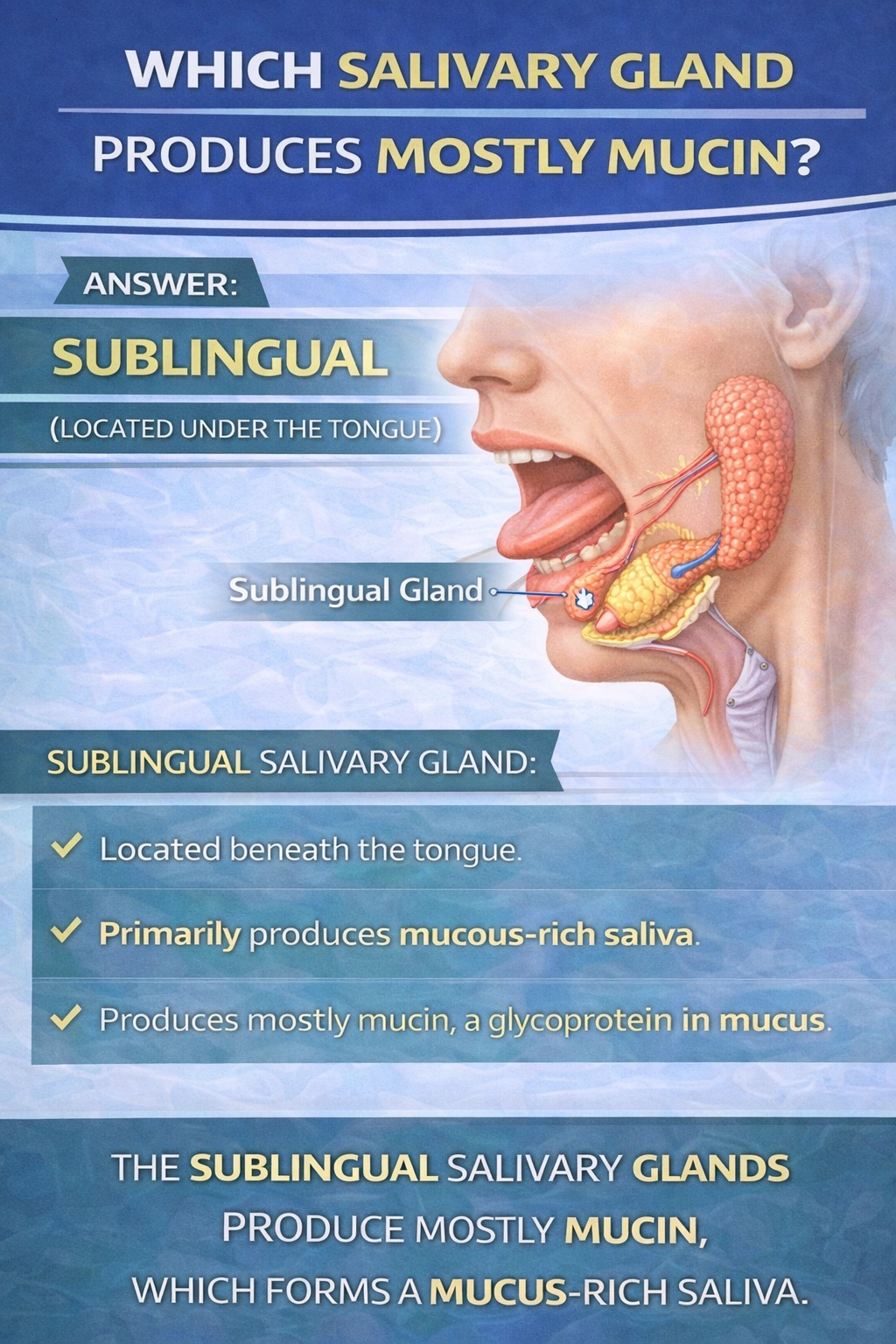
Which salivary gland produces mostly mucin?
-
A
Sublingual
-
B
Submandibula
-
C
Parotid
-
D
Thyroid
The salivary gland that produces mostly mucin is the sublingual gland.
Mucin is a glycoprotein that forms mucus, giving saliva its thick, slippery, and lubricating quality. This type of secretion is especially important for moistening the oral cavity, protecting the mucosa, and facilitating chewing and swallowing. Among the major salivary glands, the sublingual glands are specialized for predominantly mucous (mucin-rich) secretion.
A) Sublingual
The sublingual glands are located beneath the tongue in the floor of the mouth and are the smallest of the three major salivary glands.
They secrete saliva that is primarily mucous in nature and rich in mucin. This thick, viscous secretion coats food particles, eases swallowing, and protects the lining of the mouth from mechanical damage and drying. Because mucin is the dominant component of their secretion, this option is correct.
B) Submandibular
The submandibular glands are located beneath the lower jaw.
They produce a mixed secretion containing both serous (watery, enzyme-rich) and mucous components. However, the serous portion predominates, meaning their saliva contains more digestive enzymes such as amylase and less mucin compared with the sublingual glands.
Since they do not produce mostly mucin, this option is incorrect.
C) Parotid
The parotid glands are the largest salivary glands and are located in front of and below the ears.
They secrete almost entirely serous saliva, which is thin and watery and rich in digestive enzymes, particularly amylase. Their secretion contains very little mucin.
Therefore, the parotid glands do not produce mostly mucin, making this option incorrect.
D) Thyroid
The thyroid gland is an endocrine gland located in the neck.
It secretes thyroid hormones (T3 and T4), which regulate metabolism, growth, and energy use in the body. It has no role in saliva production and does not produce mucin.
This option is unrelated to salivary gland function and is incorrect.
Conclusion:
Salivary glands differ in the type of secretion they produce: parotid glands are mainly serous, submandibular glands are mixed but mostly serous, and sublingual glands are predominantly mucous.
Because mucin is the main component of mucous saliva, the gland that produces mostly mucin is the sublingual gland.
Topic Flashcards
Click to FlipWhich salivary gland produces a primarily serous (watery, enzyme-rich) secretion?
The parotid gland.
Where are the sublingual salivary glands located?
Beneath the tongue, in the floor of the mouth
What is the name of the enzyme in saliva that begins the chemical digestion of carbohydrates?
Salivary amylase (ptyalin).
Besides lubrication, name two other important functions of saliva.
Digestion (amylase), oral hygiene (antibacterial properties), taste (solubilizes food), buffering acids
What are the many small, dispersed glands in the oral mucosa that secrete mucus continuously to keep the mouth moist called?
Minor salivary glands (e.g., labial, buccal, palatal glands).