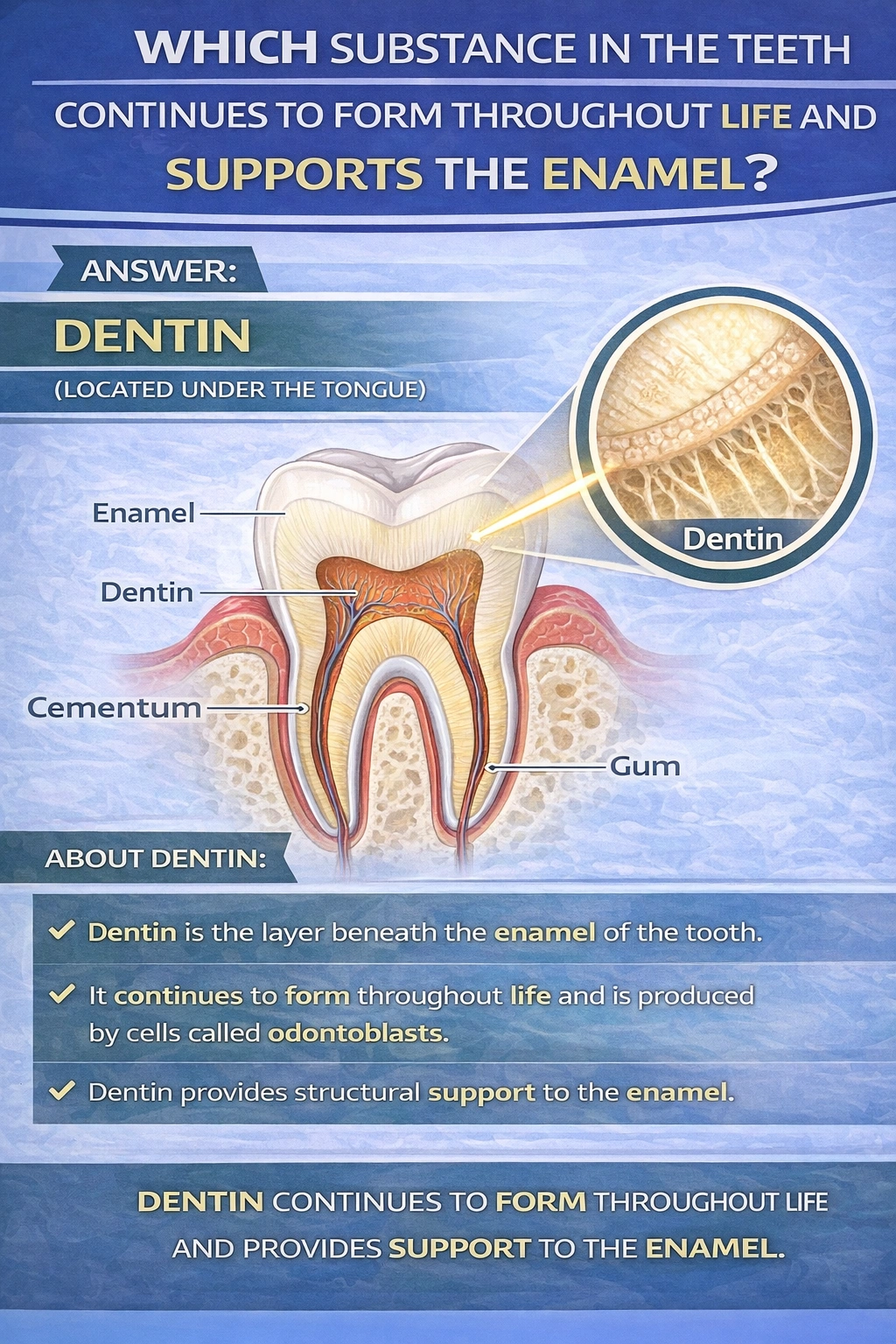
Which substance in the teeth continues to form throughout life and supports the enamel?
-
A
Dentin
-
B
Cementum
-
C
Gum
-
D
Pulp
The substance in the teeth that continues to form throughout life and supports the enamel is dentin.
Dentin forms the main structural body of the tooth and lies directly beneath the enamel in the crown and beneath the cementum in the root. It is produced by specialized cells called odontoblasts, which remain active throughout life. This continuous formation, known as secondary dentin, helps maintain tooth strength, protects the pulp, and compensates for normal wear of the enamel over time.
A) Dentin
Dentin is a hard, calcified tissue that makes up the majority of the tooth’s structure. It is slightly softer than enamel but much harder than bone, providing strong internal support for the enamel layer that covers the crown of the tooth.
Unlike enamel, which is formed only during early development and does not regenerate, dentin continues to be produced slowly throughout life. Odontoblasts lining the pulp cavity deposit new dentin in response to aging, normal chewing stress, or injury. This ongoing production helps reinforce the tooth and protect the pulp chamber from exposure.
Because dentin both supports the enamel and continues to form throughout life, this option is correct.
B) Cementum
Cementum is a thin, bone-like tissue that covers the root of the tooth and helps anchor it to the jawbone through the periodontal ligament.
While cementum may thicken slightly over time, its primary function is attachment and stabilization of the tooth within the socket, not support of the enamel. Enamel is found on the crown of the tooth, whereas cementum is confined to the root.
Therefore, cementum is not the substance that supports enamel or primarily continues forming throughout life in the way dentin does.
C) Gum
The gums, or gingiva, are soft tissues that surround the teeth and protect the underlying bone and tooth roots.
Gums do not form part of the tooth structure itself and do not provide structural support to enamel. They also do not produce hard tissue.
For these reasons, this option is incorrect.
D) Pulp
The pulp is the soft inner tissue of the tooth that contains blood vessels, nerves, and connective tissue.
While the pulp supplies nutrients to odontoblasts and plays a role in tooth vitality, it does not form hard tissue and does not directly support the enamel layer. Its function is physiological rather than structural.
Thus, this option is incorrect.
Conclusion:
Enamel is the hardest substance in the body but cannot regenerate once formed. It relies on dentin beneath it for structural support and shock absorption. Dentin is continuously produced throughout life by odontoblasts, strengthening the tooth and protecting its inner structures.
Therefore, the correct answer is dentin.
Topic Flashcards
Click to FlipWhat are the specialized cells that line the pulp cavity and produce dentin throughout life?
Odontoblasts.
What is the name for the microscopic channels in dentin that contain fluid and processes from the odontoblasts?
Dentinal tubules.
What is the term for the new, slower-forming dentin laid down after tooth eruption, which gradually reduces the size of the pulp chamber?
Secondary dentin.
What is the hard, non-living tissue that covers the crown of the tooth and is supported by the underlying dentin?
Enamel.
What is the name for the dentin-like material that forms rapidly in response to injury or caries to wall off the pulp?
Tertiary dentin (reparative or reactionary dentin).