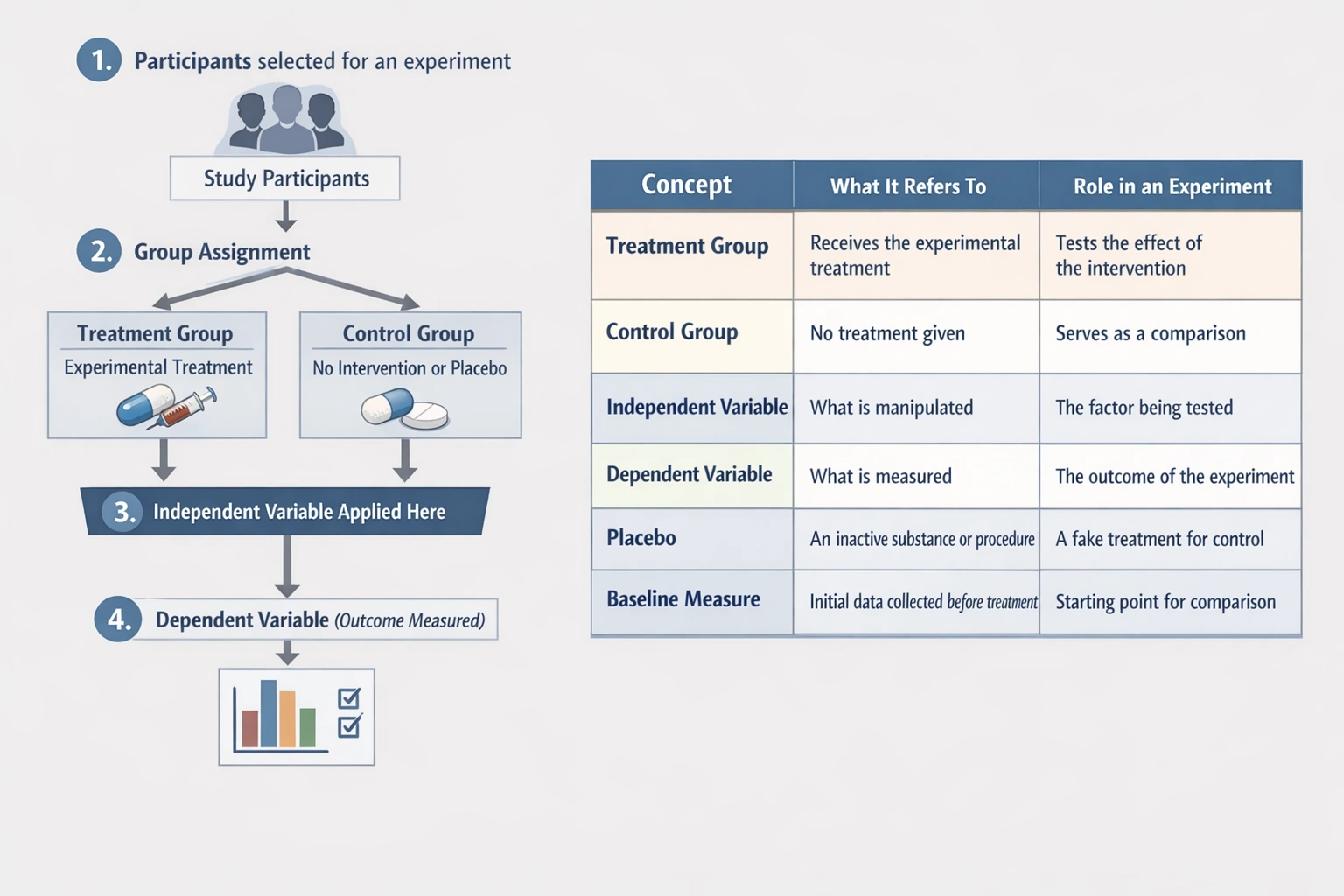
What is a treatment group?
-
A
A type of placebo
-
B
A baseline measure
-
C
The outcome of interest
-
D
The variable being manipulated
A treatment group is the variable being manipulated.
In experimental research, the treatment group refers to the set of subjects or samples that are exposed to the specific intervention or condition whose effect is being studied. This intervention represents the independent variable, which is deliberately altered by the researcher to observe its impact on a dependent variable.
A) A type of placebo
A placebo is an inert substance or simulated procedure that lacks therapeutic effect, administered to a control group to account for psychological responses like the placebo effect. While a treatment group can receive a placebo if the experiment is designed to test the placebo effect itself, the term "treatment group" is not synonymous with "placebo." A treatment group is defined by receiving any experimental manipulation, whether it is an active drug, a new therapy, a specific environmental condition, or indeed a placebo. The key is the act of application, not the nature of the substance.
B) A baseline measure
A baseline measure refers to the initial data collected from subjects before any experimental intervention is applied. These measurements establish a reference point against which post-treatment data are compared to assess change. The baseline is a measurement or observation, not a group of subjects. The treatment group is the cohort that receives the intervention after baseline measurements are taken.
C) The outcome of interest
The outcome of interest, or dependent variable, is the data that is measured, recorded, and analyzed to determine if it was affected by the manipulation. It is the effect or response. The treatment group is the collection of subjects upon which the outcome is measured after they have received the intervention. Confusing the group that receives the manipulation with the data that is measured conflates the agent of change with the result of that change.
D) The variable being manipulated
This is the accurate description. In an experiment, the independent variable is the factor that the researcher controls and changes. The treatment group is the specific subset of experimental units that are subjected to a particular level or type of this independent variable. For example, in a drug trial, the group receiving the actual drug is the treatment group—the "treatment" is the manipulated variable (drug administration). The group serves as the physical embodiment of the experimental condition being tested.
Conclusion:
The treatment group is fundamentally defined by its exposure to the experimental intervention, which is the independent variable manipulated by the researcher. It is not defined as a placebo, a measurement, or the measured outcome itself. It is the group to which the variable of interest is applied.
Topic Flashcards
Click to FlipIn an experiment testing a new fertilizer, the plants that receive the new fertilizer are part of which group?
The treatment group.
What is the primary difference between a treatment group and a control group in an experiment?
The treatment group is exposed to the independent variable (the intervention), while the control group is not.
The specific condition or intervention applied to the treatment group is also known as the _____ variable
Independent variable.
Can a single experiment have more than one treatment group? Explain.
Yes. An experiment can have multiple treatment groups, each exposed to a different level or type of the independent variable (e.g., different dosages of a drug).
In a medical trial, what is the purpose of comparing the results from the treatment group to the results from the control group?
To determine if any observed changes in the outcome are actually caused by the treatment/intervention and not by other factors.