Extract:

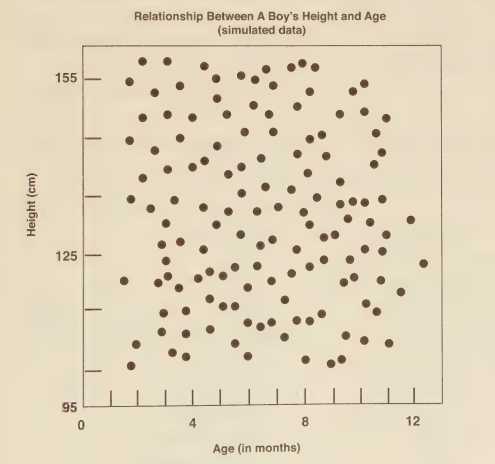
Which analysis describes the results shown in the following image?
-
A
As a baby gets older, he gets taller.
-
B
Birth month is independent of height.
-
C
Older boys are taller than younger boys.
-
D
A baby's height stays the same every month.
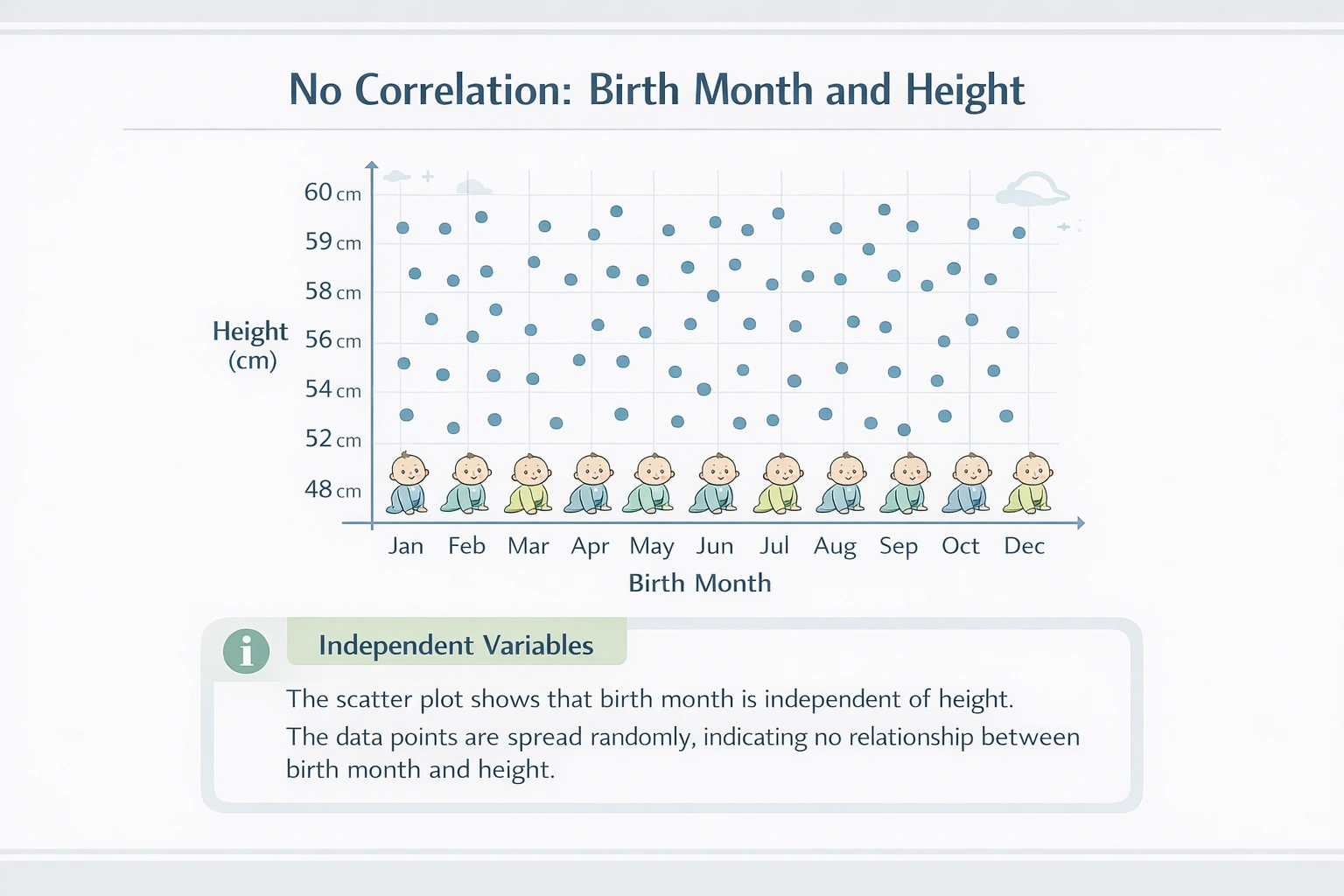
The data shows that birth month is independent of height.
In a scatter plot comparing two variables, a lack of any discernible pattern—where data points are spread randomly without forming an upward or downward trend—indicates no correlation. This means the two variables are independent; knowing the value of one provides no predictive information about the value of the other. If the graph plots a baby's height against his birth month and shows such a random scatter, it demonstrates that the month in which a baby is born has no consistent or predictable relationship with his height at the time of measurement.
A) As a baby gets older, he gets taller.
This statement describes a positive correlation, where an increase in one variable (age) is associated with an increase in another (height). The described graph, however, does not plot height against the age of an individual baby over time. It plots height against the categorical variable of birth month for a group of babies. The "non-correlation" explicitly stated in the graph's description directly contradicts the presence of such a clear, positive trend. The graph does not display the progressive increase expected from tracking growth over time.
B) Birth month is independent of height.
Independence between variables is statistically represented by the absence of correlation in a scatter plot. A random cloud of points signifies that changes in birth month do not correspond to any systematic changes in height. The graph's description confirms a "non-correlation," which is synonymous with statistical independence for the purposes of this analysis. Therefore, this is the accurate description of the graphical result.
C) Older boys are taller than younger boys.
This is a general biological truth when comparing children of different ages. However, the graph in question is not comparing the ages of different children. It is examining a potential link between the specific month of birth and a height measurement, which is a different analytical question. The graph's data, showing no correlation, does not support the conclusion that within this dataset, babies born in certain months (which might make them older or younger relative to a fixed date) are consistently taller or shorter.
D) A baby's height stays the same every month.
This statement would be represented by a perfectly horizontal line on a graph plotting an individual baby's height over successive months. The described graph does not track a single baby over time; it is a cross-sectional plot of many babies, with each data point representing a different child. The axes are height and birth month, not height and age. This option fundamentally misinterprets the type of data presented and the variables being compared.
Conclusion:
Interpreting graphical data requires careful attention to the variables on each axis and the pattern formed by the data points. A scatter plot showing a random distribution of points, with no upward or downward slope, provides visual evidence for a lack of relationship between the variables. In this case, the absence of a pattern indicates that a baby's birth month and his measured height are unrelated, meaning birth month is independent of height.

Topic Flashcards
Click to FlipIn a scatter plot, what pattern of data points visually demonstrates that two variables have "no correlation" or are independent?
A random scatter of points with no apparent upward or downward trend (a "cloud" of points).
What is the key difference between a graph tracking one baby's height over several months and a graph plotting many babies' heights against their birth month?
The first shows change over time (age vs. height) for one subject; the second shows a potential association between two different variables (birth month vs. height) across a group.
If a scatter plot of "Shoe Size" vs. "Test Score" shows a random cloud of points, what conclusion can you draw?
There is no relationship; shoe size is independent of test score.
Why is the statement "Older boys are taller than younger boys" likely true in general, but NOT necessarily what the described graph shows?
Because the graph's axes are "Birth Month" and "Height," not "Age" and "Height." It doesn't compare ages directly.
What would a graph look like if it did support the statement "As a baby gets older, he gets taller"?
A scatter plot with a clear upward trend (positive correlation) when plotting "Age in Months" on the x-axis and "Height" on the y-axis for the same baby or group.