What type of chemical reaction produces a salt?
-
A
An oxidation reaction
-
B
A neutralization reaction
-
C
A synthesis reaction
-
D
A decomposition reaction
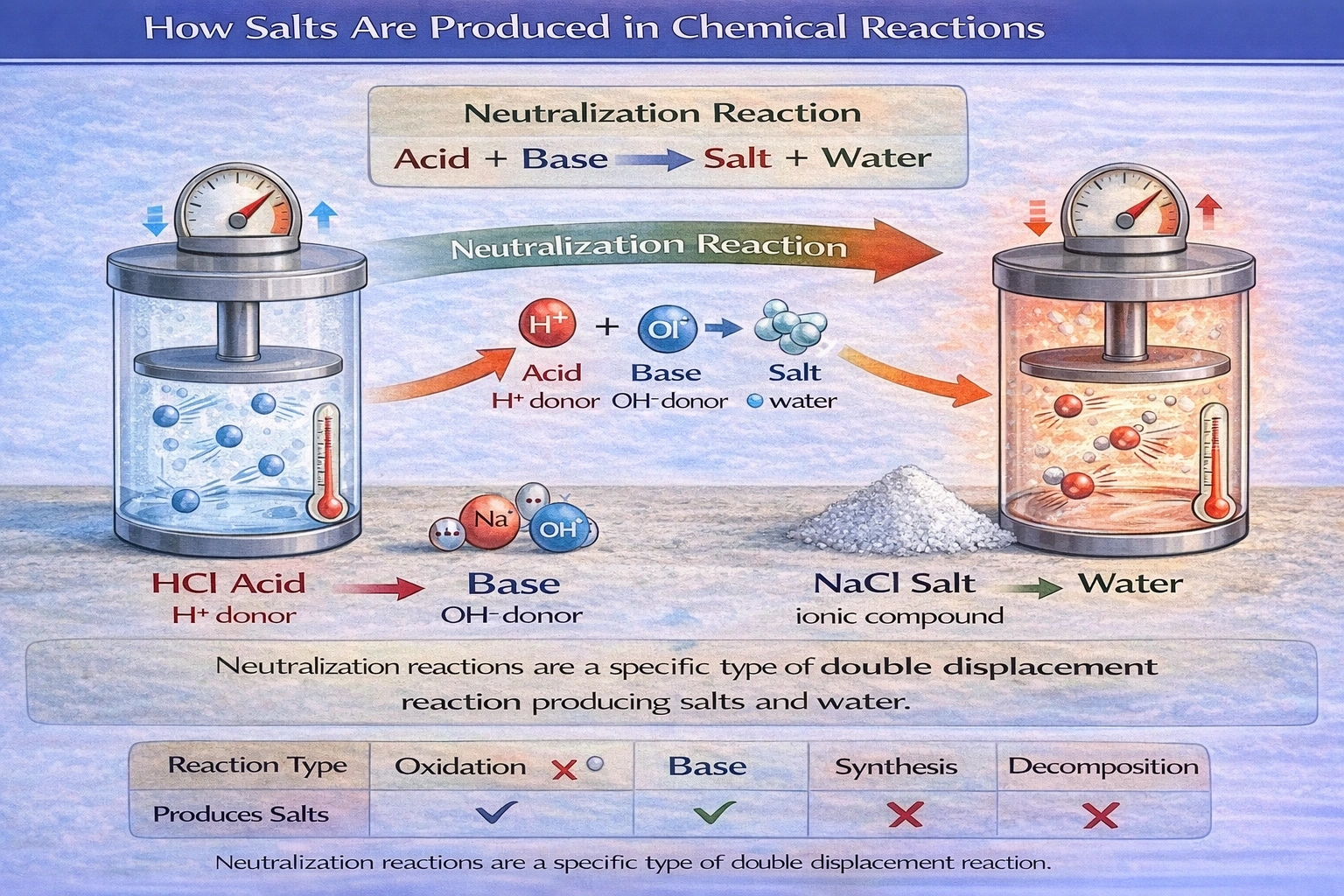
Neutralization reactions between acids and bases produce salts and water as characteristic products, following the general pattern acid + base → salt + water through proton transfer and ionic compound formation.
Neutralization represents a specific subclass of double displacement reactions where H⁺ ions from acids combine with OH⁻ ions from bases to form water, while remaining ions associate into ionic crystalline solids classified as salts—fundamental to acid-base chemistry and pH regulation.
A) An oxidation reaction
Oxidation reactions involve electron loss (increase in oxidation state) and typically produce oxides, not salts—though some oxidation processes may incidentally form salts (e.g., metal oxidation in acidic environments). Oxidation alone doesn't define salt production; many oxidation reactions yield gases (combustion producing CO₂) or elemental products without salt formation. Salt production isn't the defining characteristic of oxidation reactions.
B) A neutralization reaction
Classic neutralization: HCl(aq) + NaOH(aq) → NaCl(aq) + H₂O(l). The H⁺ from hydrochloric acid combines with OH⁻ from sodium hydroxide to form water, while Na⁺ and Cl⁻ ions associate into sodium chloride salt. This pattern generalizes: HNO₃ + KOH → KNO₃ + H₂O; H₂SO₄ + 2NH₃ → (NH₄)₂SO₄. Salts form as ionic compounds from cation-anion pairing after proton transfer neutralizes acidic and basic properties. This reaction type specifically defines salt production as a primary outcome.
C) A synthesis reaction
Synthesis (combination) reactions join simpler substances into complex products (A + B → AB). While some syntheses produce salts (2Na + Cl₂ → 2NaCl), many produce non-salt compounds (2H₂ + O₂ → 2H₂O; CaO + CO₂ → CaCO₃). Salt production isn't inherent to synthesis reactions—only specific elemental combinations yield salts. Synthesis describes reaction mechanism, not product type specificity.
D) A decomposition reaction
Decomposition breaks complex substances into simpler components (AB → A + B). Some decompositions yield salts as reactants breaking down (CaCO₃ → CaO + CO₂), but salts are starting materials rather than products. Decomposition typically produces elements or simpler compounds—not salts as characteristic products. Thermal decomposition of salts usually destroys rather than creates salt structures.
Conclusion:
Neutralization uniquely defines salt production as its characteristic outcome through acid-base proton transfer chemistry. While other reaction types may occasionally produce salts incidentally, neutralization consistently yields salts plus water as defining products across all acid-base combinations. This specificity makes neutralization the correct answer essential knowledge for predicting reaction products, understanding buffer systems, and managing pH in biological/environmental contexts where salt formation accompanies acid-base equilibration. Option B precisely identifies the reaction type whose fundamental purpose is salt generation through complementary acid and base interaction.