What is the bladder capacity of the average adult?
-
A
200 ml
-
B
500 ml
-
C
1,000 ml
-
D
800 ml
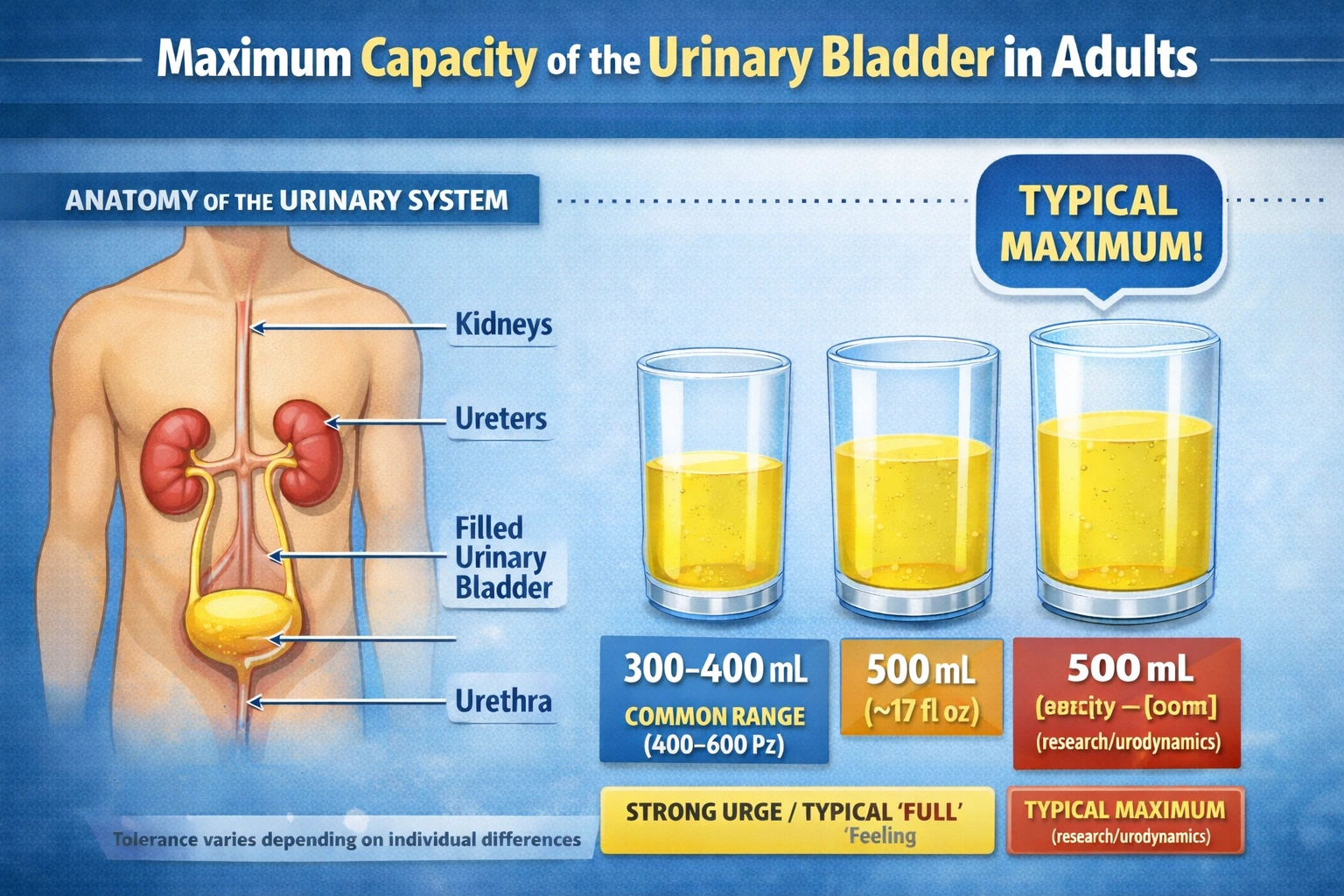
The bladder capacity of the average adult is about 500 milliliters.
The urinary bladder is a muscular, elastic organ designed to store urine until it can be conveniently expelled. In healthy adults, the bladder gradually stretches as it fills, and sensations of fullness increase as volume rises. Although the bladder can sometimes hold more, about 500 ml is considered the typical comfortable maximum capacity for most adults.
A) 200 ml
A volume of 200 ml is relatively small for an adult bladder capacity.
At around 150–300 ml, stretch receptors in the bladder wall begin to signal the brain, producing the first sensation of needing to urinate. This represents an early warning level rather than the bladder’s full storage capacity.
Therefore, while 200 ml may trigger the initial urge to void, it does not reflect the average total capacity of the bladder and is incorrect.
B) 500 ml
An average adult bladder can comfortably hold approximately 400–600 ml of urine, with 500 ml commonly cited as the standard reference value.
At this volume, most individuals experience a strong and persistent urge to urinate, but the bladder remains within a safe and functional range. This capacity reflects the bladder’s normal elasticity and ability to store urine without causing pain or tissue damage.
Because this value accurately represents typical adult bladder storage, this option is correct.
C) 1,000 ml
Although the bladder is capable of stretching significantly, a volume of 1,000 ml is well above normal capacity.
Reaching this level would usually cause marked discomfort, bladder wall strain, and potential risk of urinary retention complications. Such volumes may occur in rare clinical situations or in individuals with chronic retention, but they do not represent average physiology.
Therefore, this option is incorrect.
D) 800 ml
A capacity of 800 ml is higher than average.
Some individuals with unusually elastic bladders or altered sensation may retain this volume, but most adults experience intense urgency and discomfort well before reaching 800 ml. It exceeds the typical comfortable storage limit for the majority of people.
Thus, while possible in certain cases, it is not considered the average bladder capacity and is incorrect.
Conclusion:
The adult urinary bladder normally begins signaling fullness at around 200–300 ml and reaches strong urgency at about 400–500 ml. Although it can stretch further, 500 ml represents the typical average capacity for healthy adults.
Therefore, the correct answer is 500 ml.

Topic Flashcards
Click to FlipWhat is the name of the smooth muscle layer in the bladder wall that contracts during urination?
The detrusor muscle.
What is the term for the normal, involuntary voiding of urine during sleep in children under 5-6 years old?
Nocturnal enuresis (bedwetting).
What is the name of the reflex arc, controlled by the sacral spinal cord, that coordinates bladder emptying?
The micturition reflex.
Which two sphincters control the release of urine from the bladder?
The internal urethral sphincter (involuntary, smooth muscle) and the external urethral sphincter (voluntary, skeletal muscle).
What condition involves a sudden, strong urge to urinate, often with increased frequency, and may be associated with a reduced functional bladder capacity?
Overactive bladder (OAB) syndrome.