Which of these shows the correct order of the flow of waste through the large intestine
-
A
cecum, ascending colon, transverse colon, descending colon, sigmoid colon
-
B
ascending colon, descending colon, sigmoid colon, transverse colon, cecum
-
C
sigmoid colon, ascending colon, descending colon, transverse colon, cecum
-
D
cecum, ascending colon, descending colon, transverse colon, sigmoid colon
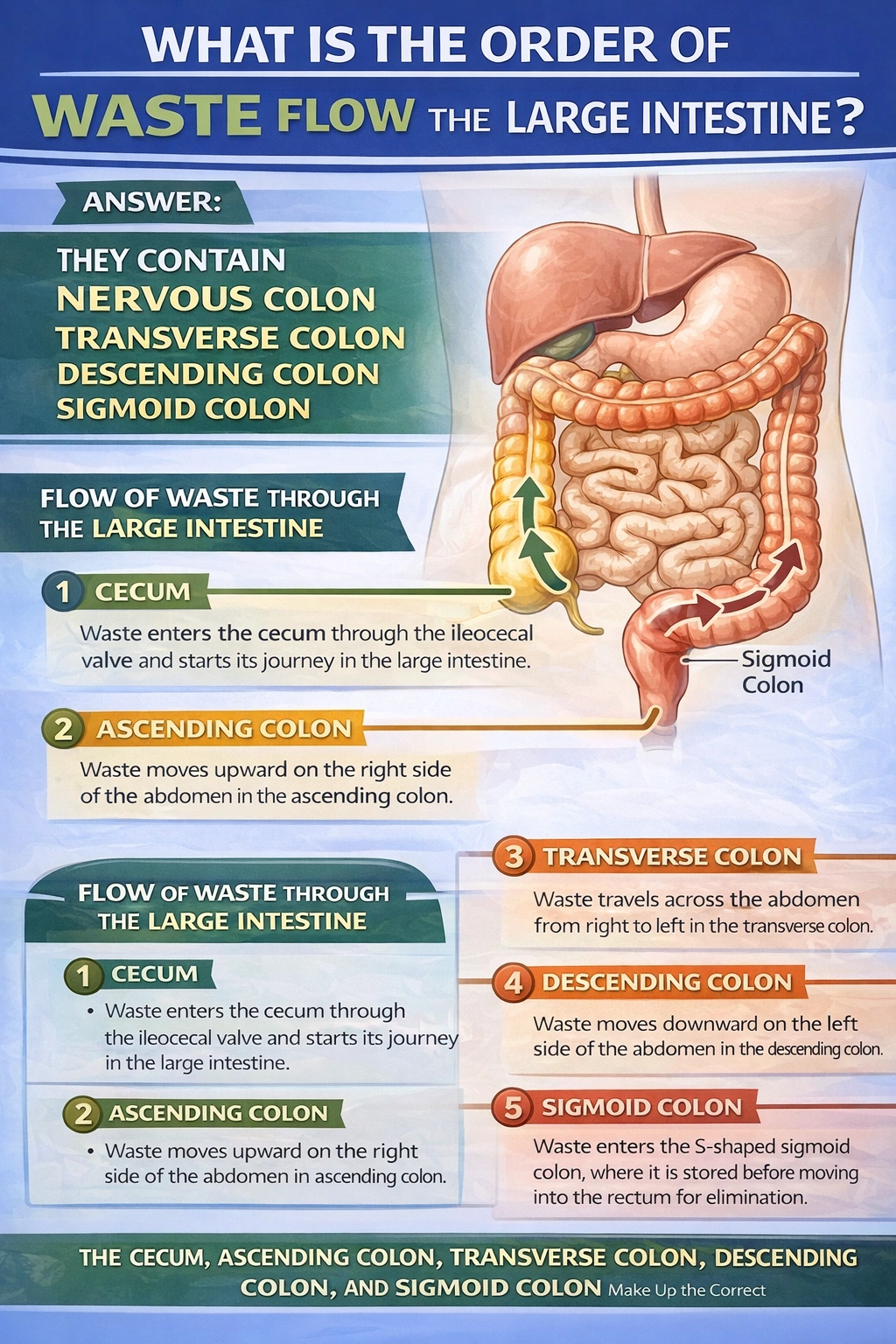
The correct order of waste flow through the large intestine is: cecum → ascending colon → transverse colon → descending colon → sigmoid colon.
The large intestine receives partially digested material from the small intestine and progressively absorbs water and electrolytes while compacting the remaining material into feces. This movement follows a fixed anatomical pathway that ensures efficient absorption and storage before elimination.
A) Cecum, ascending colon, transverse colon, descending colon, sigmoid colon
This sequence correctly reflects the anatomical and functional progression of waste through the large intestine.
Waste first enters the cecum, a pouch-like structure that receives material from the ileum via the ileocecal valve. From there, it moves upward into the ascending colon on the right side of the abdomen, where significant water and salt absorption begins.
Next, the waste passes into the transverse colon, which runs horizontally across the abdomen and continues the process of dehydration and compaction. It then enters the descending colon on the left side of the abdomen, where further water absorption occurs.
Finally, waste moves into the sigmoid colon, an S-shaped segment that serves as a storage area before feces pass into the rectum for elimination. Because this order accurately matches normal anatomy and physiology, this option is correct.
B) Ascending colon, descending colon, sigmoid colon, transverse colon, cecum
This sequence is incorrect because it does not begin with the cecum, which is the true entry point of the large intestine.
Additionally, it places the transverse colon after the sigmoid colon, which is anatomically inaccurate. The transverse colon should come between the ascending and descending colon, not near the end of the sequence. Therefore, this option does not represent the correct flow of waste.
C) Sigmoid colon, ascending colon, descending colon, transverse colon, cecum
This option is incorrect because it reverses the normal direction of waste movement.
The sigmoid colon is one of the final segments of the large intestine, not the starting point. Waste does not begin in the sigmoid colon, nor does it travel backward toward the cecum. The correct flow always begins at the cecum after material exits the small intestine.
D) Cecum, ascending colon, descending colon, transverse colon, sigmoid colon
Although this option correctly begins with the cecum and ascending colon, it incorrectly places the descending colon before the transverse colon.
Anatomically, waste must pass across the abdomen through the transverse colon before descending down the left side of the body. Placing the descending colon before the transverse colon disrupts the correct physical layout of the large intestine.
Conclusion:
The large intestine processes waste in a precise anatomical sequence that allows for gradual absorption of water and compaction of fecal material. This sequence begins in the cecum, continues through the ascending colon, transverse colon, and descending colon, and ends in the sigmoid colon.
Therefore, the correct order of waste flow through the large intestine is: cecum → ascending colon → transverse colon → descending colon → sigmoid colon.
Topic Flashcards
Click to FlipWhat is the name of the pouch-like structure that receives waste from the small intestine via the ileocecal valve?
The cecum.
Which part of the large intestine runs horizontally across the upper abdomen, from the right to left colic flexure?
The transverse colon.
What are the small, fat-filled pouches of visceral peritoneum that hang from the external surface of the large intestine?
Omental appendices (or epiploic appendages).
What is the name of the S-shaped final segment of the colon that stores feces before they move into the rectum?
The sigmoid colon.
What are the three longitudinal bands of smooth muscle that run along the length of the colon, causing it to form pouches called haustra?
The taeniae coli.