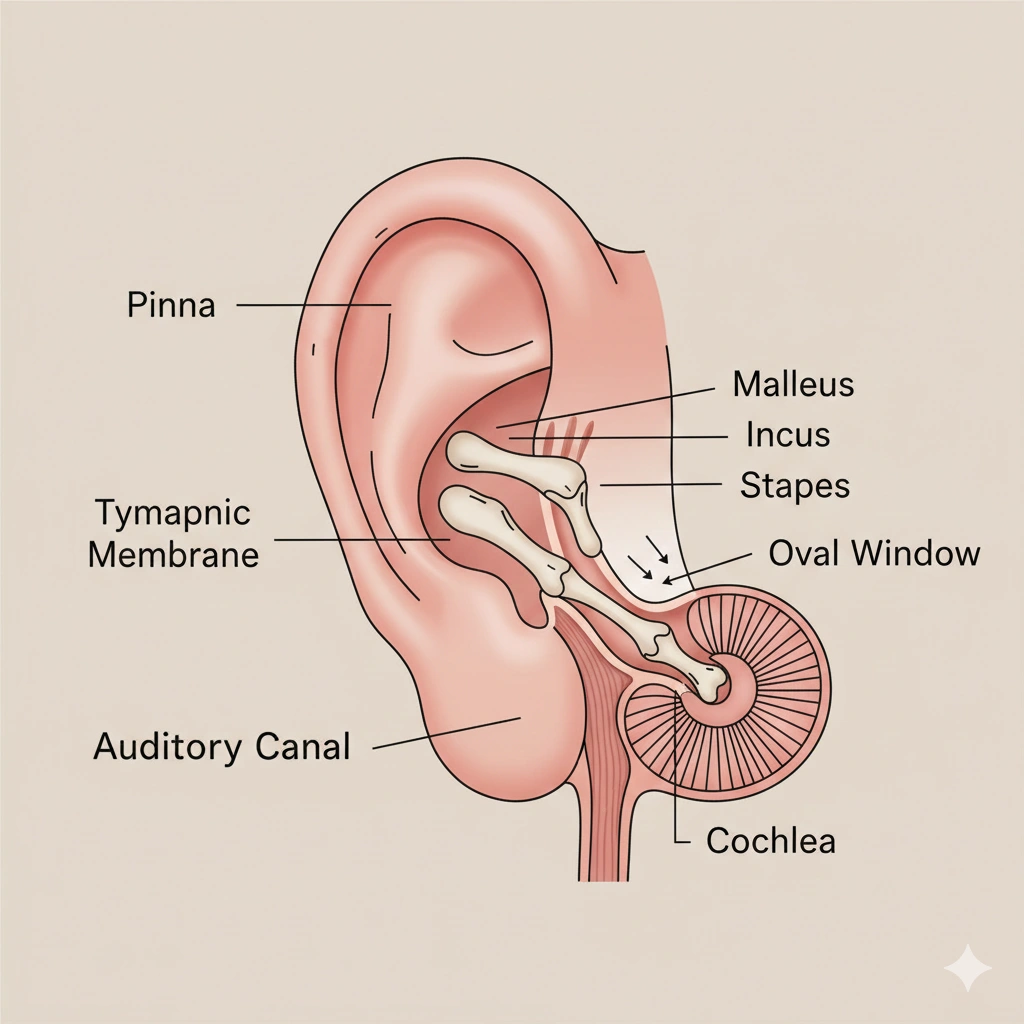
Which part of the human ear compresses sound waves and passes them to the inner ear?
-
A
Eardrum
-
B
Cochlea
-
C
Stirrup
-
D
Pinna
The eardrum compresses sound waves and passes them to the inner ear.
When sound waves enter the outer ear, they strike the eardrum (tympanic membrane), causing it to vibrate. These vibrations are then transmitted to the middle ear bones, which further amplify and pass the sound waves to the inner ear for processing.
A. Eardrum
This is the correct answer. The eardrum (tympanic membrane) vibrates in response to sound waves, compressing them and transmitting the vibrations to the ossicles (middle ear bones), which then pass the vibrations to the inner ear for further processing.
B. Cochlea
The cochlea is part of the inner ear, and its role is to convert sound vibrations into electrical signals that the brain can interpret. However, it does not compress sound waves. The compression of sound waves happens at the eardrum and middle ear bones.
C. Stirrup
The stirrup (stapes) is one of the ossicles in the middle ear. It helps transmit the vibrations from the eardrum to the inner ear but does not compress sound waves. Its function is more about amplifying and passing along the vibrations rather than compressing sound waves.
D. Pinna
The pinna is the outer part of the ear that helps funnel sound waves into the ear canal. It plays a role in collecting sound but does not compress or transmit sound waves to the inner ear. The pinna is involved in the directional hearing and amplification of sound, but it does not carry out the compression of sound waves.
Conclusion:
The eardrum is the part of the human ear that compresses sound waves and passes them to the inner ear, where the vibrations are processed for hearing. The other parts, such as the cochlea, stirrup, and pinna, play different roles in the hearing process but do not directly compress sound waves.

Topic Flashcards
Click to FlipWhich ear part vibrates when struck by sound waves and passes them forward?
Eardrum (tympanic membrane) compresses sound into mechanical vibrations that travel to the ossicles.
Which part of the ear acts as the boundary between outer and middle ear?
Eardrum seals the external auditory canal and vibrates to pass sound to the malleus.
What happens to the eardrum when loud sound waves arrive?
It vibrates more forcefully, passing stronger mechanical signals via ossicles to protect and stimulate the inner ear.
How does the eardrum differ from the cochlea in sound processing?
Eardrum mechanically compresses and transmits sound waves; cochlea converts those vibrations into electrical nerve impulses.
What protects the middle ear while allowing sound compression and passage?
Eardrum acts as a flexible, airtight membrane that vibrates to transfer sound without letting air or debris enter the middle ear.