Which organ system is primarily responsible for regulating muscle growth?
-
A
The skeletal system
-
B
The endocrine system
-
C
The nervous system
-
D
The reproductive system
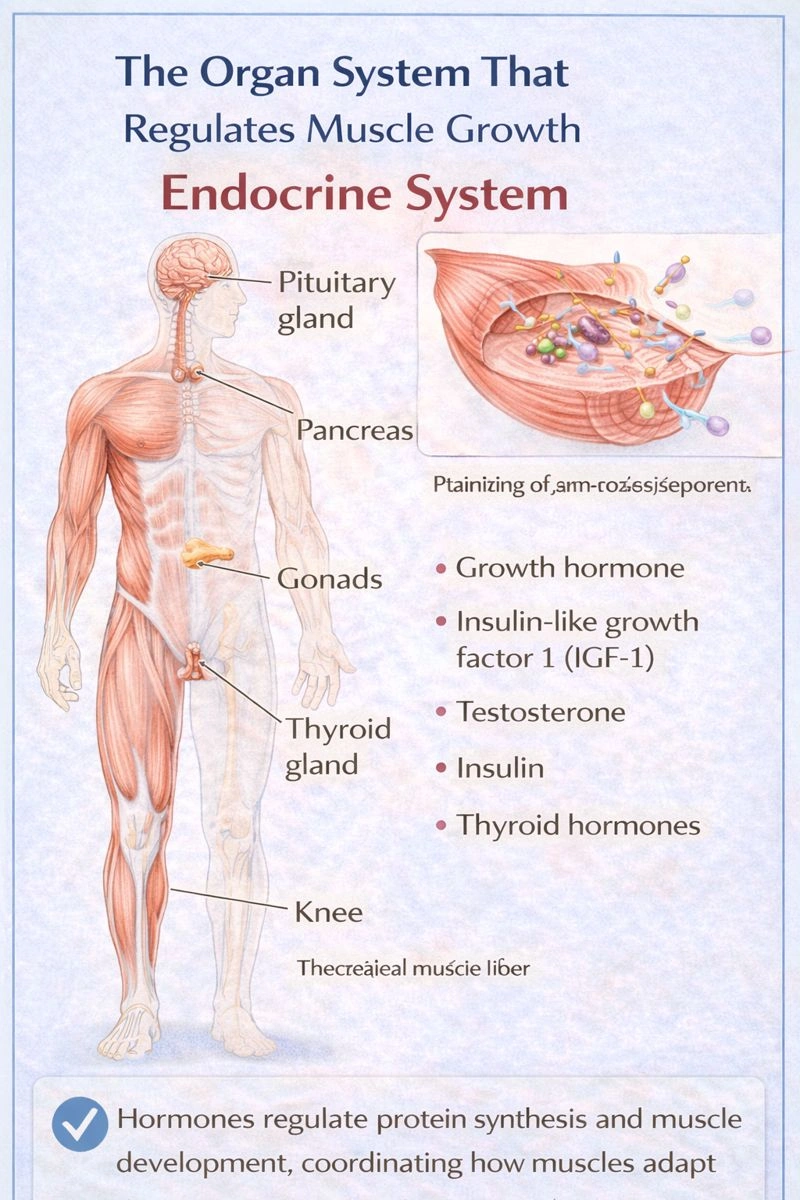
The organ system primarily responsible for regulating muscle growth is the endocrine system.
Muscle growth (hypertrophy and, to a lesser extent, hyperplasia) is controlled mainly by hormones that regulate protein synthesis, cell metabolism, nutrient uptake, and tissue repair. These hormonal signals coordinate how muscles adapt to exercise, injury, and developmental changes.
A) The skeletal system
The skeletal system provides the rigid framework of the body and serves as the attachment site for muscles via tendons. Bones act as levers that allow muscles to generate movement and also remodel in response to mechanical stress placed on them by muscle contraction.
However, bones do not control or regulate muscle growth at the cellular or biochemical level. They respond to muscle forces but do not initiate protein synthesis, cell division, or metabolic changes within muscle tissue. Therefore, the skeletal system is not the primary regulator of muscle growth.
B) The endocrine system
The endocrine system regulates muscle growth through the coordinated release of several key hormones, including:
- Growth hormone (GH), which stimulates protein synthesis and muscle cell growth
- Insulin-like growth factor 1 (IGF-1), which mediates many of GH’s effects directly in muscle tissue
- Testosterone, which increases protein synthesis and reduces protein breakdown
- Insulin, which promotes uptake of glucose and amino acids into muscle cells
- Thyroid hormones, which regulate overall metabolic rate and energy availability
These hormones determine how efficiently muscles repair after exercise, how much protein is built into muscle fibers, and how muscle mass changes over time. Because hormonal regulation is central to muscle development and maintenance, this option is correct.
C) The nervous system
The nervous system controls muscle contraction by transmitting electrical signals from motor neurons to muscle fibers. It regulates:
- Motor unit recruitment
- Muscle coordination
- Strength of contraction
- Reflex activity
While neural activity influences how muscles are used and can indirectly affect muscle size through training or disuse, it does not directly control the biochemical processes of protein synthesis and tissue growth. Denervation can cause muscle atrophy, but this is a secondary effect rather than true regulation of growth.
Therefore, this option is incorrect.
D) The reproductive system
The reproductive system produces sex hormones such as testosterone and estrogen, which do influence muscle mass and strength.
However, these hormones are only one part of the broader hormonal network involved in muscle growth. The reproductive system itself does not coordinate overall growth regulation; this function belongs to the endocrine system as a whole, which integrates signals from multiple glands.
Thus, this option is incomplete and incorrect.
Conclusion:
Muscle growth depends on hormonal control of protein synthesis, metabolism, nutrient uptake, and tissue repair. These regulatory processes are carried out by hormones released from endocrine glands such as the pituitary, pancreas, thyroid, and gonads.
Although the skeletal system provides structure, the nervous system controls contraction, and the reproductive system contributes some hormones, the endocrine system is the primary regulator of muscle growth.
- Therefore, the correct answer is the endocrine system..

Topic Flashcards
Click to FlipWhich hormone, released by the anterior pituitary gland, directly stimulates protein synthesis and muscle cell growth?
Growth hormone (GH).
What is the primary hormone produced in the liver (and locally in muscle) that mediates many of the growth-promoting effects of GH?
Insulin-like Growth Factor-1 (IGF-1).
Which androgen hormone, produced primarily in the testes (and in smaller amounts in the ovaries/adrenals), significantly increases muscle protein synthesis?
Testosterone.
How does the hormone insulin support muscle growth beyond its role in blood sugar regulation?
It promotes the uptake of glucose and amino acids into muscle cells, providing energy and building blocks for protein synthesis.
What condition results from the overproduction of growth hormone in adulthood, leading to abnormal growth of bones and soft tissues, including organs?
Acromegaly