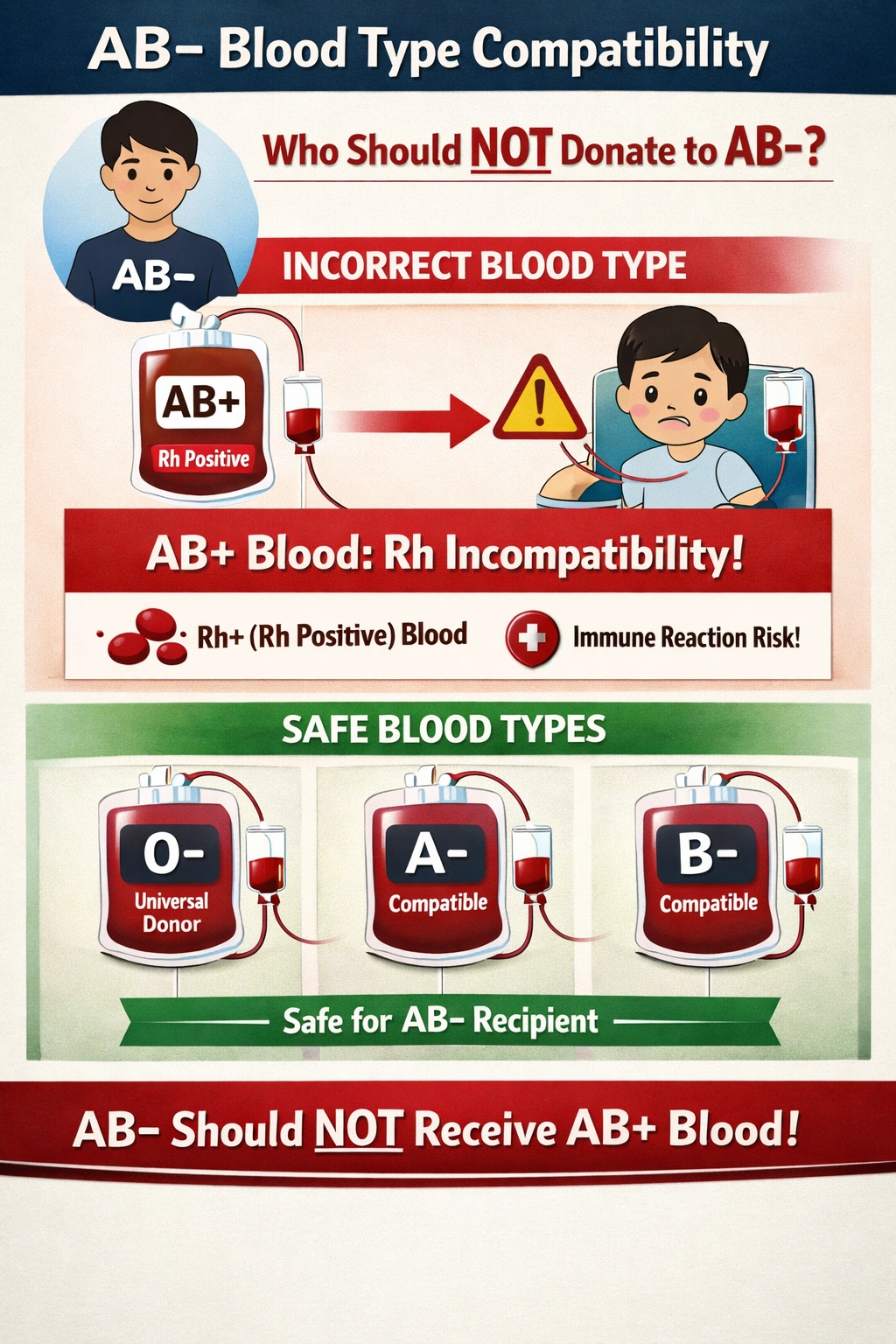
A person with AB- blood should not receive blood from which other blood type?
-
A
AB+
-
B
O
-
C
A
-
D
B
A person with AB− blood should not receive blood from AB+ donors.
Individuals with AB− blood have both A and B antigens on their red blood cells but lack the Rh (D) antigen. This means they can accept blood containing A and/or B antigens without an ABO incompatibility reaction. However, because they are Rh-negative, they must not receive Rh-positive blood. Exposure to the Rh antigen can stimulate antibody production and lead to dangerous transfusion reactions, especially with repeated exposure.
A) AB+
A person with AB− blood has both A and B antigens on their red blood cells, so receiving blood with A and B antigens does not pose a problem within the ABO system. However, AB+ blood contains the Rh antigen, which is absent in AB− individuals.
When an Rh-negative person receives Rh-positive blood, their immune system may recognize the Rh antigen as foreign and begin producing anti-Rh antibodies. This immune response can cause hemolysis of transfused red blood cells and may lead to serious complications such as fever, kidney failure, shock, or even death. Additionally, future transfusions become more dangerous once sensitization occurs.
For this reason, AB+ blood is incompatible with AB− recipients and should not be given.
B) O−
O− blood contains no A antigens, no B antigens, and no Rh antigen. Because of this, it is considered the universal donor type for red blood cells.
A person with AB− blood can safely receive O− blood because there are no antigens present that would trigger an immune response. There is no ABO incompatibility and no Rh incompatibility. Therefore, O− blood is safe and appropriate for AB− recipients.
C) A−
A− blood contains the A antigen and lacks the Rh antigen. A person with AB− blood already has the A antigen, so there is no ABO conflict.
Because both donor and recipient are Rh-negative, there is also no Rh incompatibility. This makes A− blood compatible and safe for individuals with AB− blood.
D) B−
B− blood contains the B antigen and does not contain the Rh antigen. Since individuals with AB− blood possess both A and B antigens, the presence of the B antigen does not cause a reaction.
The absence of the Rh antigen further ensures compatibility. Therefore, B− blood is also safe for AB− recipients.
Conclusion:
People with AB− blood can receive blood from O−, A−, B−, and AB− donors because these types do not introduce incompatible ABO antigens or the Rh antigen. However, AB+ blood contains the Rh antigen, which can trigger antibody formation and dangerous transfusion reactions in Rh-negative individuals.
For this reason, a person with AB− blood should not receive blood from an AB+ donor.

Topic Flashcards
Click to FlipWhat are the proteins found on the surface of red blood cells that determine blood type called?
Antigens (or agglutinogens).
What is the name of the condition where an Rh-negative mother produces antibodies that attack her Rh-positive fetus's red blood cells?
Hemolytic Disease of the Newborn (HDN) or Erythroblastosis Fetalis.
Which blood type is considered the "universal recipient" for red blood cell transfusions and why?
AB+; because it has A, B, and Rh antigens, so it will not produce anti-A, anti-B, or anti-Rh antibodies against any donated blood.
What treatment is given to an Rh-negative mother after delivering an Rh-positive baby to prevent sensitization?
Rh immunoglobulin (RhoGAM).
In an emergency when the recipient's blood type is unknown, which blood type is typically used for transfusion?
O negative (O-).