Which blood type is regarded as the common donor?
-
A
AB
-
B
O
-
C
O+
-
D
AB+
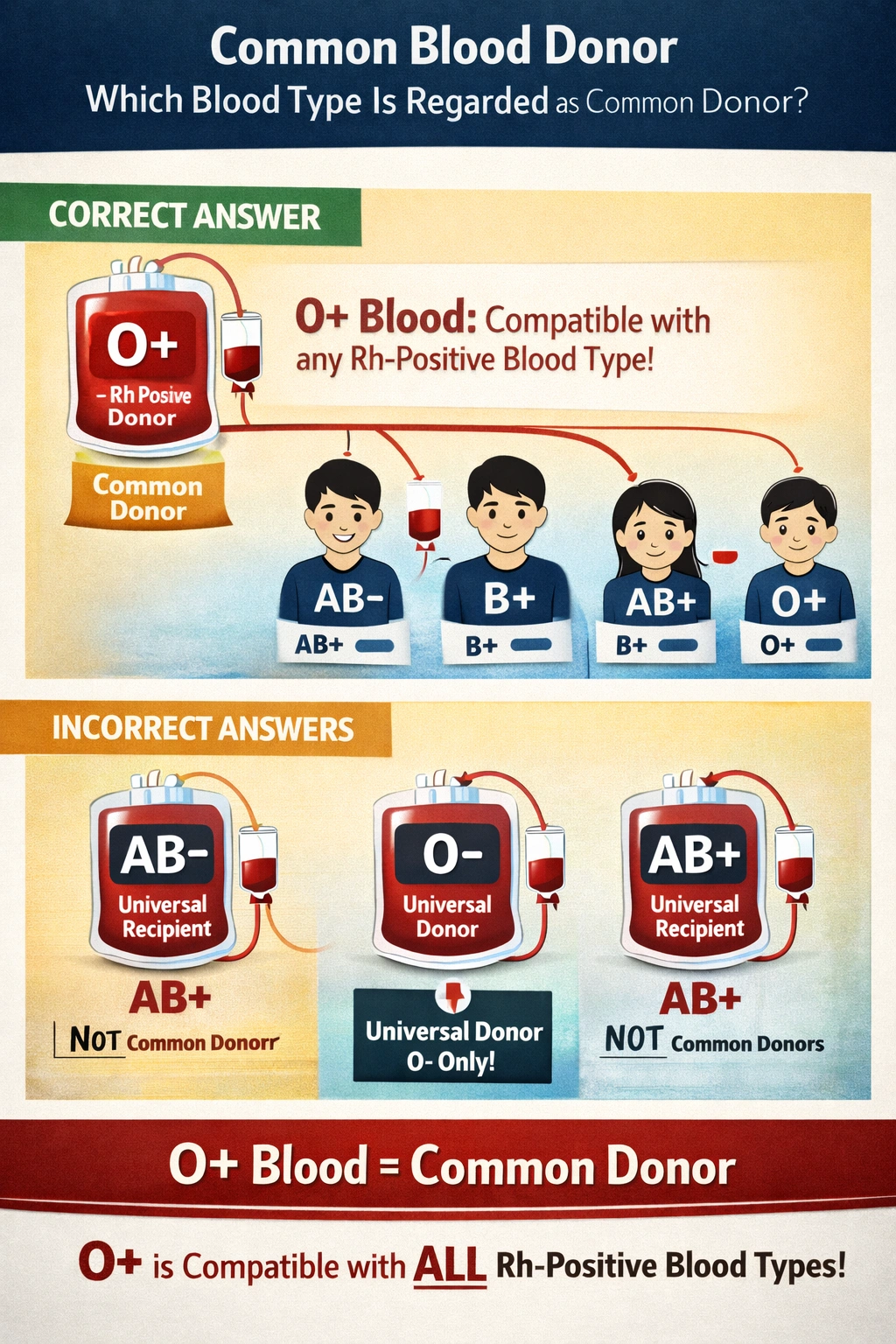
The blood type regarded as the common donor is O+.
In blood transfusion practice, the term “common donor” refers to a blood type that can be safely given to a large proportion of the population. This is different from the “universal donor,” which is strictly O−. Because most people are Rh-positive, O+ blood can be transfused to many patients of different ABO groups, making it the most frequently used donor type in hospitals and emergency settings.
A) AB
AB blood type is known as the universal recipient within the ABO blood group system, not a universal or common donor. Individuals with AB blood have both A and B antigens on their red blood cells, which means their immune systems do not produce antibodies against A or B antigens.
However, because AB blood contains both A and B antigens, it cannot be safely transfused to individuals with type A, type B, or type O blood, as this would trigger an immune reaction. For this reason, AB blood is poorly suited for donation to the general population and is not considered a common donor type.
B) O
Blood type O lacks both A and B antigens. When combined with Rh negativity (O−), it becomes the true universal donor because it can be given to people of all ABO and Rh types.
However, not all type O blood is universally compatible. O+ blood contains the Rh antigen and therefore cannot be given to Rh-negative individuals. Since the option simply states “O” without specifying Rh factor, it is incomplete and does not accurately describe the blood type regarded as the common donor in clinical practice.
C) O+
O+ blood contains no A or B antigens but does contain the Rh antigen. Because of this, it can be safely transfused to individuals who are Rh-positive, regardless of whether they are type A, B, AB, or O.
Since the majority of the population is Rh-positive, O+ blood can be used for a very large percentage of patients. Hospitals rely heavily on O+ donors because this blood type is both common in the population and widely compatible.
Although O+ is not the universal donor (that role belongs to O−), it is regarded as the common donor due to its broad usability and frequent demand in transfusion medicine.
D) AB+
AB+ blood type is the universal recipient, meaning individuals with this type can receive blood from any ABO group and either Rh type without an immune reaction.
However, AB+ blood contains A antigens, B antigens, and the Rh antigen, making it incompatible with most recipients. It can only be safely given to other AB+ individuals. As a result, AB+ blood is not suitable for widespread donation and is not considered a common donor type.
Conclusion:
A common donor blood type is one that can be safely transfused to a large portion of the population. While O− is the universal donor, O+ is the most widely usable blood type in everyday clinical practice because it is compatible with all Rh-positive patients across all ABO groups.
For this reason, O+ is regarded as the common donor blood type.
Topic Flashcards
Click to FlipWhat percentage of the U.S. population is estimated to have O+ blood type?
Approximately 38% (making it the most common blood type).
In addition to O+, which other blood type is critical for hospitals to maintain in supply because it is the universal donor for red blood cells?
O negative (O-).
What is the term for the lab test that confirms compatibility between donor blood and recipient blood before a transfusion?
Crossmatching
Which blood component (e.g., red cells, plasma, platelets) from an AB+ donor is considered the "universal donor" component?
Plasma (AB+ plasma lacks anti-A and anti-B antibodies and can be given to patients of any blood type).
What is the name of the rare blood type that lacks all Rh antigens (Rh-null) and can be donated to anyone with a rare Rh deficiency, but can only receive blood from another Rh-null donor?
Golden blood (Rh-null blood).