Ligaments connect ____.
-
A
bone to bone
-
B
muscle to muscle
-
C
tendon to bone
-
D
muscle to bone
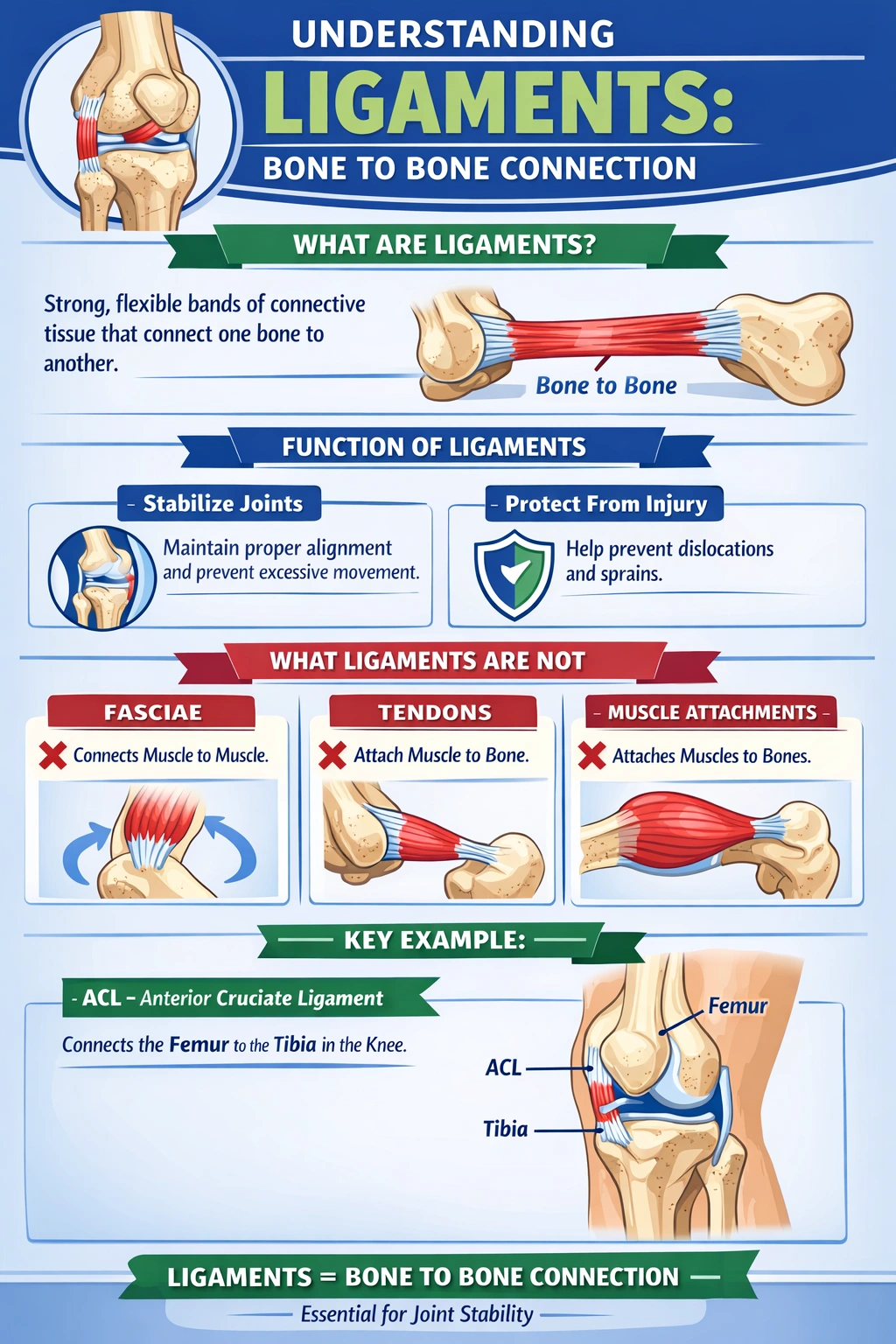
Ligaments connect bone to bone.
Ligaments are strong bands of dense connective tissue that play a critical role in stabilizing joints. They hold bones together, guide joint motion, and prevent excessive or abnormal movement that could result in injury. Without ligaments, joints would be unstable and prone to dislocation.
A) Bone to bone
Ligaments are specifically designed to connect one bone to another at a joint. Their fibers are arranged in a way that provides both strength and limited flexibility, allowing normal movement while maintaining structural integrity.
For example, in the knee joint, the anterior cruciate ligament (ACL) connects the femur to the tibia and helps control forward movement and rotation of the leg. Similar stabilizing ligaments exist in the shoulder, ankle, elbow, and spine.
By holding bones in proper alignment and resisting excessive motion, ligaments protect joints from damage and ensure smooth, coordinated movement. This makes this option correct.
B) Muscle to muscle
Muscles are not connected to one another by ligaments. While muscles may lie adjacent to each other and function together in groups, they are separated and supported by connective tissues called fascia.
Fascia surrounds individual muscles and muscle groups, allowing them to move smoothly relative to each other. However, it does not perform the joint-stabilizing function characteristic of ligaments. Because ligaments do not connect muscles to other muscles, this option is incorrect.
C) Tendon to bone
Tendons and ligaments are often confused because both are made of dense connective tissue, but they serve different purposes.
Tendons connect muscle to bone and transmit the force generated by muscle contraction to produce movement. A common example is the Achilles tendon, which connects the calf muscles to the heel bone.
Ligaments, in contrast, do not attach to muscles and do not generate movement. Their role is stabilization, not force transmission. Therefore, this option is incorrect.
D) Muscle to bone
Muscle-to-bone connections are formed by tendons, not ligaments.
Tendons anchor muscles to bones so that muscle contraction can move the skeleton. Ligaments, however, connect bones to other bones to support joints. Because this option describes the function of tendons rather than ligaments, it is incorrect.
Conclusion:
Ligaments are specialized connective tissues whose primary function is to stabilize joints by linking bones together. They do not connect muscles to bones or muscles to other muscles, and they are distinct from tendons in both structure and function.
Therefore, ligaments connect bone to bone.
Topic Flashcards
Click to FlipWhat is the primary structural protein that makes ligaments strong and slightly elastic?
Collagen (primarily Type I collagen).
What is the name of the ligament that stabilizes the knee by preventing forward displacement of the tibia relative to the femur?
The Anterior Cruciate Ligament (ACL).
What term describes an injury where a ligament is stretched or torn?
A sprain.
What is the name of the ligament that holds the radial head in place at the elbow, allowing supination and pronation?
The annular ligament.
What are the thick bands of connective tissue that form sheet-like structures to hold muscles and organs in place?
Fascia.