Chocolate cysts of the ovaries are attributed to ____
-
A
Menorrhagia
-
B
Endometriosis
-
C
pelvic inflammatory disease
-
D
ectopic pregnancy
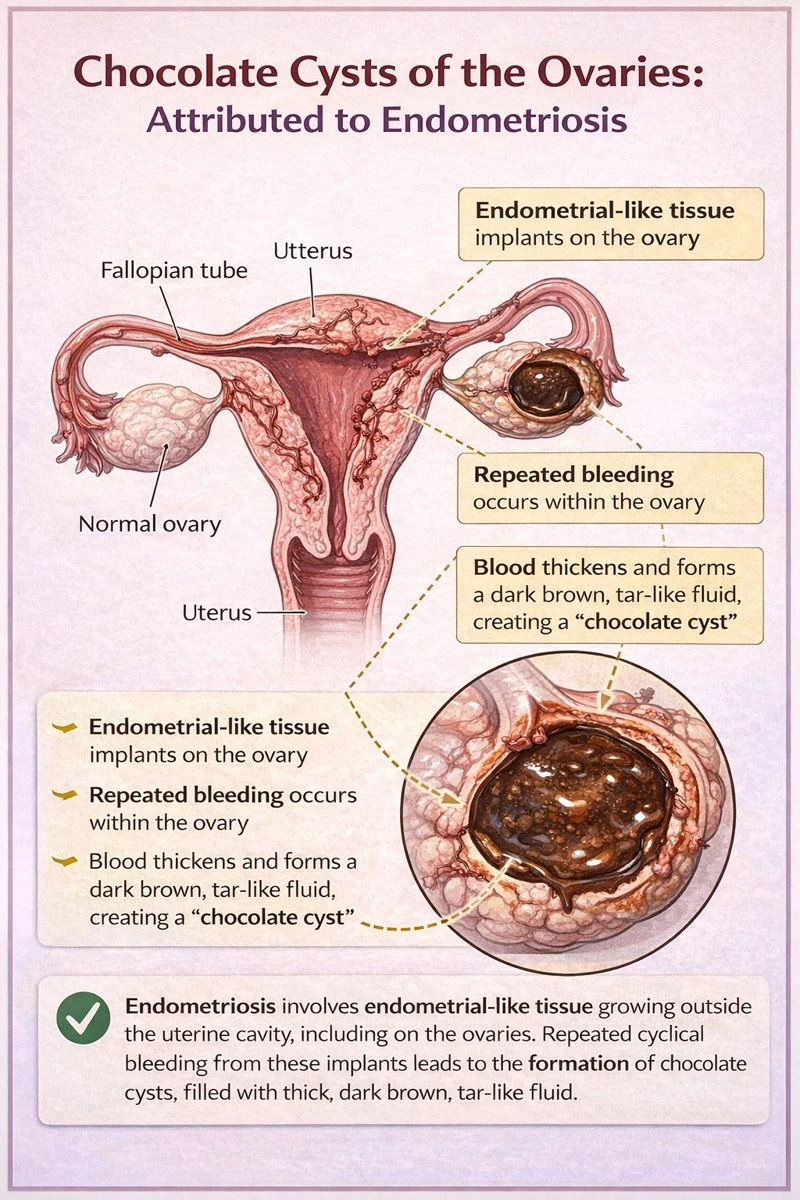
Chocolate cysts of the ovaries are attributed to endometriosis.
Chocolate cysts, medically termed ovarian endometriomas, develop when endometrial-like tissue implants on the ovary and undergoes repeated cyclical bleeding. Over time, the trapped blood breaks down and thickens, forming a dark brown, tar-like fluid that gives these cysts their characteristic “chocolate” appearance. This process is a direct consequence of endometriosis and reflects its chronic, hormone-dependent nature.
A) Menorrhagia
Menorrhagia refers to abnormally heavy or prolonged menstrual bleeding from the uterus. It is a symptom or clinical finding rather than a disease process that causes structural ovarian pathology.
Although menorrhagia may occur in individuals with endometriosis due to hormonal imbalance or uterine involvement, it does not produce ovarian cysts by itself. It represents excessive shedding of the uterine lining, not implantation of endometrial tissue outside the uterus. Therefore, menorrhagia is not responsible for the formation of chocolate cysts.
B) Endometriosis
Endometriosis is a disorder in which tissue similar to the endometrium grows outside the uterine cavity, commonly on the ovaries, fallopian tubes, pelvic peritoneum, and uterosacral ligaments.
When this ectopic endometrial tissue implants on the ovary, it responds to monthly hormonal changes just like normal uterine lining. Repeated bleeding occurs within the confined ovarian space, leading to accumulation of old blood and gradual cyst formation. Over time, this blood becomes thick, dark, and oxidized, producing the classic chocolate-colored fluid.
These cysts are called endometriomas and are strongly associated with chronic pelvic pain, dysmenorrhea, dyspareunia, and infertility. Because this mechanism is unique to endometriosis, it is the correct explanation for chocolate cyst formation.
C) Pelvic inflammatory disease (PID)
Pelvic inflammatory disease is an infection of the female reproductive organs, most often caused by ascending bacterial infections such as Chlamydia trachomatis or Neisseria gonorrhoeae.
PID can result in tubal scarring, adhesions, chronic pelvic pain, and infertility. While it may cause inflammatory masses or tubo-ovarian abscesses, it does not cause the repeated cyclical bleeding and hemosiderin accumulation that characterize chocolate cysts. Therefore, PID is not the cause of ovarian endometriomas.
D) Ectopic pregnancy
An ectopic pregnancy occurs when a fertilized ovum implants outside the uterine cavity, most commonly in the fallopian tube.
This condition is an acute obstetric emergency associated with internal bleeding and rupture, but it does not involve chronic implantation of endometrial tissue on the ovaries or formation of cystic blood collections. Its pathophysiology is unrelated to endometrioma development. Thus, it is not responsible for chocolate cysts.
Conclusion:
Chocolate cysts, or ovarian endometriosis, result from repeated bleeding of endometrial-like tissue implanted on the ovaries. Menorrhagia is a menstrual symptom, PID is an infectious condition, and ectopic pregnancy is an abnormal implantation of an embryo. Only endometriosis directly causes the pathological process that leads to these characteristic cysts.
For this reason, chocolate cysts of the ovaries are attributed to endometriosis.
Topic Flashcards
Click to FlipWhat is the medical term for a "chocolate cyst" found on the ovary?
An endometrioma.
What is the name of the phenomenon where endometrial tissue is found outside the uterine cavity, causing pain and infertility?
Endometriosis.
What are the two most common symptoms associated with ovarian endometriomas?
Chronic pelvic pain (especially cyclical) and dysmenorrhea (painful periods). Infertility is also a major association.
During what phase of the menstrual cycle do endometriomas typically cause pain, and why?
The menstrual phase; because the ectopic endometrial tissue bleeds in response to hormonal withdrawal, causing inflammation and stretching of the ovarian capsule.
What is the name of the surgical procedure often used to diagnose and potentially treat endometriosis and associated cysts?
Laparoscopy.