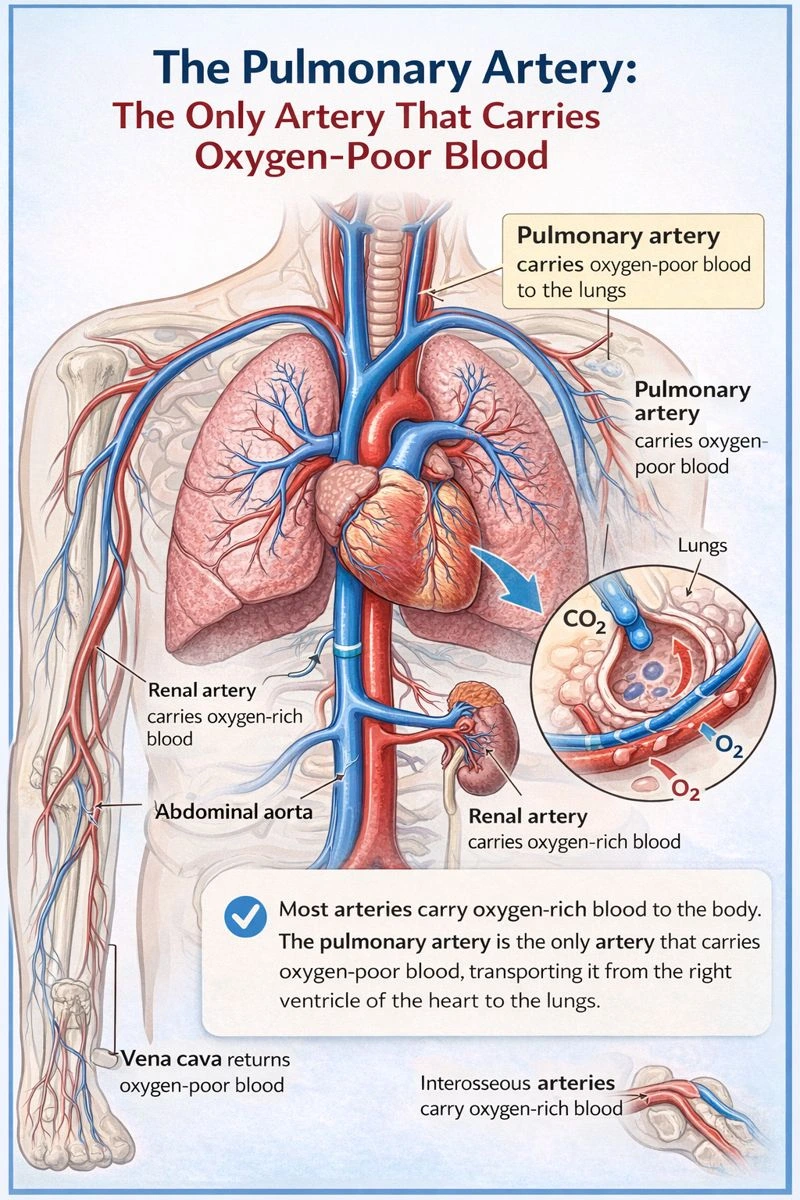
What is the only artery in the body to carry oxygen-poor blood
-
A
renal artery
-
B
interosseous artery
-
C
pulmonary artery
-
D
vena cava
The only artery in the body that carries oxygen-poor blood is the pulmonary artery.
In the circulatory system, arteries are generally defined as blood vessels that carry blood away from the heart, and in most cases, this blood is rich in oxygen. However, there is one important exception. The pulmonary artery carries deoxygenated blood from the right side of the heart to the lungs, where gas exchange occurs and the blood becomes oxygenated. This unique role makes it the only artery that transports oxygen-poor blood.
A) Renal artery
The renal artery branches from the abdominal aorta and supplies blood to the kidneys. Its primary function is to deliver oxygen and nutrients to kidney tissue so that filtration of waste products and regulation of fluid and electrolytes can occur.
Because the renal artery originates from the systemic circulation after blood has already been oxygenated in the lungs, it carries oxygen-rich blood. It does not transport oxygen-poor blood under normal physiological conditions. Therefore, this option is incorrect.
B) Interosseous artery
Interosseous arteries are branches found in the limbs, particularly in the forearm and lower leg, where they supply blood to bones, muscles, and surrounding connective tissue.
Like most systemic arteries, they carry oxygen-rich blood that has already passed through the lungs. Their role is to nourish tissues and support metabolic activity, not to transport blood to the lungs for oxygenation. As a result, this option is incorrect.
C) Pulmonary artery
The pulmonary artery arises from the right ventricle of the heart and carries blood directly to the lungs. This blood is oxygen-poor because it has already delivered oxygen to body tissues and now contains a high concentration of carbon dioxide.
In the lungs, the blood releases carbon dioxide and absorbs oxygen across the alveolar-capillary membrane. After this process, the newly oxygenated blood returns to the heart via the pulmonary veins.
This makes the pulmonary artery unique: it is an artery by definition because it carries blood away from the heart, yet it transports deoxygenated blood. For this reason, it is the correct answer.
D) Vena cava
The vena cava, consisting of the superior and inferior vena cava, is a vein, not an artery. It returns oxygen-poor blood from the body back to the right atrium of the heart.
Although it does carry deoxygenated blood, it does not meet the criteria of the question because it is part of the venous system and does not carry blood away from the heart. Therefore, it is not the correct answer.
Conclusion:
Most arteries carry oxygen-rich blood to body tissues, while veins return oxygen-poor blood to the heart. The pulmonary artery is the sole exception to this rule, as it carries deoxygenated blood from the right ventricle to the lungs for oxygenation.
For this reason, the pulmonary artery is the only artery in the body that carries oxygen-poor blood.
Topic Flashcards
Click to FlipWhat is the only vein in the body that carries oxygen-rich blood?
The pulmonary vein (carries blood from the lungs to the left atrium).
In fetal circulation, which artery carries oxygen-poor blood and waste products from the fetus to the placenta?
The umbilical artery (there are two, but they are arteries carrying deoxygenated blood—another exception).
What is the name of the circulation loop that carries blood from the heart to the lungs and back?
The pulmonary circulation
Which chamber of the heart pumps blood into the pulmonary artery?
The right ventricle.
What unique structural feature do the pulmonary arteries have compared to systemic arteries of similar size, due to the lower pressure in the pulmonary circuit?
They have thinner, more elastic walls.