Which is not true of synovial joints?
-
A
They are the most common joint in the body.
-
B
They are found in the intervertebral discs of the spinal column
-
C
They are the most movable joint type in the body.
-
D
They have a fluid-filled capsule that surrounds their articulating surface.
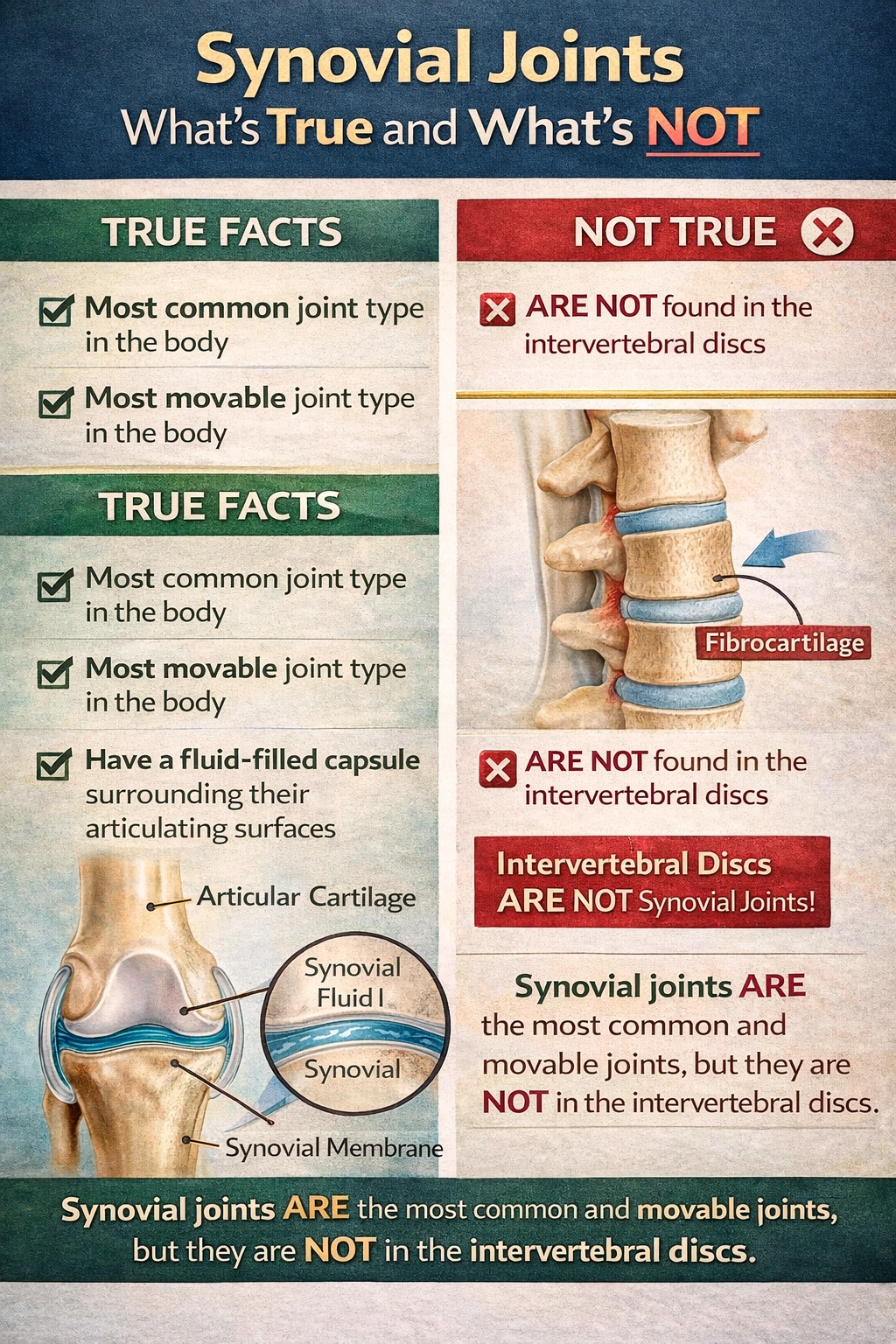
Synovial joints are not found in the intervertebral discs of the spinal column.
Synovial joints are specialized joints designed to permit free movement between bones. They possess a unique structural organization that includes a synovial cavity, articular cartilage, and a fluid-filled capsule, allowing smooth and extensive motion. However, not all joints in the body belong to this category, and the joints between vertebral bodies are a key exception.
A) They are the most common joint in the body
This statement is true.
Synovial joints are the most prevalent type of joint in the human body. They are found in major regions such as the knees, hips, shoulders, elbows, wrists, ankles, and fingers. Their defining feature is the presence of a synovial cavity filled with synovial fluid, which reduces friction and facilitates smooth movement.
Because daily activities such as walking, grasping, bending, and lifting depend heavily on movable joints, synovial joints dominate the skeletal system. Their structural design supports both mobility and mechanical efficiency, making them the most widespread joint type.
B) They are found in the intervertebral discs of the spinal column
This statement is not true.
Intervertebral discs form cartilaginous joints, specifically a subtype called symphyses. These joints consist of fibrocartilage connecting adjacent vertebral bodies, providing both stability and limited flexibility while absorbing shock during movement.
Unlike synovial joints, intervertebral disc joints do not contain a synovial cavity, do not have a synovial membrane, and do not contain synovial fluid. Their purpose is primarily structural support and controlled flexibility rather than free motion.
Because intervertebral discs are cartilaginous joints rather than synovial joints, this statement is incorrect.
C) They are the most moveable joint type in the body
This statement is true.
Synovial joints allow the greatest range of motion of all joint types. Their structural components permit movements such as flexion, extension, rotation, abduction, adduction, and circumduction.
Different subtypes of synovial joints allow varying degrees of motion. Hinge joints permit movement in one plane, pivot joints allow rotation, and ball-and-socket joints allow movement in multiple directions. This high mobility distinguishes synovial joints from fibrous joints, which allow little to no movement, and cartilaginous joints, which allow only limited movement.
D) They have a fluid-filled capsule that surrounds their articulating surface
This statement is true.
One of the hallmark characteristics of synovial joints is the presence of a joint capsule composed of an outer fibrous layer and an inner synovial membrane. The synovial membrane secretes synovial fluid into the joint cavity.
This fluid lubricates the joint, reduces friction, nourishes the articular cartilage, and absorbs shock. The capsule encloses and stabilizes the joint while still permitting motion, making it essential for normal joint function.
Conclusion:
Synovial joints are the most common and most movable joints in the human body and are defined by the presence of a fluid-filled joint capsule and synovial cavity. These features allow for smooth and extensive motion.
Intervertebral discs, however, form cartilaginous joints rather than synovial joints and lack a synovial cavity entirely. Therefore, the statement that synovial joints are found in the intervertebral discs of the spinal column is not true, making option B the correct answer.
Topic Flashcards
Click to FlipWhat are the three main structural classifications of joints in the body?
Fibrous, cartilaginous, and synovial joints
What is the primary function of synovial fluid within a synovial joint?
To lubricate the joint, reduce friction, nourish articular cartilage, and absorb shock
Which type of synovial joint allows motion primarily in one plane (e.g., elbow, knee)?
A hinge joint.
What is the name of the smooth, white tissue that covers the ends of bones in a synovial joint?
Articular cartilage.
What type of joint (structural and functional) is a suture in the skull?
Structurally fibrous, functionally a synarthrosis (immovable).