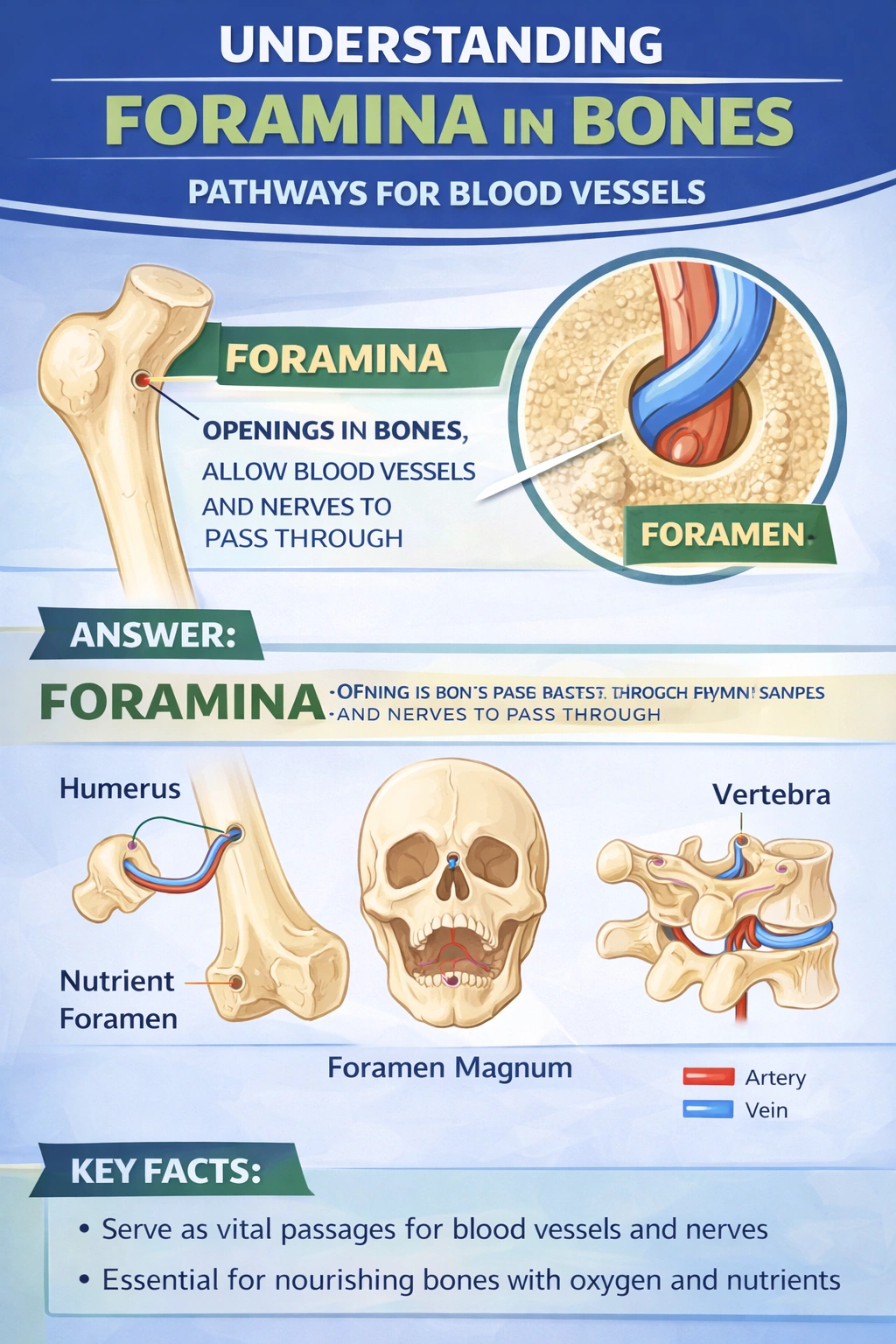
Blood vessels enter and exit bones through ____.
-
A
Fovea
-
B
Fossa
-
C
Facets
-
D
Foramina
Blood vessels enter and exit bones through foramina.
Bones are living tissues that require a constant supply of oxygen and nutrients and the removal of metabolic waste. To support this, blood vessels must be able to pass into and out of bone tissue. This is made possible by specialized openings in the bone structure known as foramina, which serve as passageways for blood vessels and nerves.
A) Fovea
A fovea is a small, shallow depression or pit found in a bone or other anatomical structure. One well-known example is the fovea capitis on the head of the femur, where a ligament attaches.
Foveae are generally associated with attachment points or minor surface features and do not function as channels for blood vessels or nerves to travel through bone. They do not provide a route for vascular entry or exit. Therefore, this option is incorrect.
B) Fossa
A fossa is a shallow depression or hollow in a bone. Fossae often serve as sites for muscle attachment or as surfaces that participate in forming joints, such as the mandibular fossa of the temporal bone.
While fossae are important for skeletal structure and articulation, they are not designed to transmit blood vessels through bone tissue. They do not penetrate bone or act as internal passageways. For this reason, this option is incorrect.
C) Facets
Facets are smooth, flat or slightly curved surfaces found on bones, especially vertebrae, where they form joints with adjacent bones.
Their primary function is to allow controlled movement and stability between articulating bones. Facets are not openings and do not permit the passage of blood vessels or nerves into or out of bone tissue. Therefore, this option is incorrect.
D) Foramina
Foramina are natural openings or holes in bones that allow blood vessels, nerves, and other structures to pass through.
These openings are essential for supplying bones with oxygen and nutrients and for removing waste products. Examples include the nutrient foramina in long bones, which allow arteries to enter the bone marrow and compact bone, and the foramen magnum in the skull, which allows passage of the spinal cord.
Because foramina are specifically designed to transmit blood vessels and nerves, this option correctly describes how blood vessels enter and exit bones.
Conclusion:
Bones require a vascular supply to remain healthy and functional. Structures such as foveae, fossae, and facets serve roles in attachment and joint formation but do not allow vessels to pass through bone. Only foramina act as true passageways for blood vessels and nerves.
Therefore, blood vessels enter and exit bones through foramina.
Topic Flashcards
Click to FlipWhat is the specific term for the small openings in bones that allow blood vessels and nerves to pass through?
Foramina (singular: foramen). The largest is the foramen magnum in the skull.
What is the name of the central canal in an osteon (Haversian system) that contains blood vessels and nerves?
The Haversian canal (central canal).
What are the strong collagen fibers that anchor the periosteum (outer bone layer) to the underlying bone called?
Sharpey's fibers (perforating fibers).
What are the channels that connect the blood vessels of the periosteum to those in the central Haversian canals?
Volkmann's canals (perforating canals).
What is the name of the artery that enters a long bone through a nutrient foramen to supply the bone marrow and inner layers?
The nutrient artery.