Which of the following is a reason that bones are considered organs?
-
A
They contain nervous and connective tissue.
-
B
They contain cells
-
C
They are not considered to be organs.
-
D
They are part of the framework of the body
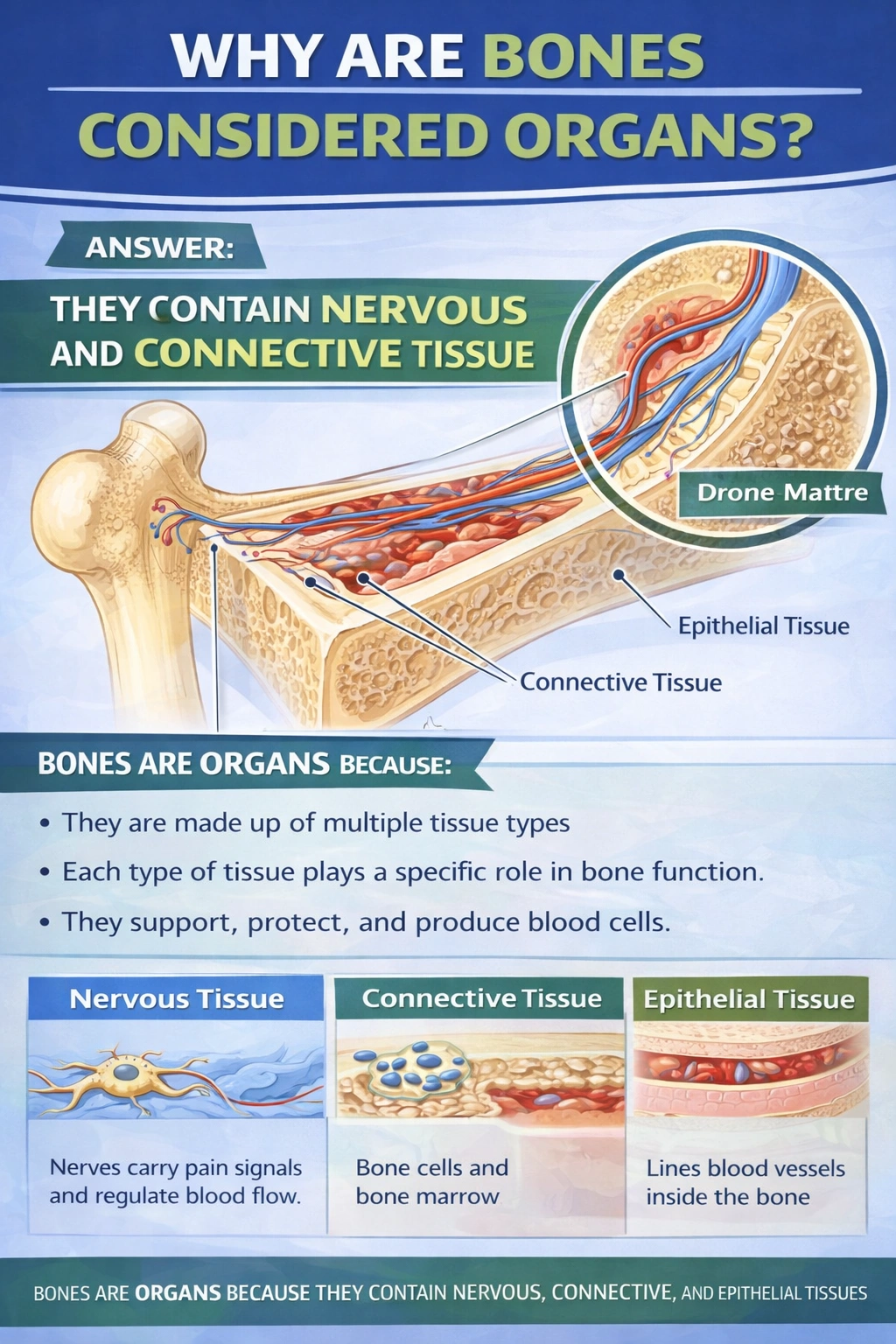
Bones are considered organs because they contain multiple types of tissue, including nervous and connective tissue, that work together to perform specific functions.
In anatomy, an organ is defined as a structure composed of two or more different tissue types that cooperate to carry out specialized tasks. Bones meet this definition because they are complex structures made of several tissues that collectively support the body, protect vital organs, enable movement, store minerals, and produce blood cells.
A) They contain nervous and connective tissue
Bones are composed of several different tissue types:
- Connective tissue, which forms the bone matrix made of collagen fibers and mineral salts, giving bones their strength and rigidity.
- Nervous tissue, which is present as sensory nerves that detect pain, pressure, and injury and help regulate blood flow within the bone.
- Epithelial tissue, which lines the blood vessels inside bones.
- Blood tissue, found within the bone marrow.
These tissues function together to allow bones to provide structural support, protect organs, serve as levers for movement, store calcium and phosphorus, and produce blood cells. Because bones contain multiple tissue types working together toward shared functions, they satisfy the biological definition of an organ. This makes this option correct.
B) They contain cells
While bones do contain specialized cells such as osteoblasts, osteocytes, and osteoclasts, the presence of cells alone does not qualify a structure as an organ.
All tissues in the body contain cells, including muscle tissue, epithelial tissue, and connective tissue. What distinguishes an organ is not merely having cells, but having multiple different tissue types organized to perform specific functions. Therefore, this statement is insufficient to explain why bones are classified as organs.
C) They are not considered to be organs
This statement is incorrect.
Bones are widely recognized as organs in human anatomy because of their complex structure and multifunctional roles. They are not simply inert support structures but living organs involved in movement, protection, mineral regulation, and blood formation. Therefore, this option is false.
D) They are part of the framework of the body
Bones do form the structural framework of the body as part of the skeletal system, and this is an important function.
However, having a structural role does not by itself qualify something as an organ. The defining feature of an organ is the presence of multiple tissue types working together. While framework support is one function of bones, it does not explain their classification as organs. Thus, this option is incomplete and incorrect.
Conclusion:
Bones are living, complex structures composed of connective tissue, nervous tissue, epithelial tissue, and blood tissue, all functioning together to support, protect, move the body, store minerals, and produce blood cells. This combination of multiple tissue types is what qualifies bones as organs.
Therefore, the correct reason bones are considered organs is that they contain nervous and connective tissue.
Topic Flashcards
Click to FlipWhat is the anatomical definition of an organ?
A structure composed of two or more different tissue types working together to perform specific functions.
Besides bone (osseous) tissue, name three other tissue types found within a bone like the femur.
Nervous tissue, blood (vascular) tissue, cartilage, epithelial tissue (lining blood vessels), and connective tissue (marrow, periosteum).
What is the name of the dense, fibrous connective tissue membrane that covers the outer surface of bones and contains blood vessels and nerves?
The periosteum.
Which soft tissue within certain bones is responsible for hematopoiesis (blood cell formation)?
Red bone marrow.
Name three major functions of bones that require the integration of multiple tissue types.
Support/protection, movement (as levers with muscle attachment), mineral storage, blood cell production.
Tendons and ligaments are also classified as organs because, like bones, they are part of the skeletal system and contain cells.
No
The presence of sensory nerves and blood vessels within a bone is a key reason it is classified as an organ.
yes