Which cells are responsible for bone formation?
-
A
Chondrocytes
-
B
Osteoclasts
-
C
Osteocytes
-
D
Osteoblasts
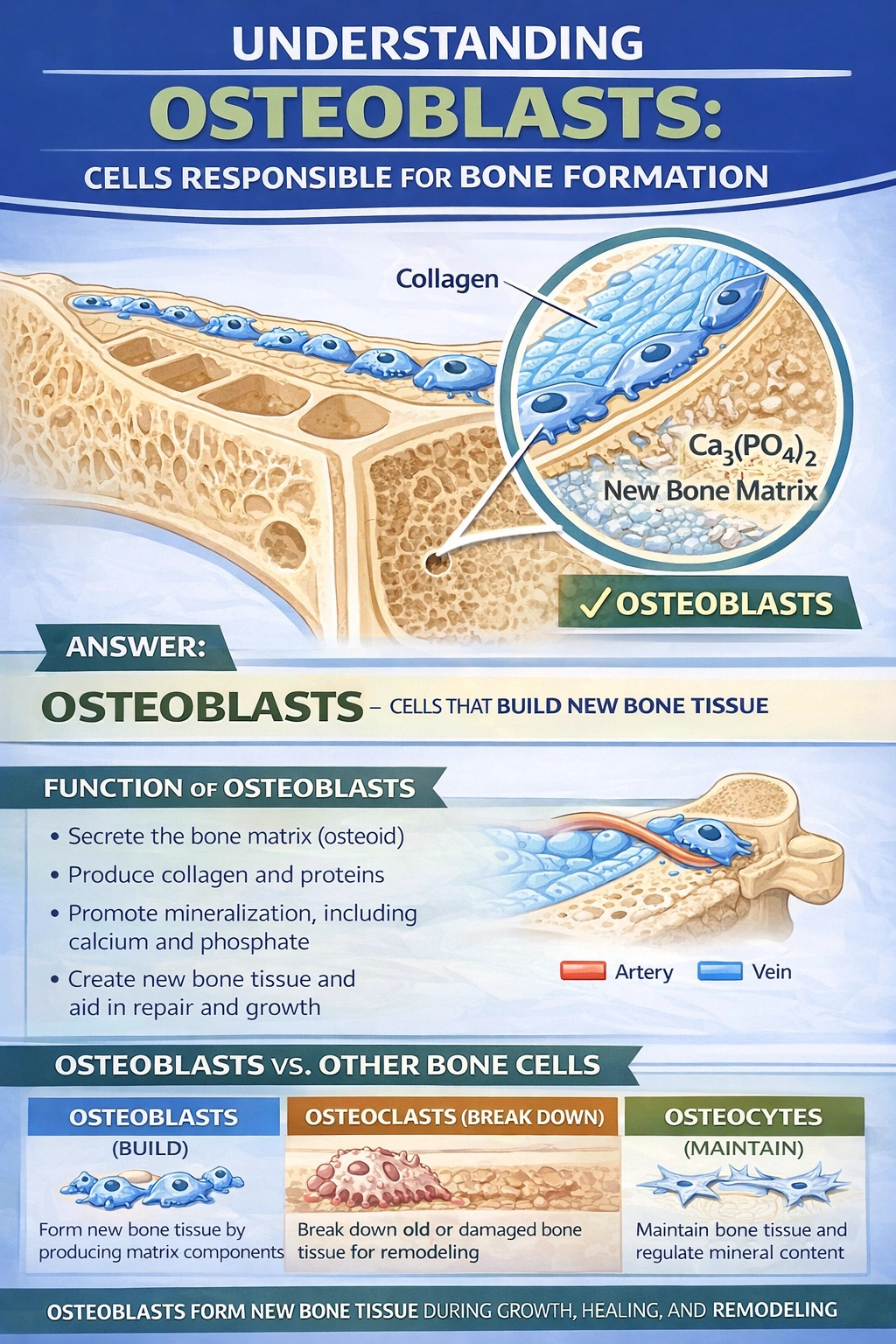
The cells responsible for bone formation are osteoblasts.
Bone is a dynamic tissue that is constantly being formed, broken down, and remodeled throughout life. This process depends on specialized bone cells with distinct functions. Among these, osteoblasts are the cells that actively build new bone by producing and mineralizing the bone matrix.
A) Chondrocytes
Chondrocytes are the cells responsible for forming and maintaining cartilage, not bone. They produce the extracellular matrix of cartilage, which is rich in collagen and proteoglycans and provides flexibility and cushioning in structures such as the nose, trachea, and joints.
During endochondral ossification, which is the developmental process by which many long bones form, cartilage initially serves as a template. However, chondrocytes themselves do not produce bone tissue. Instead, the cartilage they form is later replaced by bone created by osteoblasts. Therefore, chondrocytes are not the cells responsible for bone formation.
B) Osteoclasts
Osteoclasts are large, multinucleated cells that specialize in bone resorption, which is the breakdown of bone tissue.
They secrete acids and enzymes that dissolve mineral deposits and degrade the organic bone matrix, releasing calcium and other minerals into the bloodstream. This function is essential for bone remodeling, calcium homeostasis, and repair of damaged bone. However, osteoclasts remove bone rather than create it, making this option incorrect.
C) Osteocytes
Osteocytes are mature bone cells that originate from osteoblasts after they become trapped within the bone matrix they secrete.
These cells maintain the bone tissue, regulate mineral content, and communicate with osteoblasts and osteoclasts to coordinate remodeling. Although osteocytes are vital for bone health and structural integrity, they do not actively form new bone. Their primary role is maintenance, not construction, so this option is incorrect.
D) Osteoblasts
Osteoblasts are the cells directly responsible for bone formation.
They synthesize and secrete osteoid, the organic portion of the bone matrix composed mainly of collagen fibers and specialized proteins. Osteoblasts also promote the deposition of calcium and phosphate salts into this matrix, a process called mineralization, which hardens the tissue into mature bone.
These cells are active during skeletal development, fracture healing, and continuous bone remodeling throughout adulthood. Because they perform the actual building of bone tissue, osteoblasts are the correct answer.
Conclusion:
Bone formation requires cells that can produce and mineralize new bone matrix. Chondrocytes form cartilage, osteoclasts break down bone, and osteocytes maintain existing bone. Only osteoblasts actively create new bone tissue.
For this reason, osteoblasts are the cells responsible for bone formation.
Topic Flashcards
Click to FlipWhat is the name of the unmineralized, organic bone matrix secreted by osteoblasts?
Osteoid.
Once an osteoblast becomes surrounded by the bone matrix it has secreted, it matures into what type of cell?
An osteocyte.
What is the primary function of osteoclasts in bone tissue?
Bone resorption (breaking down bone to release minerals).
What hormone, produced by the parathyroid glands, stimulates osteoclast activity to increase blood calcium levels?
Parathyroid hormone (PTH).
During which two major physiological processes are osteoblasts most active?
Bone growth (ossification) and fracture repair.