Which muscle in the human body is the longest?
-
A
vastus lateralis
-
B
vastus medialis
-
C
Sartorius
-
D
adductor longus
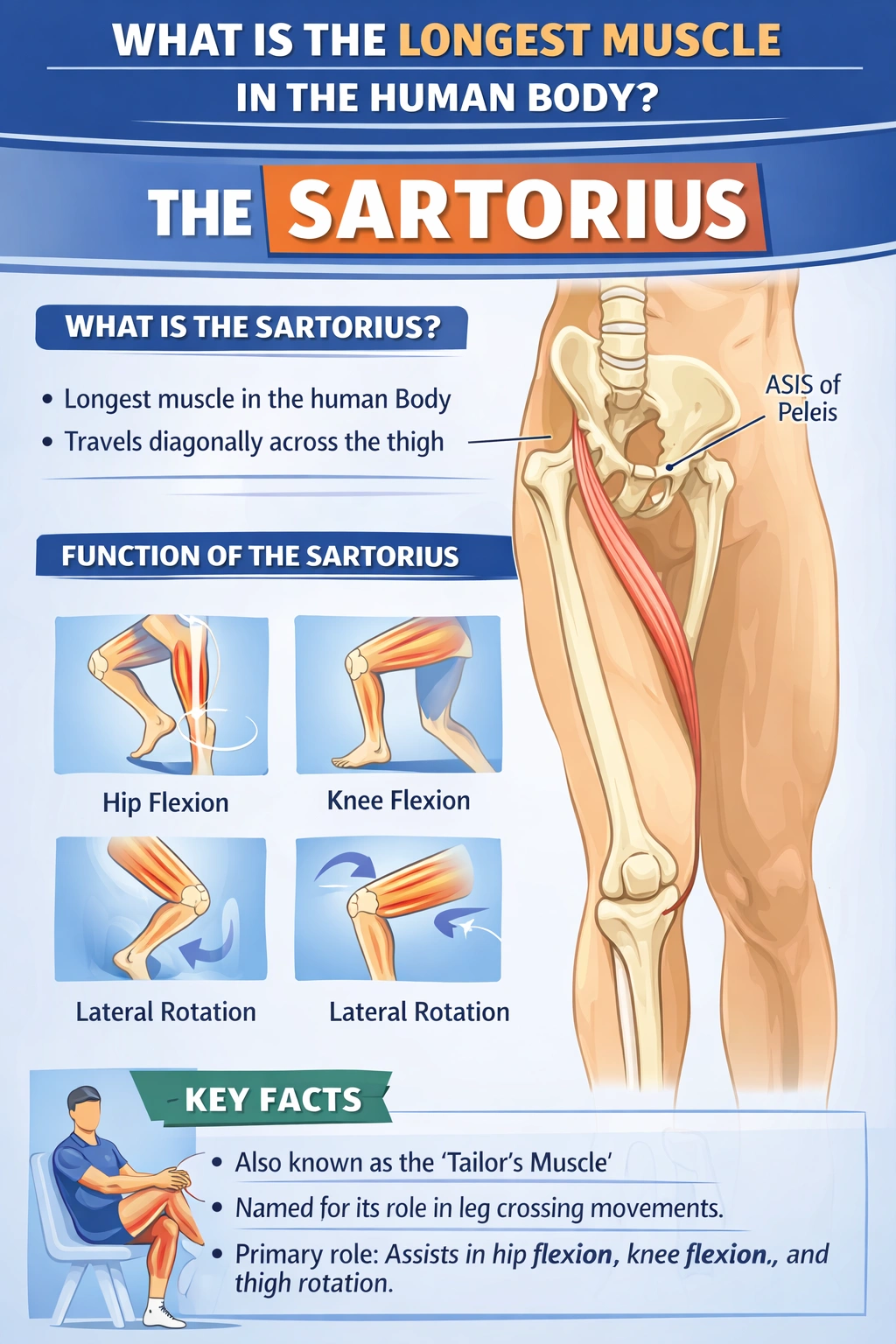
The longest muscle in the human body is the sartorius.
The sartorius extends obliquely across the thigh from the pelvis to the lower leg, giving it the greatest linear length of any skeletal muscle. Its unique course allows it to participate in movements at both the hip and knee joints, contributing to complex actions such as flexing the hip, bending the knee, and rotating the thigh.
A) Vastus lateralis
The vastus lateralis is one of the four muscles that form the quadriceps femoris group on the anterior thigh. Its primary function is extension of the knee, and it also contributes to stabilization of the patella.
Although it is a large and powerful muscle, especially important for walking, running, and jumping, it does not span as great a distance as the sartorius. The vastus lateralis is notable for its thickness and strength rather than its length. Therefore, it is not the longest muscle in the human body.
B) Vastus medialis
The vastus medialis is another quadriceps muscle located on the medial side of the thigh. It plays a crucial role in knee extension and in maintaining proper tracking of the patella during movement.
Like the vastus lateralis, it is an important stabilizer and contributor to lower-limb strength, but it does not extend from the pelvis to the lower leg in the same elongated manner as the sartorius. Consequently, it is not the longest muscle.
C) Sartorius
The sartorius originates from the anterior superior iliac spine of the pelvis and travels diagonally across the front of the thigh to insert on the medial surface of the tibia, just below the knee.
Because it crosses both the hip and knee joints and follows a long, ribbon-like path, it is the longest skeletal muscle in the human body. Functionally, it assists in hip flexion, abduction, and lateral rotation, as well as knee flexion. These combined actions are involved in movements such as sitting cross-legged, which is why the sartorius is often referred to as the “tailor’s muscle.”
Its exceptional length and multi-joint function make it distinct from all other muscles, confirming it as the correct choice.
D) Adductor longus
The adductor longus is located on the medial thigh and functions primarily to adduct the hip, drawing the leg toward the midline of the body. It also assists with hip flexion and stabilization during walking.
While it is an important muscle for posture and gait, its anatomical span is much shorter than that of the sartorius. It does not cross the knee joint or traverse the thigh diagonally, so it cannot be considered the longest muscle.
Conclusion:
Several muscles of the thigh are large and powerful, including the vastus lateralis, vastus medialis, and adductor longus. However, only the sartorius extends from the pelvis to the medial tibia in a long, diagonal course across the thigh.
For this reason, the sartorius is the longest muscle in the human body.
Topic Flashcards
Click to FlipWhat is the common nickname for the sartorius muscle, derived from a sitting position associated with tailors?
The "tailor's muscle."
What two joints does the sartorius muscle cross to perform its actions?
The hip joint and the knee joint.
What specific bony landmark on the pelvis does the sartorius originate from?
The Anterior Superior Iliac Spine (ASIS).
What nerve provides motor innervation to the sartorius muscle?
The femoral nerve (L2-L4).
Which two other muscles join the sartorius to form the medial border of the femoral triangle?
The inguinal ligament (superiorly) and the adductor longus (medially). (The sartorius forms the lateral border).