Where would you be likely to find a Schwann cell?
-
A
Where would you be likely to find a Schwann cell?
-
B
Where would you be likely to find a Schwann cell?
-
C
In the skeletal system
-
D
In the muscular system
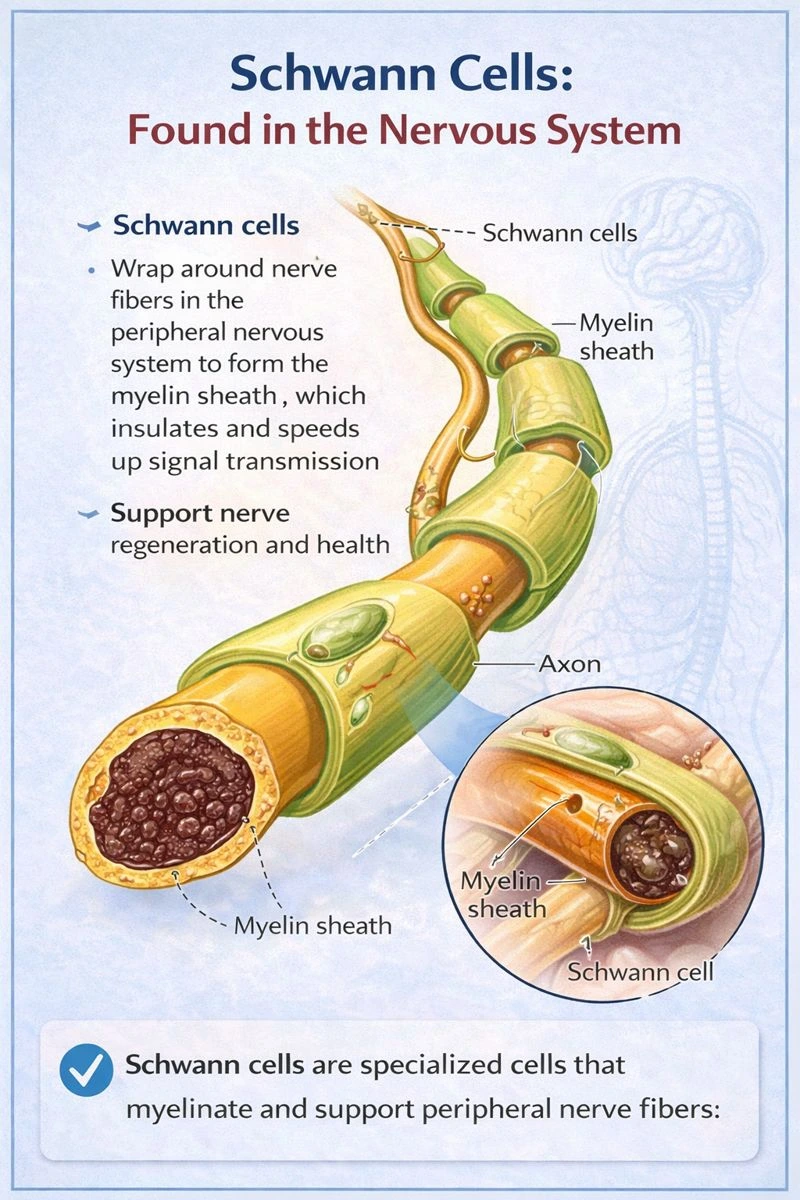
You would be most likely to find a Schwann cell in the nervous system.
Schwann cells are specialized supporting cells that belong to the peripheral nervous system. Their primary role is to insulate nerve fibers by forming the myelin sheath, which greatly increases the speed and efficiency of electrical signal transmission. They also play an essential role in maintaining nerve health and aiding regeneration after injury.
A) In the digestive system
The digestive system contains its own network of neurons known as the enteric nervous system, sometimes referred to as the “brain of the gut.” This system includes neurons and a distinct type of supporting cell called enteric glial cells.
Although enteric glial cells perform supportive and protective roles similar to other glial cells, they are not Schwann cells. Schwann cells are specific to the peripheral nervous system and are structurally and functionally different from the glial cells found within the gastrointestinal tract. Therefore, this option is incorrect.
B) In the nervous system
Schwann cells are the principal glial cells of the peripheral nervous system. They wrap around axons of peripheral neurons to form the myelin sheath, a lipid-rich insulating layer that allows electrical impulses to travel rapidly along nerve fibers by a process called saltatory conduction.
In addition to myelination, Schwann cells provide metabolic and structural support to neurons and are critical for nerve repair. When a peripheral nerve is damaged, Schwann cells help guide regrowth of the axon toward its target tissue.
Because of these essential functions and their exclusive association with peripheral nerves, the nervous system is where Schwann cells are found, making this option correct.
C) In the skeletal system
The skeletal system is composed primarily of bones and connective tissues. The main cell types present in bone include osteoblasts, osteocytes, and osteoclasts, which are involved in bone formation, maintenance, and resorption.
Although bones are innervated by nerves, particularly in the periosteum, Schwann cells are part of the nerve tissue itself and not components of bone tissue. They are not structural or functional elements of the skeletal system. Therefore, this option is incorrect.
D) In the muscular system
Muscle tissue contains muscle fibers, satellite cells, connective tissue cells, and blood vessels. Motor neurons extend into muscle tissue to form neuromuscular junctions, allowing nerve impulses to stimulate muscle contraction.
However, Schwann cells remain associated with the axons of these motor neurons rather than being part of the muscle tissue itself. They support and insulate the nerve fibers up to the point where the nerve communicates with the muscle but do not belong to the muscular system. Thus, this option is incorrect.
Conclusion:
Schwann cells are specialized glial cells responsible for myelinating and supporting peripheral nerve fibers. They are not found in digestive tissues, bone, or muscle itself but are integral components of the peripheral nervous system.
- For this reason, Schwann cells are found in the nervous system.

Topic Flashcards
Click to FlipWhat is the primary function of a Schwann cell in the peripheral nervous system (PNS)?
To form the myelin sheath around axons, which insulates them and speeds up nerve impulse conduction.
What is the name of the supporting cells in the central nervous system (CNS) that perform a similar myelinating function to Schwann cells?
Oligodendrocytes.
What is the term for the gaps between adjacent Schwann cells along a myelinated axon?
Nodes of Ranvier.
Besides myelination, what critical role do Schwann cells play after a peripheral nerve injury?
They help clear debris and form a regeneration tube (bands of Büngner) to guide and support the regrowth of the axon.
What autoimmune disease involves the immune system attacking the myelin sheaths (formed by Schwann cells) in the peripheral nerves?
Guillain-Barré syndrome.