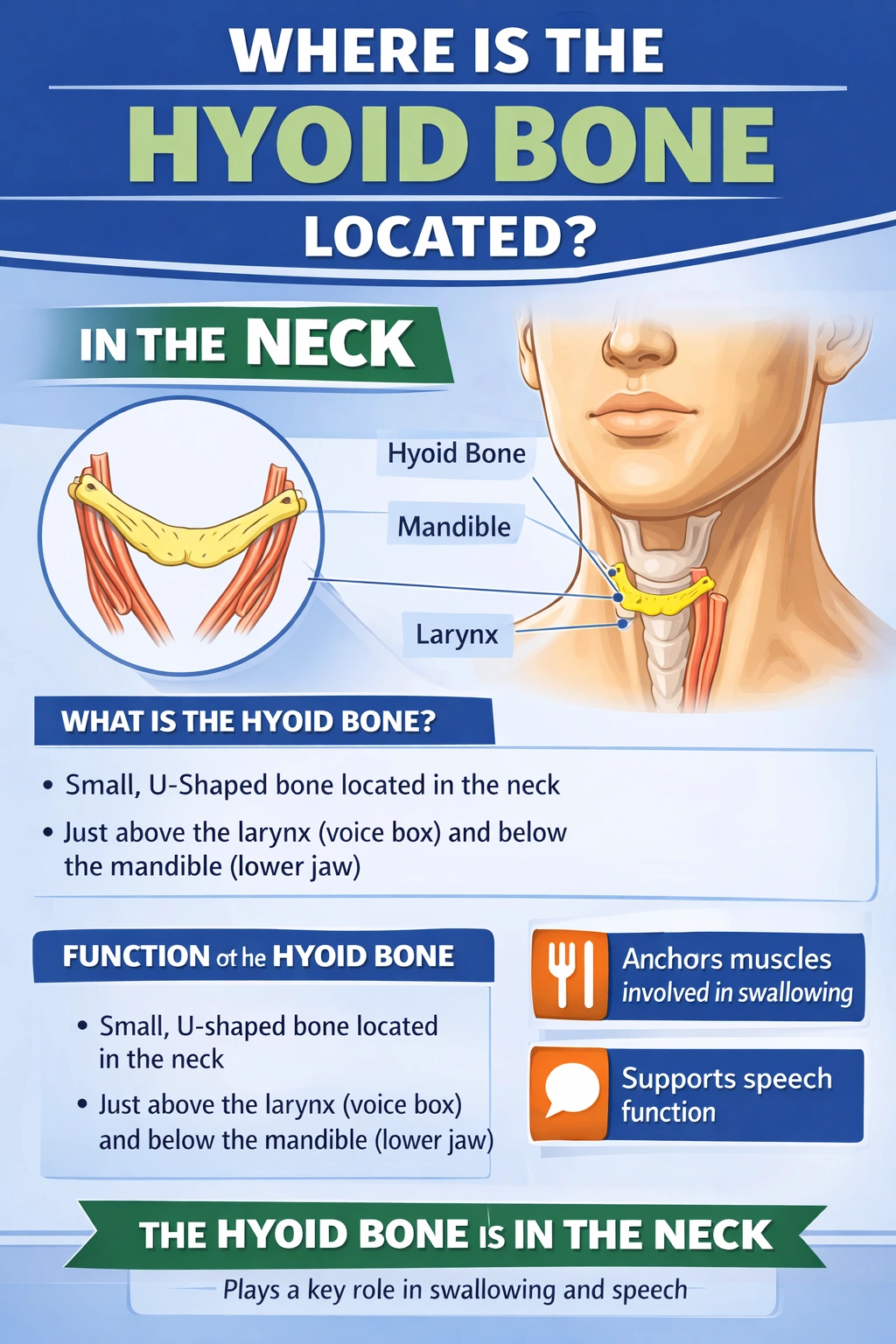
Where is the hyoid bone located
-
A
rib cage
-
B
Leg
-
C
Neck
-
D
Pelvis
The hyoid bone is located in the neck.
The hyoid is a small, U-shaped bone that plays an important role in swallowing and speech. Unlike most bones in the body, it does not articulate directly with any other bone. Instead, it is suspended in place by muscles and ligaments, allowing it to serve as a stable anchor point for structures involved in tongue movement, phonation, and swallowing.
A) Rib cage
The rib cage consists of the ribs, sternum, and thoracic vertebrae. Its primary function is to protect vital organs such as the heart and lungs and to assist in breathing mechanics.
This structure is located in the thoracic region of the body, well below the head and neck. The hyoid bone is not part of the thoracic skeleton and does not contribute to chest wall structure or respiratory protection. Therefore, this option is incorrect.
B) Leg
The leg refers to the lower limb, extending from the knee to the foot, and includes bones such as the tibia, fibula, tarsals, metatarsals, and phalanges.
The hyoid bone is not associated with the appendicular skeleton and has no role in locomotion or lower-limb support. It is located in the upper body within the cervical region, making this option incorrect.
C) Neck
The hyoid bone is located in the anterior neck, positioned just above the larynx (voice box) and below the mandible (lower jaw).
It is unique because it does not form joints with other bones. Instead, it is suspended by a complex arrangement of muscles and ligaments connecting it to the skull, tongue, pharynx, and larynx. This positioning allows the hyoid to stabilize the airway and provide attachment for muscles involved in swallowing, speech, and tongue movement.
Because of this anatomical location and functional significance, the neck is the correct answer.
D) Pelvis
The pelvis forms the lower part of the trunk and consists of the hip bones, sacrum, and coccyx. It supports abdominal organs and connects the spine to the lower limbs.
The hyoid bone is not associated with the pelvic girdle and does not participate in weight bearing or support of pelvic organs. Therefore, this option is incorrect.
Conclusion:
The hyoid bone is a uniquely positioned bone that lies in the neck, suspended above the larynx and below the mandible. It serves as a critical attachment site for muscles involved in swallowing and speech and does not belong to the rib cage, leg, or pelvis.
For this reason, the correct answer is that the hyoid bone is located in the neck.
Topic Flashcards
Click to FlipWhat unique structural characteristic makes the hyoid bone different from all other bones in the human body?
It does not articulate (form a joint) with any other bone.
Which two major groups of muscles attach to the hyoid bone to assist in swallowing and speech?
The suprahyoid muscles (above it) and the infrahyoid muscles (below it).
What is the name of the prominent midline structure on the hyoid bone where many muscles attach?
The body of the hyoid (the central part of the "U").
In forensic pathology, a fracture of the hyoid bone is often indicative of what type of injury?
Strangulation or manual throttling.
During swallowing, the hyoid bone is pulled upward and forward. What is the primary purpose of this movement?
To elevate the larynx and close the epiglottis, protecting the airway and helping propel food into the esophagus.
The hyoid bone is part of the axial skeleton and is classified as a cranial bone.
No
A fractured hyoid bone is a common injury in cases of whiplash from car accidents.
No