How does the nervous system work with the muscular system?
-
A
The muscles of the body produce chemicals that feed the nerves.
-
B
The nervous system tells the muscles how to respond to the environment.
-
C
The nervous system releases chemicals that remove excess waste from the muscles.
-
D
The muscular system provides input that allows the nerves to make decisions.
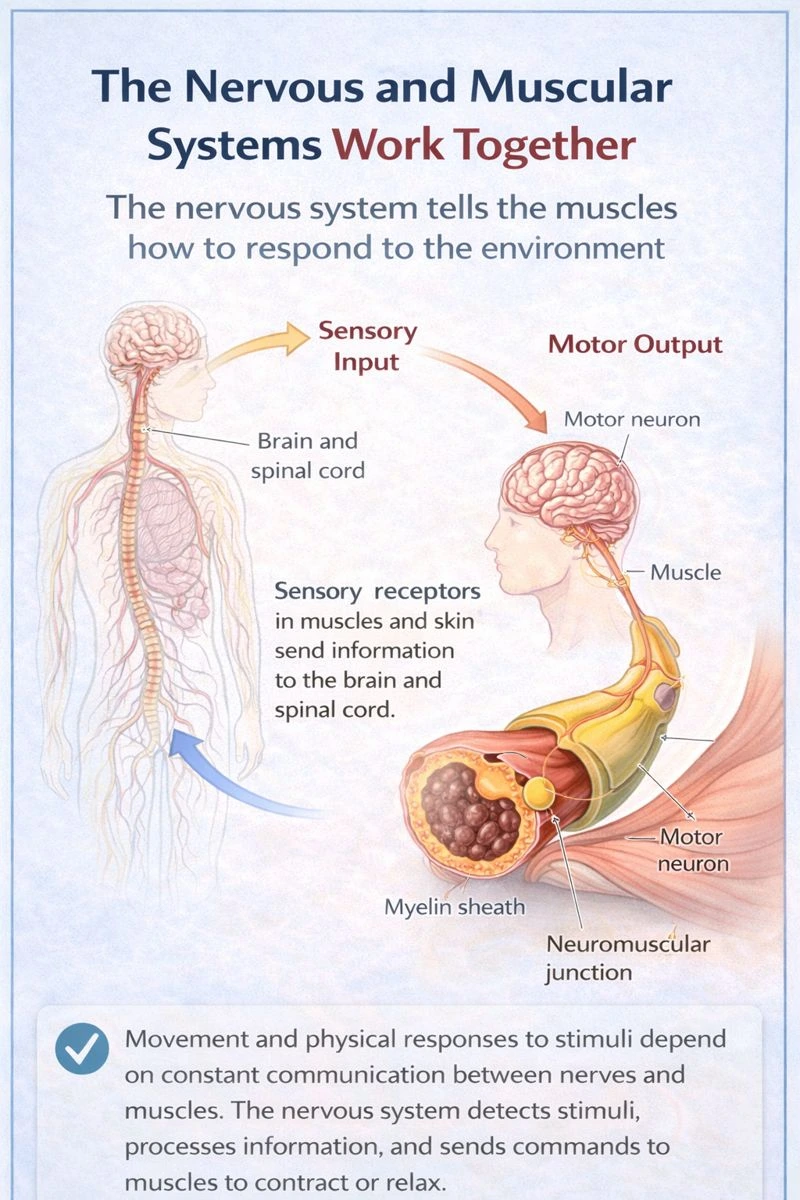
The nervous system works with the muscular system by telling the muscles how to respond to the environment.
Movement, posture, and physical responses to stimuli depend on constant communication between nerves and muscles. The nervous system detects changes in the internal and external environment, processes this information, and sends precise electrical signals to muscles to contract or relax. This coordination allows the body to perform voluntary actions such as walking and writing, as well as involuntary actions such as maintaining balance and reflexes.
A) The muscles of the body produce chemicals that feed the nerves
Muscles do release certain substances, such as growth factors and signaling molecules, that can influence nearby tissues. However, these substances do not serve as the primary source of nutrition or functional control for nerve cells.
Nerves receive oxygen and nutrients through the blood supply, just like other tissues. The essential functional relationship between the nervous and muscular systems is based on electrical signaling and motor control, not chemical feeding. Therefore, this statement does not describe how the two systems fundamentally work together and is incorrect.
B) The nervous system tells the muscles how to respond to the environment
Motor neurons carry electrical impulses from the brain and spinal cord to muscle fibers. At the neuromuscular junction, these impulses trigger the release of the neurotransmitter acetylcholine, which initiates muscle contraction.
At the same time, sensory receptors in muscles and tendons detect changes in muscle length, tension, and body position. This information is sent back to the central nervous system, allowing continuous adjustment of movement and posture. Through this two-way communication, the nervous system directs muscle activity so the body can respond appropriately to stimuli such as heat, pain, obstacles, or changes in balance.
This direct control of muscle contraction by neural signals represents the primary way the nervous and muscular systems function together, making this option correct.
C) The nervous system releases chemicals that remove excess waste from the muscles
The removal of metabolic waste products from muscles, such as carbon dioxide and lactic acid, is performed by the circulatory and lymphatic systems.
The nervous system does not secrete substances that clean or detoxify muscle tissue. Its role is communication and control, not waste management. Therefore, this option is incorrect.
D) The muscular system provides input that allows the nerves to make decisions
Muscles do contain sensory receptors, such as muscle spindles and Golgi tendon organs, which send information about muscle stretch and tension to the nervous system. This information helps refine movement and maintain posture.
However, muscles do not make decisions or direct nervous system activity. Decision-making occurs in the brain and spinal cord. Muscles function as effectors that carry out instructions rather than as control centers. For this reason, this option is not accurate.
Conclusion:
The nervous system and muscular system are closely integrated to produce movement and coordinated responses to environmental changes. The nervous system detects stimuli, processes information, and sends commands through motor neurons to control muscle contraction. Muscles then execute these commands to produce motion.
- Therefore, the correct description of how these systems work together is that the nervous system tells the muscles how to respond to the environment.

Topic Flashcards
Click to FlipWhat is the name of the specialized synapse where a motor neuron communicates with a muscle fiber?
The neuromuscular junction (NMJ)
Which neurotransmitter is released by motor neurons at the neuromuscular junction to trigger muscle contraction?
Acetylcholine (ACh)
What are the sensory receptors in muscles that detect stretch and help coordinate reflexive adjustments?
Muscle spindles.
What is the term for the basic functional unit of neural control of muscle contraction, consisting of a motor neuron and all the muscle fibers it innervates?
A motor unit.
What type of neural circuit is responsible for an automatic, involuntary muscular response to a stimulus, such as the knee-jerk reflex?
A reflex arc.