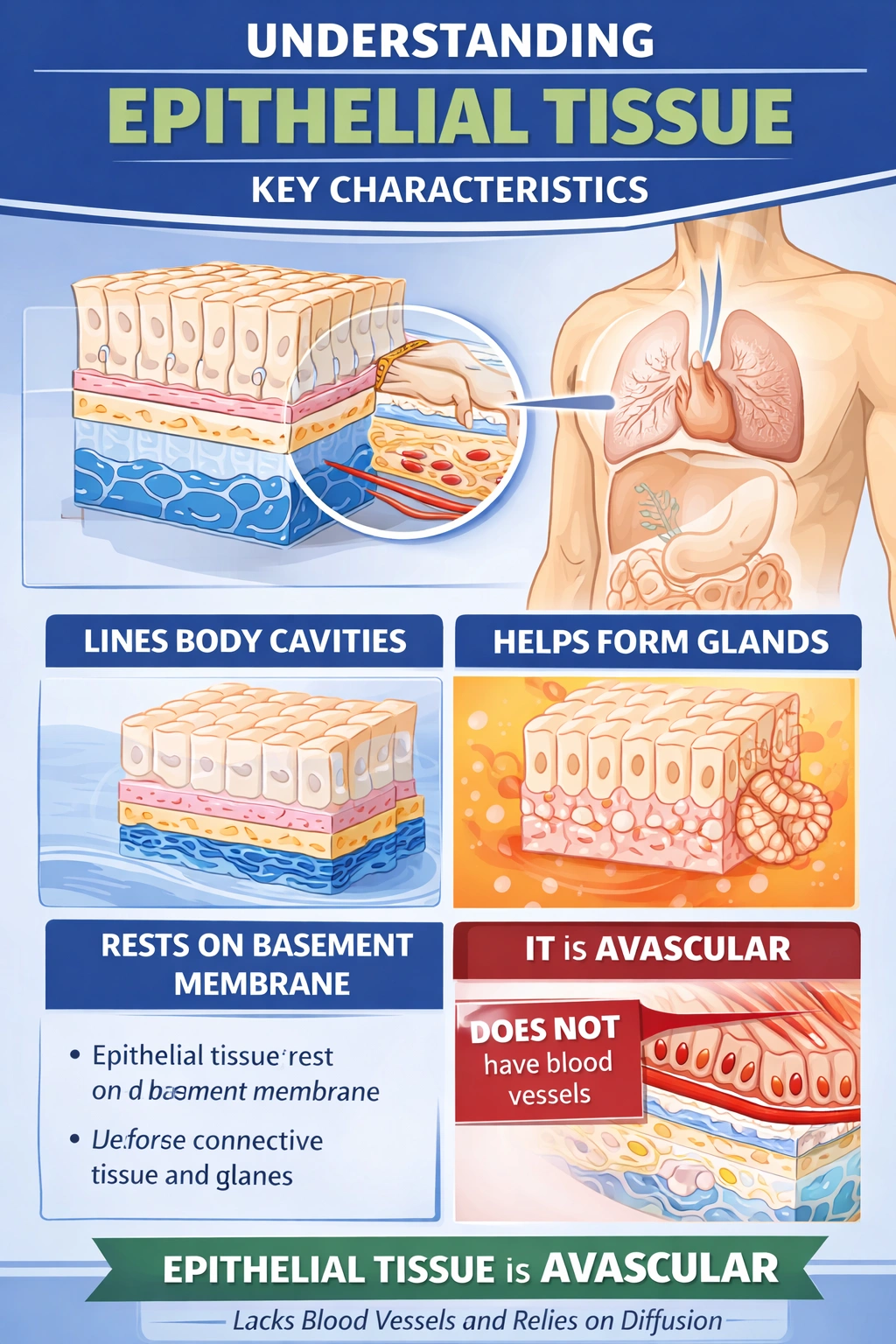
Which is not true of epithelial tissue?
-
A
It lines cavities in the body.
-
B
It helps form certain glands.
-
C
It is vascular.
-
D
It rests on a basement membrane
Epithelial tissue is not vascular.
Epithelial tissue is one of the four basic tissue types in the human body and serves critical functions such as protection, absorption, filtration, and secretion. It covers body surfaces, lines internal cavities and organs, and forms glands. Despite these important roles, epithelial tissue has several defining structural characteristics, one of which is the absence of blood vessels.
A) It lines cavities in the body
This statement is true.
Epithelial tissue lines many internal body cavities and hollow organs, including the digestive tract, respiratory tract, urinary tract, reproductive organs, and blood vessels. These epithelial linings protect underlying tissues, regulate the movement of substances, and often participate in absorption and secretion.
For example, the epithelial lining of the small intestine absorbs nutrients, while the epithelial lining of the respiratory tract helps trap and remove particles. Because lining body cavities is a fundamental function of epithelial tissue, this statement is correct.
B) It helps form certain glands
This statement is true.
Epithelial tissue gives rise to both endocrine and exocrine glands. Endocrine glands, such as the thyroid and adrenal glands, release hormones directly into the bloodstream. Exocrine glands, such as sweat glands, salivary glands, and mammary glands, secrete substances through ducts to epithelial surfaces.
Glandular epithelial cells are specialized for secretion and are essential for regulating metabolism, digestion, temperature control, and many other physiological processes. Therefore, this statement accurately describes epithelial tissue.
C) It is vascular
This statement is not true.
Epithelial tissue is avascular, meaning it contains no blood vessels. Instead, epithelial cells receive oxygen and nutrients by diffusion from capillaries located in the underlying connective tissue. These substances pass through the basement membrane to nourish the epithelial layer.
This lack of direct blood supply is a defining feature of epithelial tissue and distinguishes it from connective tissue, muscle tissue, and nervous tissue, which are generally vascularized. Because epithelial tissue does not contain blood vessels, this statement is incorrect.
D) It rests on a basement membrane
This statement is true.
All epithelial tissue rests on a basement membrane, a thin layer of extracellular material that separates the epithelium from the underlying connective tissue. The basement membrane provides structural support, anchors epithelial cells in place, and acts as a selective barrier for diffusion.
It also plays a role in tissue repair and regeneration, helping guide new epithelial cell growth after injury. The presence of a basement membrane is one of the hallmark features of epithelial tissue.
Conclusion:
Epithelial tissue lines body cavities, forms glands, and rests on a basement membrane. However, it does not contain blood vessels and depends on diffusion from underlying tissues for nourishment.
Therefore, the statement that epithelial tissue is vascular is not true, making option C the correct answer.
Topic Flashcards
Click to FlipWhat term describes epithelial tissue that is only one cell layer thick?
Simple epithelium.
What is the name of the specialized structure that attaches epithelial cells to each other laterally, providing a barrier function?
Tight junctions (occluding junctions).
What type of epithelial tissue is specialized for stretching and is found in the bladder?
Transitional epithelium (urothelium).
How do the cells in avascular epithelial tissues receive oxygen and nutrients?
By diffusion from blood vessels in the underlying connective tissue.
What is the term for the free (unattached) surface of an epithelial cell that often faces a lumen or the outside environment?
The apical surface.