The imaginary line that separates the body into superior and inferior regions is called the ____.
-
A
coronal plane
-
B
vertical plane
-
C
sagittal plane
-
D
transverse plane
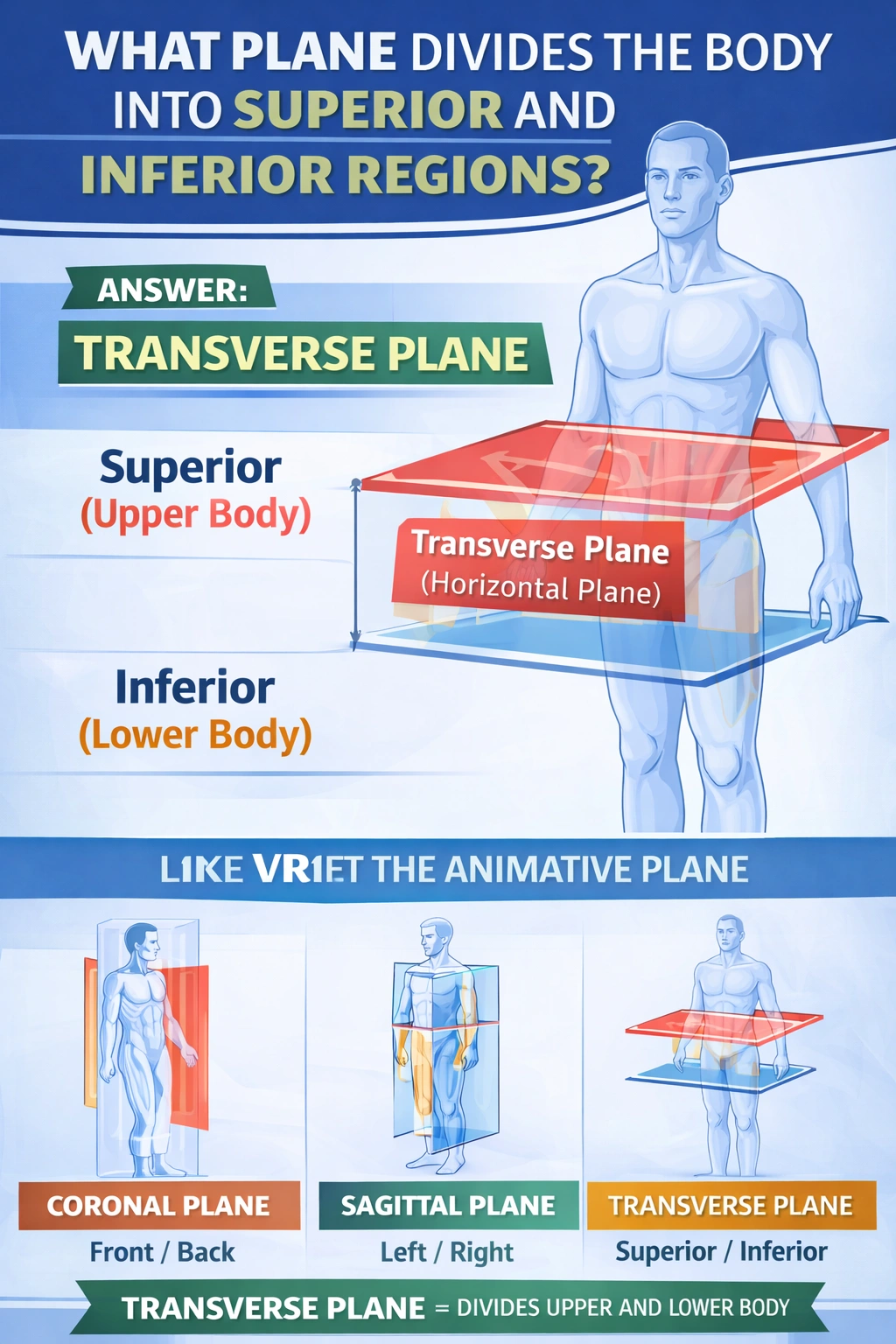
The imaginary line that separates the body into superior (upper) and inferior (lower) regions is called the transverse plane.
In anatomical terminology, the body is described using standardized planes that help clinicians and students understand the location of structures and interpret medical images. Each plane divides the body in a specific direction. The transverse plane is unique because it runs horizontally and creates upper and lower portions of the body.
A) Coronal plane
The coronal plane, also known as the frontal plane, divides the body into anterior (front) and posterior (back) regions.
This plane runs vertically from side to side and is commonly used to describe structures that lie toward the front or back of the body. While it is essential for anatomical orientation, it does not divide the body into upper and lower halves. Therefore, this option is incorrect.
B) Vertical plane
The term vertical plane is a general description and not a specific anatomical plane.
Both the sagittal and coronal planes are vertical, but they divide the body into left and right or front and back portions, respectively. Because “vertical plane” does not refer to a distinct anatomical division used in standard terminology, it cannot correctly describe the separation of superior and inferior regions. This option is incorrect.
C) Sagittal plane
The sagittal plane divides the body into left and right portions.
It runs vertically from front to back and is often used to describe structures as being medial or lateral. The midsagittal plane further divides the body into equal left and right halves. However, it does not separate the body into upper and lower sections, making this option incorrect.
D) Transverse plane
The transverse plane, also called the horizontal plane, divides the body into superior (upper) and inferior (lower) regions.
It runs horizontally across the body and is perpendicular to both the sagittal and coronal planes. This plane is commonly used in cross-sectional imaging such as CT scans and MRI studies to view “slices” of the body from top to bottom.
Because it specifically separates the body into upper and lower parts, this option is correct.
Conclusion:
Anatomical planes provide a standardized way to describe the positions of structures in the human body. The coronal plane divides front and back, the sagittal plane divides left and right, and the transverse plane divides upper and lower portions.
Therefore, the plane that separates the body into superior and inferior regions is the transverse plane.
Topic Flashcards
Click to FlipWhat is another name for the transverse plane?
The horizontal plane.
Which plane divides the body into anterior (front) and posterior (back) portions?
The coronal plane (also called the frontal plane).
What is the term for a sagittal plane that divides the body exactly into equal left and right halves?
The midsagittal plane (or median plane).
In which plane do movements like flexion and extension primarily occur?
The sagittal plane.
What type of section is produced by a cut along the transverse plane?
A cross-section (or horizontal section).