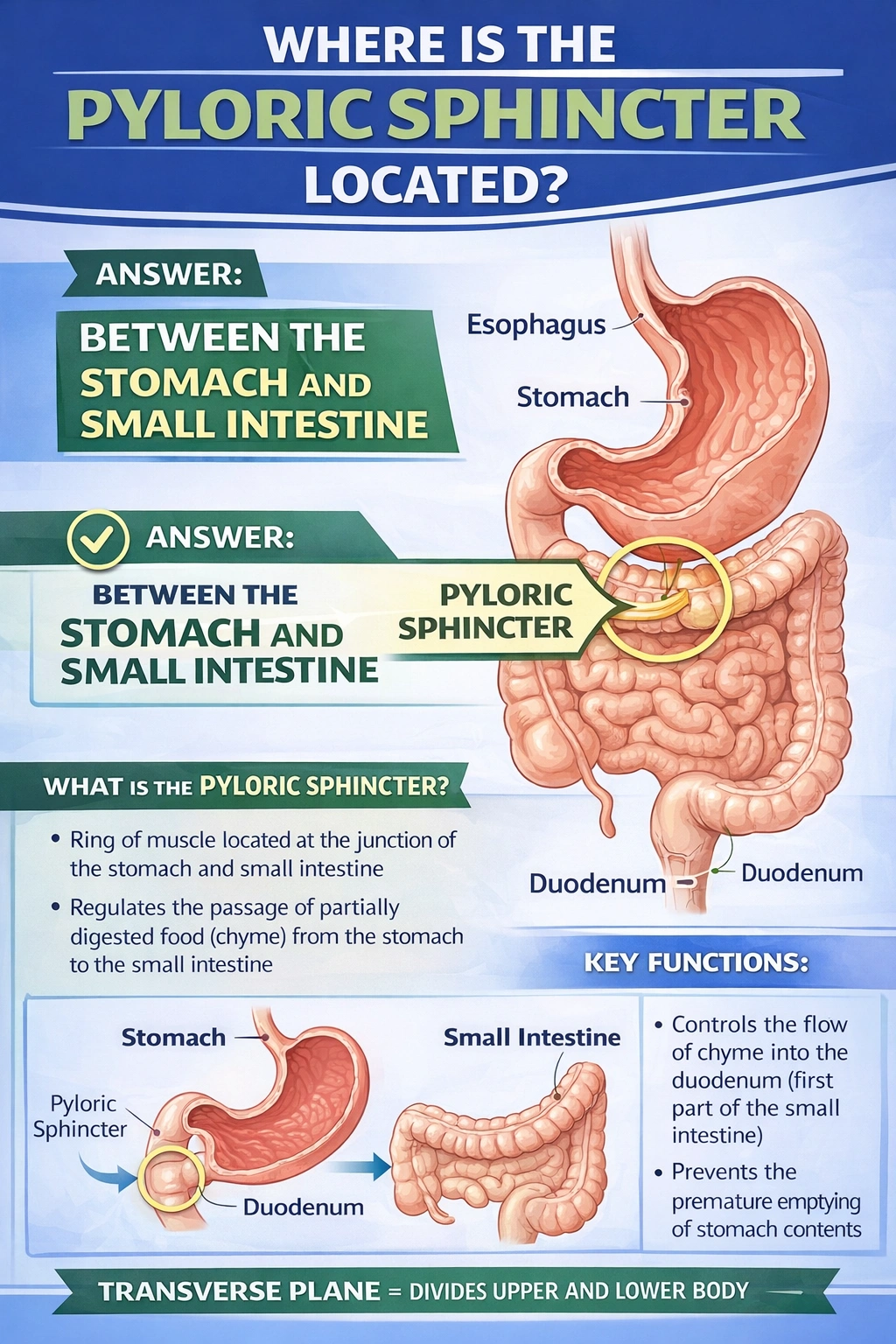
The pyloric sphincter is located between ____.
-
A
the esophagus and stomach
-
B
the rectum and anus
-
C
the small and large intestine
-
D
the stomach and small intestine
The pyloric sphincter is located between the stomach and the small intestine.
The pyloric sphincter is a thick ring of smooth muscle that regulates the movement of partially digested food, known as chyme, from the stomach into the duodenum, which is the first part of the small intestine. Its controlled opening and closing ensures that digestion in the stomach is adequate before contents pass into the intestines and prevents backflow from the small intestine into the stomach.
A) The esophagus and stomach
The muscular valve located between the esophagus and the stomach is called the lower esophageal sphincter, also known as the cardiac sphincter.
This sphincter controls the entry of food into the stomach and prevents acidic stomach contents from refluxing into the esophagus. It plays an important role in preventing heartburn and gastroesophageal reflux disease, but it is not involved in regulating gastric emptying into the intestines. Therefore, this option does not describe the location of the pyloric sphincter and is incorrect.
B) The rectum and anus
The sphincter found between the rectum and anus is the anal sphincter, which consists of internal and external muscle layers.
Its function is to control defecation by regulating the release of feces from the body. It operates at the terminal end of the digestive tract and has no role in stomach digestion or intestinal entry. Therefore, this option is incorrect.
C) The small and large intestine
The structure that regulates movement between the small intestine and large intestine is the ileocecal valve, sometimes referred to as the ileocecal sphincter.
It controls the passage of digested material from the ileum into the cecum and helps prevent bacteria from the large intestine from entering the small intestine. This is a different anatomical structure from the pyloric sphincter and is located much farther along the digestive tract. Thus, this option is incorrect.
D) The stomach and small intestine
The pyloric sphincter is located at the junction between the stomach and the duodenum, the first segment of the small intestine.
It opens intermittently to allow small amounts of chyme to pass into the intestine for further digestion and nutrient absorption. By regulating the speed of gastric emptying, it prevents the small intestine from being overloaded and ensures optimal digestive efficiency. It also prevents intestinal contents from moving backward into the stomach.
Because this accurately describes both the location and function of the pyloric sphincter, this option is correct.
Conclusion:
Different sphincters regulate different junctions within the digestive tract. The lower esophageal sphincter controls food entry into the stomach, the ileocecal valve regulates flow into the large intestine, and the anal sphincter controls waste elimination.
The pyloric sphincter specifically regulates passage from the stomach into the small intestine. Therefore, it is located between the stomach and the small intestine.
Topic Flashcards
Click to FlipWhat is the name of the first part of the small intestine that receives chyme from the stomach via the pyloric sphincter?
The duodenum.
What term describes the semi-liquid mixture of partially digested food and gastric juices that the pyloric sphincter releases from the stomach?
Chyme.
What hormone, released by the duodenum in response to fatty chyme, inhibits stomach motility and slows the opening of the pyloric sphincter?
Cholecystokinin (CCK).
What is the name of the sphincter located at the junction between the esophagus and the stomach?
The lower esophageal sphincter (LES) or cardiac sphincter.
What is the medical term for a condition where the pyloric sphincter is abnormally narrowed or blocked?
Pyloric stenosis.