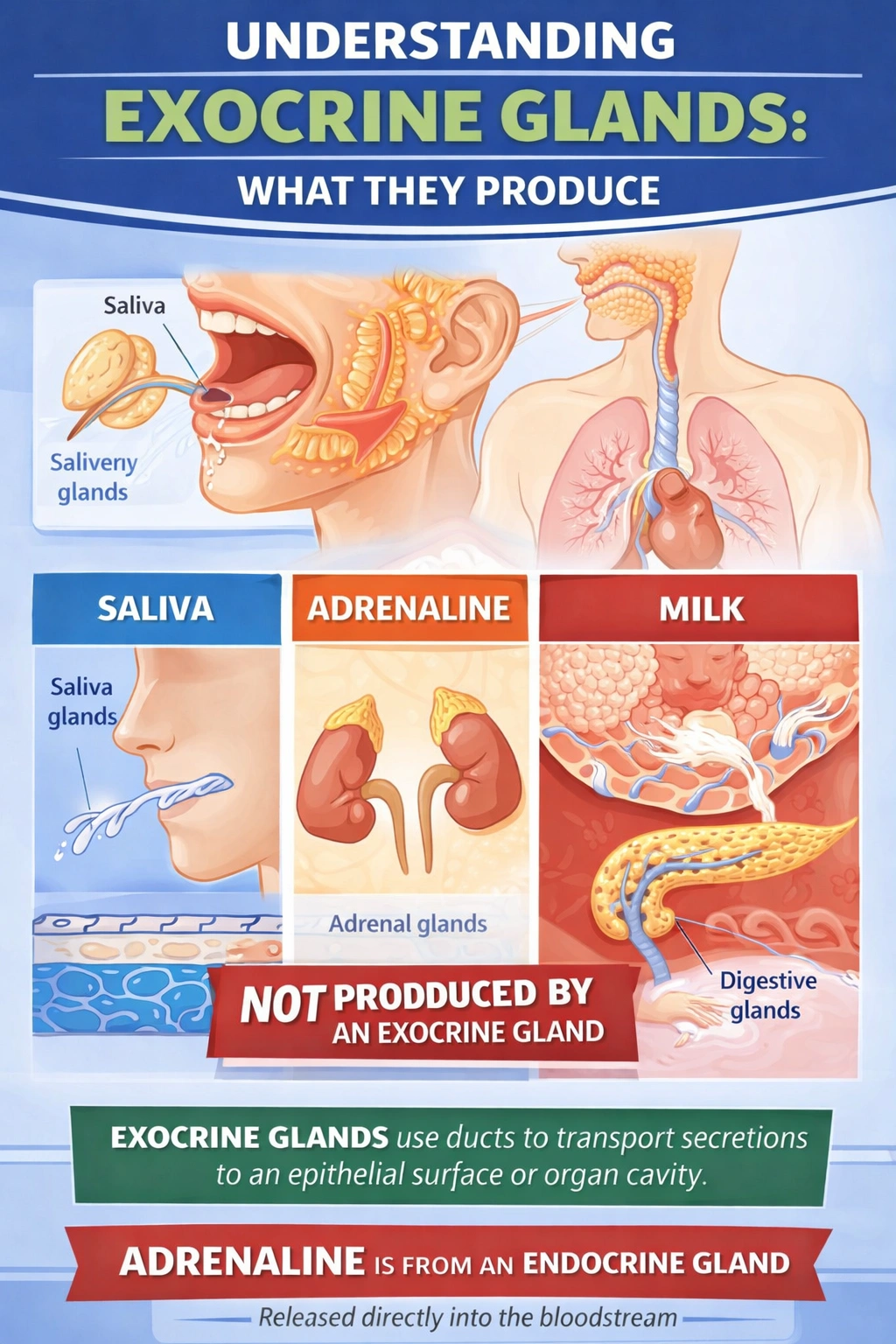
Which is not produced by an exocrine gland?
-
A
Saliva
-
B
Adrenaline
-
C
Milk
-
D
digestive enzymes
Adrenaline is not produced by an exocrine gland.
Exocrine glands release their secretions through ducts onto an epithelial surface or into a body cavity, such as the digestive tract or the skin. In contrast, endocrine glands release hormones directly into the bloodstream without using ducts. Adrenaline is a hormone released into the blood, which places it in the category of endocrine secretions rather than exocrine products.
A) Saliva
Saliva is produced by the salivary glands, including the parotid, submandibular, and sublingual glands, all of which are exocrine glands.
These glands secrete saliva through ducts into the oral cavity. Saliva contains water, mucus, electrolytes, and enzymes such as amylase, which begins the digestion of carbohydrates. Because saliva is delivered through ducts to an epithelial surface, it is a classic example of an exocrine secretion. Therefore, this option is incorrect.
B) Adrenaline
Adrenaline, also known as epinephrine, is produced by the adrenal medulla of the adrenal glands. These glands are part of the endocrine system.
Instead of being transported through ducts, adrenaline is released directly into the bloodstream, where it acts on distant organs to increase heart rate, elevate blood pressure, dilate airways, and mobilize glucose during stress.
Because adrenaline is a hormone secreted directly into the blood and not through ducts, it is not produced by an exocrine gland. This makes this option correct.
C) Milk
Milk is produced by the mammary glands, which are specialized exocrine glands.
These glands secrete milk through ducts that open at the nipple, delivering the product to the exterior of the body for infant nutrition. The presence of ducts and surface delivery clearly classifies milk as an exocrine secretion. Therefore, this option is incorrect.
D) Digestive enzymes
Digestive enzymes are produced by several exocrine glands, most notably the pancreas and the salivary glands.
The pancreas releases enzymes such as amylase, lipase, and proteases through the pancreatic duct into the small intestine, while salivary glands secrete amylase into the mouth. These enzymes are transported through ducts to act within the digestive tract, making them exocrine products. Therefore, this option is incorrect.
Conclusion:
Exocrine glands release substances through ducts to body surfaces or cavities, including saliva, milk, and digestive enzymes. Adrenaline, however, is a hormone released directly into the bloodstream by the adrenal glands, which are endocrine glands.
For this reason, adrenaline is not produced by an exocrine gland.
Topic Flashcards
Click to FlipWhat is the structural feature that distinguishes an exocrine gland from an endocrine gland?
Exocrine glands have ducts; endocrine glands are ductless and secrete directly into the bloodstream.
Which part of the adrenal gland produces adrenaline (epinephrine), and is it considered endocrine or exocrine?
The adrenal medulla; it is an endocrine tissue.
Name three types of secretions produced by exocrine glands (other than saliva, milk, or digestive enzymes).
Sweat, sebum (oil), mucus, tears, earwax, bile (from the liver).
What term describes exocrine glands that release their secretions by exocytosis, without losing cellular material (e.g., pancreatic cells)?
Merocrine (or eccrine) glands
What is the name of the exocrine glands in the stomach that secrete hydrochloric acid and pepsinogen?
Gastric glands (specifically, the parietal and chief cells within them).