Muscle contractions that normally move food along the human digestive system are known as ___________.
-
A
defecation
-
B
osmosis
-
C
peristalsis
-
D
circulation
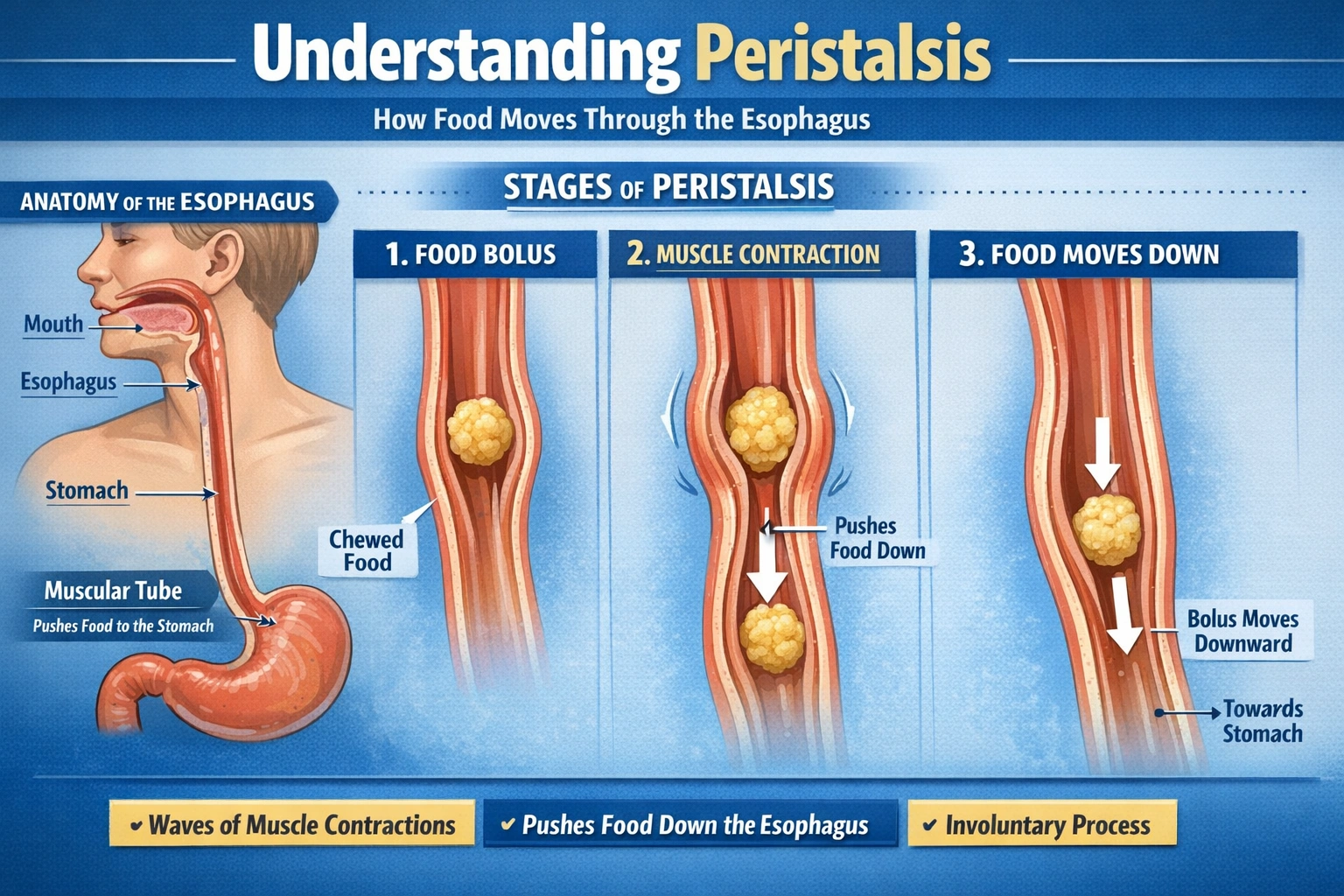
The muscular contractions that normally move food along the human digestive system are known as peristalsis.
As food passes from the esophagus to the stomach and through the intestines, it must be propelled forward in a controlled and continuous manner. This movement is not dependent on gravity but on involuntary, organized contractions of smooth muscle within the digestive tract walls. These contractions ensure that food is mixed with digestive secretions and advanced efficiently for digestion and absorption.
A) Defecation
Defecation is the process of eliminating solid waste from the body through the anus. It represents the final stage of digestion, occurring after nutrients have already been absorbed and waste material has formed in the large intestine.
Although peristalsis contributes to moving fecal material toward the rectum prior to defecation, defecation itself is a separate reflex action involving the rectum and anal sphincters. It is not the continuous muscular mechanism responsible for transporting food throughout the digestive tract. Therefore, this option is incorrect.
B) Osmosis
Osmosis is a passive transport process in which water moves across a semipermeable membrane from an area of lower solute concentration to an area of higher solute concentration.
This process occurs at the microscopic, cellular level and is essential for maintaining fluid balance and facilitating nutrient absorption in the intestines. However, osmosis does not involve muscle contraction and does not generate the force needed to propel food or digestive contents through the gastrointestinal tract. For this reason, it is not the correct answer.
C) Peristalsis
Peristalsis refers to coordinated, rhythmic contractions of the circular and longitudinal layers of smooth muscle in the walls of the digestive tract. These contractions form wave-like movements that push food, known as a bolus or chyme depending on its location, forward through the esophagus, stomach, small intestine, and large intestine.
During peristalsis, muscles behind the food mass contract while muscles in front of it relax. This creates directional movement that prevents backward flow and ensures steady progression of contents through the digestive system. These contractions are involuntary and are regulated by the enteric nervous system.
Because peristalsis is the specific muscular process responsible for moving food through the digestive tract, this option is correct.
D) Circulation
Circulation refers to the movement of blood through the heart and blood vessels as part of the cardiovascular system.
While circulation is vital for transporting nutrients absorbed from the digestive tract to the rest of the body, it does not describe the physical movement of food within the gastrointestinal lumen. It involves blood flow, not muscular propulsion of digestive contents. Therefore, this option is incorrect.
Conclusion:
Food movement through the digestive system depends on involuntary, rhythmic muscle contractions that propel contents forward in a coordinated manner. Defecation is waste elimination, osmosis is a cellular fluid process, and circulation refers to blood flow.
Only peristalsis accurately describes the muscular mechanism that moves food along the human digestive tract.

Topic Flashcards
Click to FlipWhat is the name of the slow-wave electrical activity generated by interstitial cells of Cajal that sets the rhythm for peristalsis?
Basic electrical rhythm (BER) or slow waves.
During peristalsis, contraction of the _____ muscle layer behind the bolus and contraction of the _____ muscle layer ahead of it work together.
Circular (behind); Longitudinal (ahead).
What is the term for the powerful peristaltic wave that begins in the stomach and propels chyme through the small intestine?
The migrating motor complex (MMC) during fasting; peristaltic rush during certain stimuli.
Which plexus of the enteric nervous system primarily controls gut motility and peristaltic reflexes?
The myenteric plexus (Auerbach's plexus).
What is the term for the backward, anti-peristaltic waves that occur in the proximal colon to aid in water absorption?
Retropulsion (or antiperistalsis, though this is more common in vomiting).