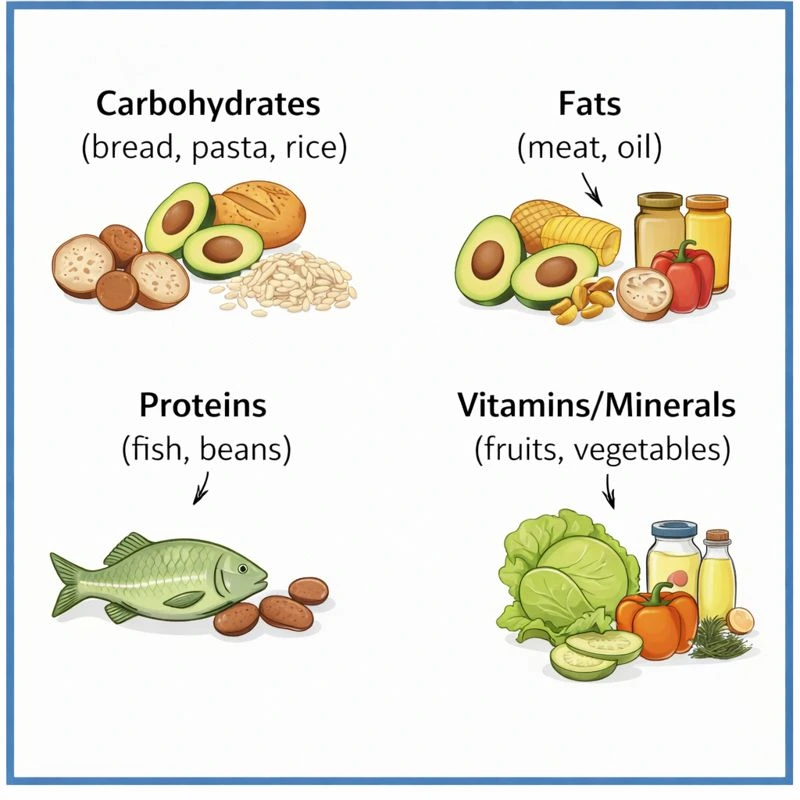
Which type of nutrient does not provide the body with energy?
-
A
Vitamin
-
B
Carbohydrate
-
C
Fat
-
D
Protein
The type of nutrient that does not provide the body with energy is vitamins.
The human body requires nutrients for two broad purposes: to supply energy for cellular activities and to regulate metabolic processes that sustain life. Carbohydrates, fats, and proteins are macronutrients that can be broken down to release energy in the form of ATP. Vitamins, however, function as regulatory molecules that support these energy-producing pathways but do not themselves undergo metabolism to yield usable energy.
A) Vitamin
Vitamins are organic compounds required in very small amounts to maintain normal metabolism, immune function, growth, and tissue repair. Many vitamins act as coenzymes, assisting enzymes in carrying out chemical reactions, particularly those involved in the metabolism of carbohydrates, fats, and proteins. Others function as antioxidants, protecting cells from oxidative damage, or play specialized roles such as blood clotting or vision.
Despite their essential importance, vitamins do not contain caloric value. They cannot be oxidized in metabolic pathways such as glycolysis, the Krebs cycle, or oxidative phosphorylation to generate ATP. Instead, they facilitate or regulate these pathways. Because they provide zero calories and do not contribute directly to energy production, vitamins are the correct answer.
B) Carbohydrate
Carbohydrates are the body’s primary and preferred source of energy and provide approximately 4 calories per gram. They are broken down into glucose, which is readily used by cells to produce ATP through cellular respiration.
Glucose is especially important for brain function and red blood cells, which rely almost exclusively on glucose for energy. Excess carbohydrates can be stored as glycogen in the liver and muscles or converted into fat for long-term storage. Since carbohydrates clearly supply energy, this option is incorrect.
C) Fat
Fats are the most energy-dense macronutrient, providing about 9 calories per gram. They are stored in adipose tissue and serve as the body’s primary long-term energy reserve.
Fatty acids are metabolized through beta-oxidation and enter the Krebs cycle to produce large quantities of ATP. In addition to energy storage, fats are essential for cell membrane structure, insulation, protection of organs, and the synthesis of certain hormones. Because fats provide substantial energy, this option is incorrect.
D) Protein
Proteins supply approximately 4 calories per gram and are primarily used for building and repairing tissues, producing enzymes, hormones, and antibodies, and maintaining fluid balance.
When energy intake from carbohydrates and fats is inadequate, amino acids can be deaminated, and their carbon skeletons can be converted into glucose or ketone bodies to produce ATP. Although protein is not the body’s preferred energy source, it is still capable of supplying energy. Therefore, this option is incorrect.
Conclusion:
Among the major nutrient groups, carbohydrates, fats, and proteins all contribute energy to the body through metabolic pathways that generate ATP. Vitamins, in contrast, function as essential regulators and cofactors but do not provide calories or serve as fuel.
- For this reason, vitamins are the only type of nutrient listed that does not provide the body with energy.

Topic Flashcards
Click to FlipWhat term describes nutrients that must be obtained from the diet because the body cannot synthesize them in sufficient amounts?
Essential nutrients.
Which B-vitamin is a central component of the coenzymes NAD and NADP, crucial for energy transfer in cellular respiration?
Niacin (Vitamin B3).
What is the name of the metabolic pathway that breaks down glucose to produce ATP in the absence of oxygen?
Glycolysis followed by fermentation (e.g., lactic acid fermentation).
Which organ stores excess glucose as glycogen and regulates blood sugar levels?
The liver.
What is the primary role of dietary fiber, a type of carbohydrate that does not provide energy?
To promote digestive health by adding bulk to stool and feeding beneficial gut bacteria.