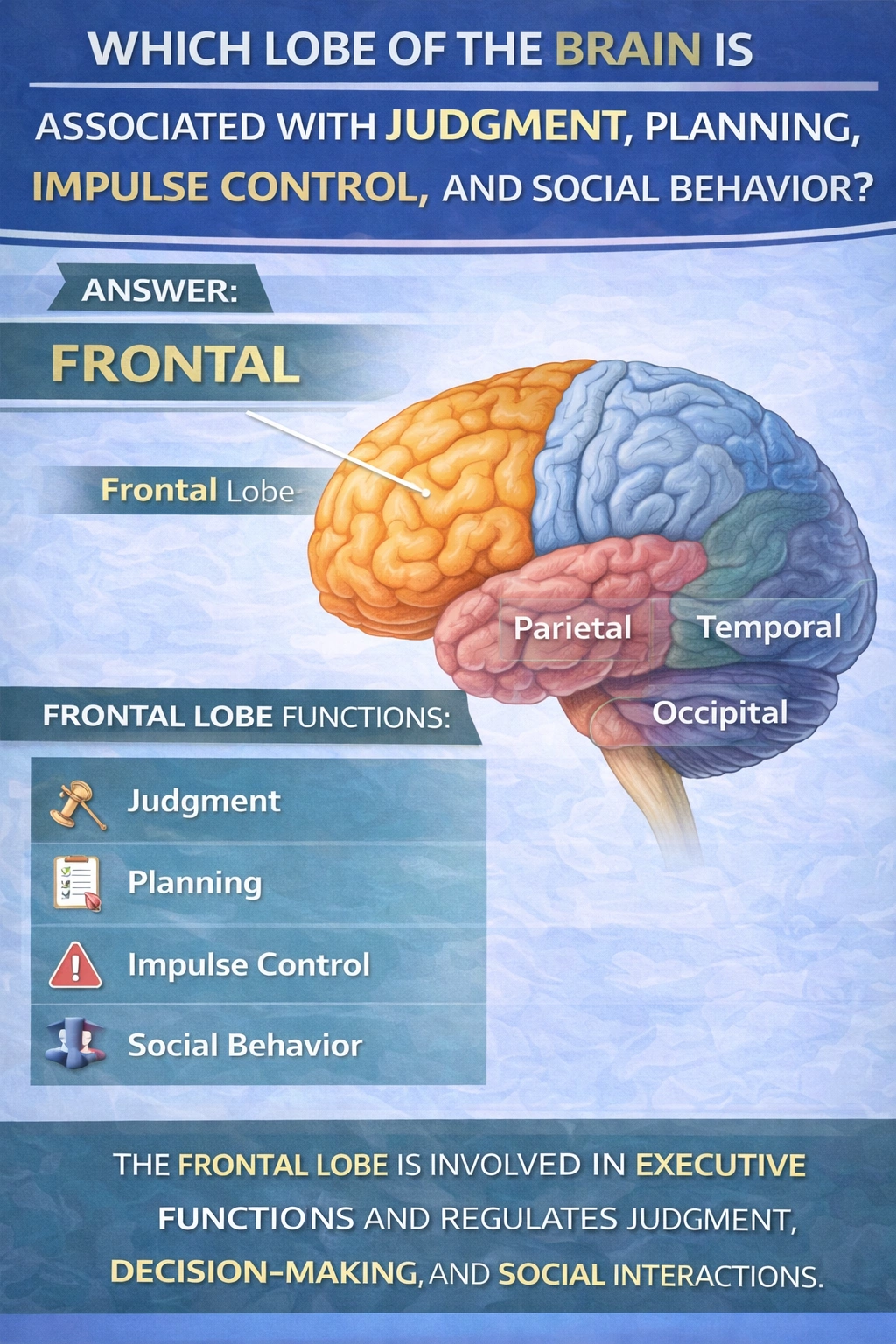
Which brain lobe is associated with judgment, planning, impulse control, and social behavior?
-
A
Parietal
-
B
Frontal
-
C
Temporal
-
D
Occipital
The brain lobe associated with judgment, planning, impulse control, and social behavior is the frontal lobe.
These functions are collectively known as executive functions and are essential for goal-directed behavior, decision-making, emotional regulation, and appropriate interaction with others. The prefrontal cortex, located in the anterior portion of the frontal lobe, is especially critical for these higher-order cognitive processes.
A) Parietal
The parietal lobe is primarily responsible for processing somatosensory information, including touch, pressure, temperature, pain, and body position.
It also plays an important role in spatial awareness, hand-eye coordination, and integrating sensory input from different parts of the body. While these functions are vital for interacting with the physical environment, they do not include judgment, long-term planning, impulse regulation, or complex social behavior.
Therefore, this option is incorrect.
B) Frontal
The frontal lobe is the center of executive functioning in the brain.
It is involved in:
- Planning and organizing actions
- Making decisions and solving problems
- Controlling impulses and inappropriate behaviors
- Regulating emotions
- Understanding and following social norms
- Personality expression and moral reasoning
The prefrontal cortex, in particular, evaluates consequences, suppresses inappropriate responses, and enables individuals to behave in socially acceptable ways.
Damage to this area can lead to impulsivity, poor judgment, lack of planning ability, personality changes, and socially inappropriate behavior, clearly demonstrating its role in these functions.
Because this lobe directly governs judgment, planning, impulse control, and social behavior, this option is correct.
C) Temporal
The temporal lobe is mainly involved in auditory processing, language comprehension, and memory formation.
It also contributes to emotional processing through its connection to the limbic system. While emotions influence behavior, the temporal lobe does not control executive functions such as decision-making, impulse regulation, or long-term planning.
Thus, this option is incorrect.
D) Occipital
The occipital lobe is the primary visual processing center of the brain.
It interprets visual stimuli such as color, depth, motion, and shape. It does not participate in behavioral regulation, judgment, or planning.
Therefore, this option is incorrect.
Conclusion:
Judgment, planning, impulse control, and social behavior are advanced cognitive abilities collectively known as executive functions. These are governed by the frontal lobe, particularly the prefrontal cortex.
The parietal lobe processes sensory information, the temporal lobe manages hearing and memory, and the occipital lobe handles vision. Only the frontal lobe is responsible for behavioral regulation and complex decision-making.
For this reason, the correct answer is the frontal lobe.
Topic Flashcards
Click to FlipWhich specific region of the frontal lobe is most critical for executive functions like judgment, planning, and impulse control?
The prefrontal cortex.
What is the name of the neurological condition resulting from frontal lobe damage, characterized by personality changes, disinhibition, and poor judgment?
Frontal lobe syndrome.
The famous case of Phineas Gage, who survived a traumatic brain injury, highlighted the importance of which brain lobe for personality and social conduct?
The frontal lobe.
Which area in the frontal lobe (usually left hemisphere) is responsible for the production of speech?
Broca's area.
Besides higher cognitive functions, the frontal lobe also contains the primary motor cortex. What is its primary role?
To plan and execute voluntary movements.